Update: Through a glass darkly: the strangest house in my suburb

In February last year, I wrote about a house in my suburb in Melbourne, Australia, that seemed incongruous with its surroundings. The street is full of period homes: Victorian cottages, lovingly restored to reflect the tastes of a bygone age. You can read more about the house here.

This was what it looked like then:Glasshouse4

As the months went on, I grew to like the little glass house, as I called it, strange though it seemed in its setting. I would often see a young man hard at work on it, early evenings and weekends. It seemed like a labour of love: someone’s dream home, slowly taking shape. A fabulous ball-like light fitting was put above the stairwell, and the kitchen fit-out almost completed.

But late last year, all work stopped. In the months since then…nothing.

It looks like the house has been deserted, and I can only surmise that the young man ran out of money, his dreams dashed, at least for the moment. Yesterday, I took this photo of it.House-revisited

We are soon to move far away from this suburb, so I don’t expect I will ever find out what happened to the little glass house. But perhaps one day I will visit, just to see.

“Stupid” award of the week

drawersWhat’s wrong with this picture?

Yes, there is a drawer missing. There wasn’t a drawer missing when we put these two sets out in front of our house this afternoon, free to a good home.

We’re moving, so we’re taking the opportunity to give away what we don’t need. These two little sets of drawers have served me well, but it’s time to update and get a proper dressing table.

So out they went. In our area, good used furniture placed out on the nature strip usually lasts from 30 seconds to 30 minutes. I like the thought of someone coming across it and taking it home to be useful again.

But when we looked after a while to see if the drawers were gone, we saw this: some bright spark had taken away just one drawer, meaning that chest of drawers is now useless for anyone else. Stupid as all get out!

Boys’ toys, girls’ toys: really?

Screen Shot 2014-04-05 at 7.22.57 AMBoys, you are astronauts, pilots, detectives, scientists; girls, you are mothers and baby minders, and you like pretty things for your hair.

Boys, you will build things, go places, blow things up, conduct scientific experiments, see the world; girls, you will stay at home, heating bottles for the baby, doing craftwork, wearing beautiful clothes and dreaming of being a makeup artist, while dressed almost exclusively in pastel pink.

I could hardly believe my eyes this morning when I saw how an online shopping website I subscribe to was advertising toys based so much on gender stereotypes. Like something out of the 1950s, it told me that boys had the whole world to explore, while girls had better stay home.

For boys, the Crazy Forts Construction Toy offers imaginative play in which you create a cave, igloo, pirate ship or castle. To be fair, this toy also has a girl pictured on the box cover with two boys, so it’s unclear why it’s marketed only for boys. There is also a build-a-fort set for girls—the “Princess Play Set” in…you guessed it, pink… “perfect for your little princess”. No mention of pirate ships, caves or castles, though.

My mum was a neuro-scientist, and she says that to a certain extent, boys naturally gravitate toward more adventurous, rough and tumble toys. But the almost complete demarcation in the media seems unnatural, as if we are choosing for our children what their roles will be before they’ve even had a chance to explore these things for themselves. No wonder there are still so few female plumbers, carpenters or mechanics.

When I was a kid, my favourite toys were Lego and my brother’s case of tiny cars, plus our cowboy play sets with hats, toy guns in holsters (very un-PC now) and sheriff’s badges. I also loved my dolls (though I couldn’t understand why my cats would never consent to being dressed in bonnet, dress and booties and wheeled around in my dolls’ pram). My hero was Georgina (“George”), the fantastically independent girl in Enid Blyton’s The Famous Five series of novels. In those days, a girl like George was called a “tom boy” because she didn’t conform to the normal idea of what a girl should behave like.

There’s nothing wrong as such with giving girls dolls and encouraging them to nurture babies: many girls do become mothers, after all. But boys become fathers, and in these days of equality, shouldn’t we also then be giving boys dollies with dummies, feeding sets and nappies? See how dumb that sounds? While personally, I have always loved dolls (and still do), I think we can leave the parenting accessories out when children are young, particularly if you’re only teaching parenting to one sex (girls).

I suspect (well, I hope) that advertisers are hopelessly out of date when they market toys in such a way. In most homes, I’m sure, children end up playing together with many of the same toys. We shouldn’t limit girls to home-based toys and boys to adventure toys: let them make up their own minds what they will be.


What do birds dream of? Or, the soundtrack to my life

Many years ago, I read a short newspaper story that has stayed with me ever since. It was about new research that had found that birds actually dream. And what do birds dream about as they slumber on their tree perches? Apparently, they dream of the songs they will sing tomorrow.

I know, “Awwwww”.

I too dream of the songs I will sing tomorrow. Well, to be more accurate, songs are often popping up in my head, whether I’m waking or sleeping. There’s a soundtrack to my life, and it’s not coming from headphones (in fact, I rarely play music via ear buds or headphone, and maybe this is why).

These are not songs that I want to listen to and some are songs I don’t even like. They just start playing, seemingly randomly, and leave me to solve their riddle as to what they are connected to. They are usually old songs I haven’t heard for a while. Many mornings I wake with a song going round in my head that has nothing much to do with anything. It’s just there. This music often has a shape in my mind, too, like a graph, with colours. In my imaginary mind, I know all the lyrics, too.

Usually, I don’t pay much attention to the songs in my head, unless they’re especially amusing or annoying. But this month, I thought it would be fun to make a list of what I’ve been listening to in my mind. Here goes:

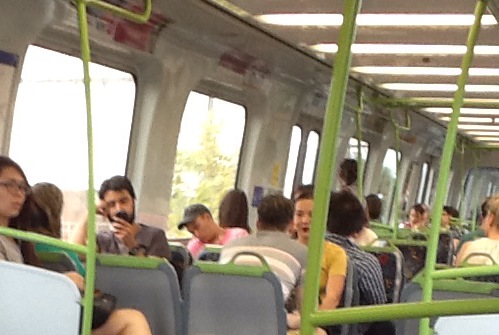
This reminds me of the daily trial just trying to get through crowds of people to do ordinary things like get on the train, find a seat (good luck), buy lunch. Picture: ©Caron Eastgate Dann 2013

This reminds me of the daily trial just trying to get through crowds of people to do ordinary things like get on the train, find a seat (good luck), buy lunch. Picture: ©Caron Eastgate Dann 2013

Thursday March 20

50 Ways to Leave Your Lover came into my mind while waiting for a train. You know, “Get out the back, Jack, make a new plan, Sam…just set yourself free”. I had been thinking about the rat race and how awful it was sometimes to be trudging along with thousands of other workers, never getting very far. Or, I feel like a fish in a pond full of others, pushing and scrabbling when a few grains of food are dropped on the top of the pond.

In a way, that “rat race” is like a bad lover that we just can’t seem to get away from. My inner psyche is obviously telling me to make a new plan to do just that!

Later in the day, my song-brain wasn’t so kind to me. It started playing MmmBop!, that 1997 teenybopper hit by Hanson. Oh dear! I think my brain was inspired by an ad at uni for something called Kimbap, a Korean students’ group function.

Friday, March 21

Comin’ through the Rye: OK, I was watching a TV show about the Scottish highlands when this one started up. But they didn’t feature this song. I remembered it because I used to sing it as a child and once won a singing competition with it.

Saturday, March 22

Oh yes, a day when I don’t have to cross town on trains or buses. I can just work from home instead. It’s peaceful, and Everything is Beautiful comes to mind. I laugh to myself, because humming this song used to be a code long ago between me and a photographer I worked with. If we didn’t like the way our interview/photo shoot was going, one of us would start humming this song. And we knew the real words were, “Everything is shit-ful, in its own wayyyyy…”

I was too busy the rest of that week to think about writing down the songs in my head, but come Friday, I remembered again to take note. It’s good to have a break from noting anyway, because otherwise you might make conscious song choices.

Friday, March 28

You Make Me Feel Like Dancing, by Leo Sayer. This is good, because it’s always been one of my favourite feel-good songs. And Friday is a feel-good day because I don’t have to get up early tomorrow!

Later in the day, as I’m walking to the bus at the start of my journey home, my brain is singing Barry Manilow’s Copacabana in all its glory.

On the train, I give up my seat to a pregnant woman, and straight away, Don’t Blame it on the Boogie, Michael Jackson’s great 1970s disco beat, is playing up a storm. This was one of my favourite songs in 1979 when I was a teenager.

Saturday, March 29

I’m writing a lecture for my master’s class on book history and the publishing industry, and up comes River Deep, Mountain High, the original 1966 Tina and Ike Turner version. No idea where that came from, but I like it.

Sunday, March 30

It’s 5pm, and I’m feeling calm about having done enough work to start the week with. The music starts and it’s a famous ballet tune whose name I can’t recall. But it’s very calming. When I come to write this blog, I remember that it’s The Dance of the Sugar Plum Fairy, by Tchaikovsky.

Thursday, April 3

I’m on my way out the door to my job as a university lecturer, and that classic song, the theme from Sesame Street, pops into my head, just like that: “Can you tell me how to get, How to get to Sesame Street?”

Whatever next?

As I say, I don’t know where these songs come from, most of the time. My mum plays songs in her head too, but she takes it a step further: the songs in her mind are all ones she makes up herself. She said she doesn’t ever need to play the radio, because there are always new songs playing in her head anyway!

And with that, I begin a new month of madness—I wonder what songs this month will bring?

Stop and smell the lunch

Szechuan chicken clay pot at Joy's Kitchen. Picture ©Caron Eastgate Dann 2014

Szechuan chicken clay pot at June’s Kitchen. Picture ©Caron Eastgate Dann 2014

I work at a university and most days, I can’t stop long enough to sit down and eat lunch properly. I have to eat on the hop, so to speak, often on the train or the platform. A home-made sandwich is the only practical thing I can carry to do this.
But the other day, I treated myself to a sit-down lunch at June’s Kitchen, at the Uni Cafe, at the plaza next to Monash University campus at Caulfield. I like this unassuming little Chinese eatery. It is not glamorous, trendy or innovative. It has comforting Chinese food, the menu on newsprint pinned around the room, written with Texta in Chinese first, with an English translation for most, but not all, of the fare.
For $10, this bubbling Szechuan chicken clay pot with side dish of rice was mine. The sauce was spicy enough to tingle without blowing your head off. I don’t know exactly what was in it, but it was a perfect balance of pepper, chilli, salt, sugar, spices, rice wine, soy sauce and more. The chicken was cooked on the bone and fell off to melt in your mouth. There were lots of potatoes in this dish, reminding me of the classic Thai mussaman curry and deliciously comforting. And this single serve would have been enough for two.
The mark of a good dish is that it stays in your memory, and I keep thinking about this one. Perhaps I will make it a weekly lunch treat. It sure beats a ham and cheese sandwich eaten while standing on the dreary platform at Flinders Street station.

Life on Mean Street

monkeysI see meanness all around me: mean employers trying to make their poorest employees work harder and harder for less and less money; mean local councils cutting back on maintenance of community streets and venues; mean people in car parks crashing into other cars and then just leaving, or nipping into a park to beat someone else; drivers not stopping for pedestrians on crossings; mean governments making the rich richer and the rest poorer; mean countries trying to invade and take over other countries; mean institutions making everything into a competition that participants must fight in to the (figurative) death.

Yes, it’s a mean old world out there. My late father once told me, “Life’s not fair”, but so much unfairness (just another word for meanness) need not be so.

Here’s my list of how to make the world a kinder and more peaceful place just by not being mean:

*Governments: you are the servants of the people. Your most important loyalty is not to the party, but to those whom you serve. Your priority is not a career path for yourself, free travel, or becoming so power-hungry you forget your real role. Your job is to make the country better for the people, not worse. Your job is not to make a few rich people get richer. It is to promote equality for all, and a decent life in which people are safe, comfortable, educated and treated humanely. Warmongering is not on.

*Employers: don’t try to make people work for less and less. Hire good people, reward industrious workers, give them proper jobs with holiday and sick pay. They will reward you by wanting to work harder (as opposed to being forced to), because they will love the business they’re in. Instead of fearful drudges, you will have an enthusiastic, happy team with you who want your company to be profitable.

*Drivers: just chill out. No matter how much you speed, weave in and out of traffic, toot your horn, monster the car in front or rip through a pedestrian crossing, you’ll probably only cut one or two minutes off the journey. Also, you might crash, and at the very least, you’ll make life miserable for others. There’s a great Greek word that covers this: “endaxi!” (relax). And if you happen to dent a parked car, own up and leave your contact details on a note.

*Neighbours: if a tree from the property next door drops some leaves on your side, it really doesn’t matter. Learn your neighbours’ names, say “Hi” to them, don’t leave nasty notes on their car like you own the road if they happen to park in a spot in front of your place.

So, to answer this month’s B4Peace challenge from Kobo at Everyday Gurus, How would you teach children to promote a more peaceful world?, my answer is that I would teach them not to be mean. This starts at the most basic level in the playground: share your toys, don’t hit others, coming first is not the most important thing, and if you see someone fall down, help pick them up. And here is some more great advice on how to make a more peaceful world.

Young or old? Here’s how to tell

photoSince last year, something strange has been happening to me. Younger people occasionally get up in a full train or bus to offer me a seat. It doesn’t happen every day, or even every week, but perhaps once a month, whereas before last year, it never happened.
Last year, I was gracious, but firmly declined any offers of seats, being secretly mortified that anyone would deem me less able to stand than them. This year, I’ve started to accept. Well, I’ve only been offered a seat once this year-that was this morning-and I was glad to have it. It was on a bus full of mostly students carrying us from the train station to campus, so there might have been something about respect for staff in it, too. Another student also offered the older, grey-haired but fit-looking lady standing beside me a seat. She graciously declined.
Is this the beginning of the end? I said to myself. Is this the beginning of the time when I begin to think of myself as “older” or no longer young, by any stretch of the imagination?
I know that people under 25 think anyone over 35 is ancient. In my (admittedly unscientific) questioning of young people, many have shown that they can’t recognise the difference between 40 and 60 or 50 and 70. They’re all just “old people”. My parents were quite a bit older than the norm when they had my brother, and when he was a mid-teenager and they were in their early 60s, one of his friends said, “How old’yer parents—about a hundred?”!
But who they perceive as being “young” is interesting and not necessarily about years. It seems to have something to do with “coolness”. I once asked a group of students, mostly aged 18-20, to decide whether a list of famous people I named were young or old. They had only those two choices, nothing in between.
I asked them about the then-Prime Minister of Australia, Kevin Rudd. “Old,” was the verdict. Then I asked them about the President of the US, Barack Obama, also in his 50s and less than four years Rudd’s junior. “Young,” they said emphatically. “Because he’s cool,” added one bright spark.
Perhaps I’m just not cool any more. *Sigh*

Coincidentally, this week’s Daily Post Writing Challenge is about ageing. You can read more here.

Goodbye to all that: decluttering your life

Goodbye, dear little car. Photo ©Gordon Dann 2014

Goodbye, dear little car.
Photo ©Gordon Dann 2014

We’re trying to declutter our home because we foresee we’ll be moving in the next year or so, and because we simply have too much stuff. Yesterday, my husband’s beloved 1958 MGA car was picked up by its enthusiastic purchaser and taken away on a truck. He had owned the car since 1969, when he bought it as a teenager and as his very first car. But he was pleased to see it go to a new person who would love it: he didn’t want to restore it (again) and he wants to do different things these days, such as travel to India.

I don’t have anything as large or valuable to get rid of, but I still have too much. A lot of the stuff I have is kept for sentimental reasons, but sometimes I wonder if these reasons are misplaced. For example, I have a novelty Easter bunny cup given to me by my brother when he was a little boy…truth be told, my mother probably bought it for him, and he wouldn’t even remember it now that he is nearly 30. The cat book-ends and the husband-and-wife cats with parasol I bought from Bali can probably go, too. Then again, when I grouped them for a photo for this post, I found they all looked so cute, I couldn’t do it. Back on their shelves, they went!

The Balinese cat book ends, the Balinese cat couple, the novelty Easter cup...could you part with these? Photo ©Caron Eastgate Dann 2014

The Balinese cat book ends, the Balinese cat couple, the novelty Easter cup…could you part with these?
Photo ©Caron Eastgate Dann 2014

There are some things I will keep forever and never even contemplate giving away. For many years, I’ve had a small art-deco style turquoise glass vase that I love—I’ve even done a painting of it:

"My Mother's Mysterious Vase", oils on canvas, painted by Caron Dann, 2011.

“My Mother’s Mysterious Vase”, oils on canvas, painted by Caron Dann, 2011.

My mother gave the vase to me, and it had belonged to her mother. But recently, I mentioned it to Mum, and she couldn’t remember off-hand which one it was. That’s because she gave it to me so long ago, and it was just one of those things she had in the cupboard and perhaps didn’t care for that much herself.

Talking about gifts, when people give me something, I am very appreciative. I love receiving a present and always feel so happy that someone has taken the trouble. I love beautiful wrapping paper and cards, too. Many of the presents I receive are things that I treasure for years, and keep for sentimental reasons. Yet, if you asked the person who gave you a particular present years ago, they probably wouldn’t even remember it, unless it was special to them, too. That’s because they bought it for you, had it for a very short time, then handed it over, duty done, and forgot about it.

Sometimes a present just wears out. In the late 1980s, I met a young woman who was to become my lifelong friend, and she gave me a huge framed Man Ray print. I loved this print and it travelled with me everywhere. It’s been on the wall of at least 13 different residences I’ve had over the years. Sadly, I realised recently that not only was the frame falling apart, but the print itself was the worse for wear. So, unfortunately, it was given away to the local second-hand shop. But someone else may be able to repair it and use it.

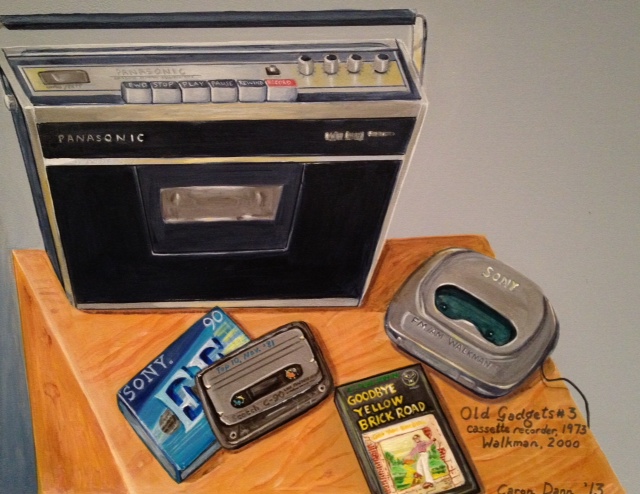
A few weeks ago, my mum finally gave away an old cassette recorder she bought in the US in the 1970s: actually, I would like to have kept this gadget, but it is gone now. Luckily though, I did this painting of it last year:

Old Gadgets #3: Panasonic cassette player-recorder, 1973; Sony Walkman, 2000. Acrylics and Faber-Castell Pitt artist pens on treated board.By Caron Eastgate Dann, 2013.

Old Gadgets #3: Panasonic cassette player-recorder, 1973; Sony Walkman, 2000. Acrylics and Faber-Castell Pitt artist pens on treated board. Painted by Caron Eastgate Dann, 2013

Sometimes, over the years, I’ve lived to regret what I’ve discarded. For example, all my handwritten notes and essays from my bachelor’s degree. Now that I’m a tertiary educator myself, I would love to be able to look back on my own undergraduate work.

But the worst decision I made about throwing something away was an electronic gadget my parents gave me in 1983. It was an early word processor, a light and portable machine about the size of a current-day notebook computer. It even had a small memory, and you had to buy special “thermal paper”, which you inserted in the top and which it then printed on as you typed. I wish I had kept that: it belongs in a museum, now.

Why an autobiographer can never tell the whole truth…even Agatha Christie

I’ve often thought that if I were famous, and a publisher wanted me to write my autobiography, I probably wouldn’t be able to do it. Writing about one’s life would require a degree of candour and honesty, a revealing of certain personal events and private thoughts that I just wouldn’t be prepared to share with the world.

But it doesn’t have to be like that. The other option is that you are in control of what you leave out of an autobiography.

Contrary to the idea that you get the true story of events ‘from the horse’s mouth’, so to speak, an autobiography is just another version of a life. As a journalist or a biographer has an agenda—to titillate and draw in readers in order to  sell newspapers or books, or to get high ratings—so the autobiographer. That is, to present themselves as they want the world to see them.

Add to that the fact that, especially as we grow older and farther away from the events we describe, our memories often aren’t precise, particularly childhood events when we might not have understood everything that was happening around us. I remember at my father’s funeral, I related some stories that were exactly as I remembered them happening, yet my mother said I had got the facts wrong in several of them.

I could swear, for example, that when my father and I watched the Apollo lunar landing on TV in 1969 when I was a very little girl (this is my first memory of television), we did so in our flat at Heslington, York, in the UK. But no, if I look at the date of that landing, we would have been back in Auckland, New Zealand by then. Strange.

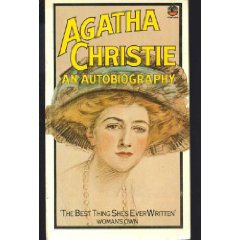
a-christieDame Agatha Christie’s autobiography

I was prompted to muse about autobiographical writing when reading this month the 551-page tome Agatha Christie: An Autobiography, kindly given to me by my friend, the crime writer Angela Savage (whose blog you can read here: http://angelasavage.wordpress.com/).

It’s a fabulous read, quite possibly the best autobiography I have read, beside Roald Dahl’s Boy (1984) and Going Solo (1986). I couldn’t put it down, in fact.

It is intriguing in its description of a Victorian upper-middle-class childhood in an age that seems so strange these days. Born in 1890, young Agatha Miller was brought into a world of apparent privilege—gracious mansions, servants, extended trips to France. Yet,  as she explains, it was not full of luxuries, at least not in the way we would expect today. There wasn’t much cash, and her father was always on the brink of financial ruin, relying on an inheritance. He never worked, and eventually depleted his inheritance by a combination of bad decisions and bad luck.

daily-mirror-agatha-christieA mystery fit for the little Belgian detective

Coincidentally, while I was reading Christie’s autobiography, there was a TV special on her life hosted by David Suchet, who played her most famous character, the Belgian detective Hercule Poirot from 1989 to 2013. Part of the show looked at what happened when her first marriage broke down in 1926, and her husband left her for a young woman he had worked with. During that time, Christie disappeared for 11 days, kissing her daughter Rosalind goodbye, leaving late at night, then deserting her car by the side of the road and disappearing. The media speculated that the by-then famous author had killed herself, perhaps by drowning. Eventually, she turned up, and it transpired that she had been staying at a hotel under an assumed name.

Christie never spoke about the incident, completely skipped it in her autobiography, and it remains something of a mystery.

So why didn’t she tell her side of the story? The only thing she says in the book is that it was well documented in the news media and she doesn’t want to say any more: and that’s the answer. She didn’t want to revisit it. Of course, in the 1970s when this book was published, readers couldn’t then look up the internet to view news archives: you would actually have had to go to a library with British newspapers of the time, and few readers would have taken the time to do that. Nowadays, you can simply google it. Speculation continues, as evidenced in this recent article: http://www.theguardian.com/uk/2006/oct/15/books.booksnews

Second marriage and life in Iraq

Some of her views, such as those on transportation of criminals to Australia and on empire would not be appreciated by many readers today: she must be read as a product of her times and class, however.

Christie travelled extensively and adventurously, and tales of these travels are another intriguing part of her autobiography. With her first husband, she travelled round the world in the early 1920s, surfed in Hawaii and visited Australia and New Zealand, all of which she describes in the book with relish. She travelled through the Middle East on her own after her divorce, and met her second husband, Max Mallowan, at Ur. He was an archaeologist who was 14 years younger than Christie. They married when he was 26 and she 40, and the marriage lasted until she died in 1976.

They had an interesting life, living for years in Iraq, at Ur, Ninevah and Nimrud for Mallowan’s archeological digs. Christie even joined in the archeological work, including photographing and drawing it for classification purposes.

Through it all, Christie kept writing, and became very wealthy. She was prolific, sometimes taking only a couple of weeks to write one of her mysteries. But she had to slow down: as she says in the autobiography she had to cut back to writing only one book a year, because writing any more resulted in such high tax that it wasn’t worth doing. She also wrote books under the pen name of Mary Westmacott. They sold well, too, and for years no one knew Westmacott was really Christie.
Interestingly, although Christie and Mallowan were both knighted in their own right—he in 1968 and she in 1971—this is another thing Christie doesn’t mention at all in her autobiography—see “At the end”, below, for the reason.

“Thanks, Grandma!”

In her later life, instead of writing cheques for her family and close friends, she would sign over the royalties of a certain work. For example, her grandson, Mathew Prichard, got the rights to The Mousetrap (then later inherited the bulk of her estate after his mother, Christie’s daughter Rosalind, died in 2004). At the time she gifted her grandson the rights to the world’s longest running play, Christie had no idea that it would be the phenomenal success it was. Read more here about Pritchard and how in 2010 he found long-lost tapes of his grandmother dictating her autobiography.

For the record, Christie’s books have sold about four billion copies—as an author, she is outsold only perhaps by Shakespeare.

At the end

While Christie writes enthusiastically of her young life and middle years, she rather trails off after the late 1940s, and only a small section at the end of the book talks about the 1950s and 1960s. The book was published posthumously in 1977, but she was clear that she would not write about anything after 1965. Although she was still working in the last 10 years of her life, she ended the book at age 75 because “it seems the right moment to stop. Because, as far as life is concerned, that is all there is to say” (Christie 1977:7).

The book is rather haphazard in parts, skipping across vast decades and back again, contradicting itself along the way. But this is part of its charm. I will leave the last word to Christie herself, who explains why the book is like this, after recovering from an illness in the mid-1960s:

“Returning from the valley of the shadow of death, I have decided not to tidy up this book too much. For one thing I am elderly. Nothing is more wearying than going over things you have written and trying to arrange them in proper sequence or turn them the other way round. I am perhaps talking to myself —a thing one is apt to do when one is a writer. One walks along the street, passing all the shops one meant to go into, or all the offices one ought to have visited, talking to oneself hard—not too loud, I hope—and rolling one’s eyes expressively, and then one suddenly sees people looking at one and drawing slightly aside, clearly thinking one is mad.”
Job insecurity as the new job security

My friend, Kenny, over at Consider the Sauce, writes about the insecurity of current work life. It’s something close to my heart.

considerthesauce's avatarconsider the sauce

security1

Today I went to work … for the simple reason I had a job to go to.

I will do the same on Monday and Tuesday.

And, hopefully, presumably, next Friday, too.

Given the ongoing ructions in the media in general and the newspaper lark in particular, this is not a situation I take for granted – even in a good week.

And this has not been a good week. (But perhaps it hasn’t been ruinously bad one either … read on, dear reader, read on …)

Once again, my colleagues and I have been tossed around by the winds of change.

In this case, it was announced on Thursday that the western suburbs affairs of the MMP group, for which I work, are to be merged with the western suburbs affairs of the Star group, which lives on the other side of the Ring Road from our Airport West…

View original post 514 more words