Young or old? Here’s how to tell

photoSince last year, something strange has been happening to me. Younger people occasionally get up in a full train or bus to offer me a seat. It doesn’t happen every day, or even every week, but perhaps once a month, whereas before last year, it never happened.
Last year, I was gracious, but firmly declined any offers of seats, being secretly mortified that anyone would deem me less able to stand than them. This year, I’ve started to accept. Well, I’ve only been offered a seat once this year-that was this morning-and I was glad to have it. It was on a bus full of mostly students carrying us from the train station to campus, so there might have been something about respect for staff in it, too. Another student also offered the older, grey-haired but fit-looking lady standing beside me a seat. She graciously declined.
Is this the beginning of the end? I said to myself. Is this the beginning of the time when I begin to think of myself as “older” or no longer young, by any stretch of the imagination?
I know that people under 25 think anyone over 35 is ancient. In my (admittedly unscientific) questioning of young people, many have shown that they can’t recognise the difference between 40 and 60 or 50 and 70. They’re all just “old people”. My parents were quite a bit older than the norm when they had my brother, and when he was a mid-teenager and they were in their early 60s, one of his friends said, “How old’yer parents—about a hundred?”!
But who they perceive as being “young” is interesting and not necessarily about years. It seems to have something to do with “coolness”. I once asked a group of students, mostly aged 18-20, to decide whether a list of famous people I named were young or old. They had only those two choices, nothing in between.
I asked them about the then-Prime Minister of Australia, Kevin Rudd. “Old,” was the verdict. Then I asked them about the President of the US, Barack Obama, also in his 50s and less than four years Rudd’s junior. “Young,” they said emphatically. “Because he’s cool,” added one bright spark.
Perhaps I’m just not cool any more. *Sigh*

Coincidentally, this week’s Daily Post Writing Challenge is about ageing. You can read more here.

Goodbye to all that: decluttering your life

Goodbye, dear little car. Photo ©Gordon Dann 2014

Goodbye, dear little car.
Photo ©Gordon Dann 2014

We’re trying to declutter our home because we foresee we’ll be moving in the next year or so, and because we simply have too much stuff. Yesterday, my husband’s beloved 1958 MGA car was picked up by its enthusiastic purchaser and taken away on a truck. He had owned the car since 1969, when he bought it as a teenager and as his very first car. But he was pleased to see it go to a new person who would love it: he didn’t want to restore it (again) and he wants to do different things these days, such as travel to India.

I don’t have anything as large or valuable to get rid of, but I still have too much. A lot of the stuff I have is kept for sentimental reasons, but sometimes I wonder if these reasons are misplaced. For example, I have a novelty Easter bunny cup given to me by my brother when he was a little boy…truth be told, my mother probably bought it for him, and he wouldn’t even remember it now that he is nearly 30. The cat book-ends and the husband-and-wife cats with parasol I bought from Bali can probably go, too. Then again, when I grouped them for a photo for this post, I found they all looked so cute, I couldn’t do it. Back on their shelves, they went!

The Balinese cat book ends, the Balinese cat couple, the novelty Easter cup...could you part with these? Photo ©Caron Eastgate Dann 2014

The Balinese cat book ends, the Balinese cat couple, the novelty Easter cup…could you part with these?
Photo ©Caron Eastgate Dann 2014

There are some things I will keep forever and never even contemplate giving away. For many years, I’ve had a small art-deco style turquoise glass vase that I love—I’ve even done a painting of it:

"My Mother's Mysterious Vase", oils on canvas, painted by Caron Dann, 2011.

“My Mother’s Mysterious Vase”, oils on canvas, painted by Caron Dann, 2011.

My mother gave the vase to me, and it had belonged to her mother. But recently, I mentioned it to Mum, and she couldn’t remember off-hand which one it was. That’s because she gave it to me so long ago, and it was just one of those things she had in the cupboard and perhaps didn’t care for that much herself.

Talking about gifts, when people give me something, I am very appreciative. I love receiving a present and always feel so happy that someone has taken the trouble. I love beautiful wrapping paper and cards, too. Many of the presents I receive are things that I treasure for years, and keep for sentimental reasons. Yet, if you asked the person who gave you a particular present years ago, they probably wouldn’t even remember it, unless it was special to them, too. That’s because they bought it for you, had it for a very short time, then handed it over, duty done, and forgot about it.

Sometimes a present just wears out. In the late 1980s, I met a young woman who was to become my lifelong friend, and she gave me a huge framed Man Ray print. I loved this print and it travelled with me everywhere. It’s been on the wall of at least 13 different residences I’ve had over the years. Sadly, I realised recently that not only was the frame falling apart, but the print itself was the worse for wear. So, unfortunately, it was given away to the local second-hand shop. But someone else may be able to repair it and use it.

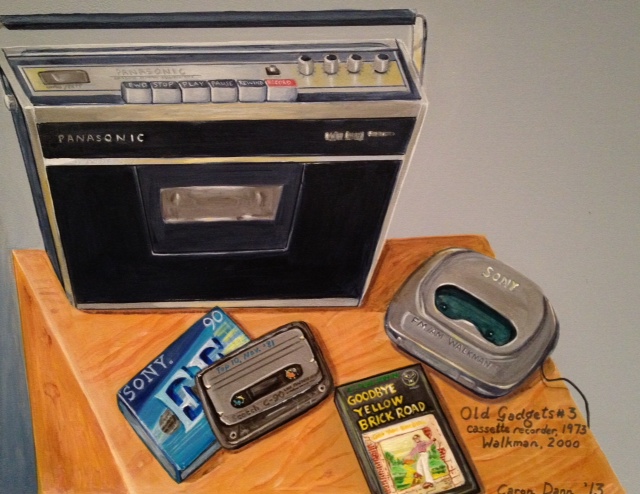
A few weeks ago, my mum finally gave away an old cassette recorder she bought in the US in the 1970s: actually, I would like to have kept this gadget, but it is gone now. Luckily though, I did this painting of it last year:

Old Gadgets #3: Panasonic cassette player-recorder, 1973; Sony Walkman, 2000. Acrylics and Faber-Castell Pitt artist pens on treated board.By Caron Eastgate Dann, 2013.

Old Gadgets #3: Panasonic cassette player-recorder, 1973; Sony Walkman, 2000. Acrylics and Faber-Castell Pitt artist pens on treated board. Painted by Caron Eastgate Dann, 2013

Sometimes, over the years, I’ve lived to regret what I’ve discarded. For example, all my handwritten notes and essays from my bachelor’s degree. Now that I’m a tertiary educator myself, I would love to be able to look back on my own undergraduate work.

But the worst decision I made about throwing something away was an electronic gadget my parents gave me in 1983. It was an early word processor, a light and portable machine about the size of a current-day notebook computer. It even had a small memory, and you had to buy special “thermal paper”, which you inserted in the top and which it then printed on as you typed. I wish I had kept that: it belongs in a museum, now.

Why an autobiographer can never tell the whole truth…even Agatha Christie

I’ve often thought that if I were famous, and a publisher wanted me to write my autobiography, I probably wouldn’t be able to do it. Writing about one’s life would require a degree of candour and honesty, a revealing of certain personal events and private thoughts that I just wouldn’t be prepared to share with the world.

But it doesn’t have to be like that. The other option is that you are in control of what you leave out of an autobiography.

Contrary to the idea that you get the true story of events ‘from the horse’s mouth’, so to speak, an autobiography is just another version of a life. As a journalist or a biographer has an agenda—to titillate and draw in readers in order to  sell newspapers or books, or to get high ratings—so the autobiographer. That is, to present themselves as they want the world to see them.

Add to that the fact that, especially as we grow older and farther away from the events we describe, our memories often aren’t precise, particularly childhood events when we might not have understood everything that was happening around us. I remember at my father’s funeral, I related some stories that were exactly as I remembered them happening, yet my mother said I had got the facts wrong in several of them.

I could swear, for example, that when my father and I watched the Apollo lunar landing on TV in 1969 when I was a very little girl (this is my first memory of television), we did so in our flat at Heslington, York, in the UK. But no, if I look at the date of that landing, we would have been back in Auckland, New Zealand by then. Strange.

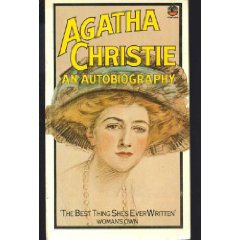
a-christieDame Agatha Christie’s autobiography

I was prompted to muse about autobiographical writing when reading this month the 551-page tome Agatha Christie: An Autobiography, kindly given to me by my friend, the crime writer Angela Savage (whose blog you can read here: http://angelasavage.wordpress.com/).

It’s a fabulous read, quite possibly the best autobiography I have read, beside Roald Dahl’s Boy (1984) and Going Solo (1986). I couldn’t put it down, in fact.

It is intriguing in its description of a Victorian upper-middle-class childhood in an age that seems so strange these days. Born in 1890, young Agatha Miller was brought into a world of apparent privilege—gracious mansions, servants, extended trips to France. Yet,  as she explains, it was not full of luxuries, at least not in the way we would expect today. There wasn’t much cash, and her father was always on the brink of financial ruin, relying on an inheritance. He never worked, and eventually depleted his inheritance by a combination of bad decisions and bad luck.

daily-mirror-agatha-christieA mystery fit for the little Belgian detective

Coincidentally, while I was reading Christie’s autobiography, there was a TV special on her life hosted by David Suchet, who played her most famous character, the Belgian detective Hercule Poirot from 1989 to 2013. Part of the show looked at what happened when her first marriage broke down in 1926, and her husband left her for a young woman he had worked with. During that time, Christie disappeared for 11 days, kissing her daughter Rosalind goodbye, leaving late at night, then deserting her car by the side of the road and disappearing. The media speculated that the by-then famous author had killed herself, perhaps by drowning. Eventually, she turned up, and it transpired that she had been staying at a hotel under an assumed name.

Christie never spoke about the incident, completely skipped it in her autobiography, and it remains something of a mystery.

So why didn’t she tell her side of the story? The only thing she says in the book is that it was well documented in the news media and she doesn’t want to say any more: and that’s the answer. She didn’t want to revisit it. Of course, in the 1970s when this book was published, readers couldn’t then look up the internet to view news archives: you would actually have had to go to a library with British newspapers of the time, and few readers would have taken the time to do that. Nowadays, you can simply google it. Speculation continues, as evidenced in this recent article: http://www.theguardian.com/uk/2006/oct/15/books.booksnews

Second marriage and life in Iraq

Some of her views, such as those on transportation of criminals to Australia and on empire would not be appreciated by many readers today: she must be read as a product of her times and class, however.

Christie travelled extensively and adventurously, and tales of these travels are another intriguing part of her autobiography. With her first husband, she travelled round the world in the early 1920s, surfed in Hawaii and visited Australia and New Zealand, all of which she describes in the book with relish. She travelled through the Middle East on her own after her divorce, and met her second husband, Max Mallowan, at Ur. He was an archaeologist who was 14 years younger than Christie. They married when he was 26 and she 40, and the marriage lasted until she died in 1976.

They had an interesting life, living for years in Iraq, at Ur, Ninevah and Nimrud for Mallowan’s archeological digs. Christie even joined in the archeological work, including photographing and drawing it for classification purposes.

Through it all, Christie kept writing, and became very wealthy. She was prolific, sometimes taking only a couple of weeks to write one of her mysteries. But she had to slow down: as she says in the autobiography she had to cut back to writing only one book a year, because writing any more resulted in such high tax that it wasn’t worth doing. She also wrote books under the pen name of Mary Westmacott. They sold well, too, and for years no one knew Westmacott was really Christie.
Interestingly, although Christie and Mallowan were both knighted in their own right—he in 1968 and she in 1971—this is another thing Christie doesn’t mention at all in her autobiography—see “At the end”, below, for the reason.

“Thanks, Grandma!”

In her later life, instead of writing cheques for her family and close friends, she would sign over the royalties of a certain work. For example, her grandson, Mathew Prichard, got the rights to The Mousetrap (then later inherited the bulk of her estate after his mother, Christie’s daughter Rosalind, died in 2004). At the time she gifted her grandson the rights to the world’s longest running play, Christie had no idea that it would be the phenomenal success it was. Read more here about Pritchard and how in 2010 he found long-lost tapes of his grandmother dictating her autobiography.

For the record, Christie’s books have sold about four billion copies—as an author, she is outsold only perhaps by Shakespeare.

At the end

While Christie writes enthusiastically of her young life and middle years, she rather trails off after the late 1940s, and only a small section at the end of the book talks about the 1950s and 1960s. The book was published posthumously in 1977, but she was clear that she would not write about anything after 1965. Although she was still working in the last 10 years of her life, she ended the book at age 75 because “it seems the right moment to stop. Because, as far as life is concerned, that is all there is to say” (Christie 1977:7).

The book is rather haphazard in parts, skipping across vast decades and back again, contradicting itself along the way. But this is part of its charm. I will leave the last word to Christie herself, who explains why the book is like this, after recovering from an illness in the mid-1960s:

“Returning from the valley of the shadow of death, I have decided not to tidy up this book too much. For one thing I am elderly. Nothing is more wearying than going over things you have written and trying to arrange them in proper sequence or turn them the other way round. I am perhaps talking to myself —a thing one is apt to do when one is a writer. One walks along the street, passing all the shops one meant to go into, or all the offices one ought to have visited, talking to oneself hard—not too loud, I hope—and rolling one’s eyes expressively, and then one suddenly sees people looking at one and drawing slightly aside, clearly thinking one is mad.”


Job insecurity as the new job security

My friend, Kenny, over at Consider the Sauce, writes about the insecurity of current work life. It’s something close to my heart.

considerthesauce's avatarconsider the sauce

security1

Today I went to work … for the simple reason I had a job to go to.

I will do the same on Monday and Tuesday.

And, hopefully, presumably, next Friday, too.

Given the ongoing ructions in the media in general and the newspaper lark in particular, this is not a situation I take for granted – even in a good week.

And this has not been a good week. (But perhaps it hasn’t been ruinously bad one either … read on, dear reader, read on …)

Once again, my colleagues and I have been tossed around by the winds of change.

In this case, it was announced on Thursday that the western suburbs affairs of the MMP group, for which I work, are to be merged with the western suburbs affairs of the Star group, which lives on the other side of the Ring Road from our Airport West…

View original post 514 more words

Valentine’s Day: why a tomato beats a red heart

People who know me well will tell you I don’t like being told what to do; I’ll decide what I do and, as I say, “YOU don’t tell me”.

So, naturally, I don’t like these days in which we are all told en masse that we WILL and HAVE TO celebrate something by spending up big, and that if we don’t, it shows we don’t care.

Today is Valentine’s Day in Australia, when we are all supposed to be romantic. There’s something creepy about being told by commercial enterprises that this is the day we will do something romantic with our partner: like a nasty voyeur watching through a peephole, or a dastardly puppeteer surveying her handiwork.

I’m NOT going to be shamed into buying roses, chocolate hearts or a $9 card.

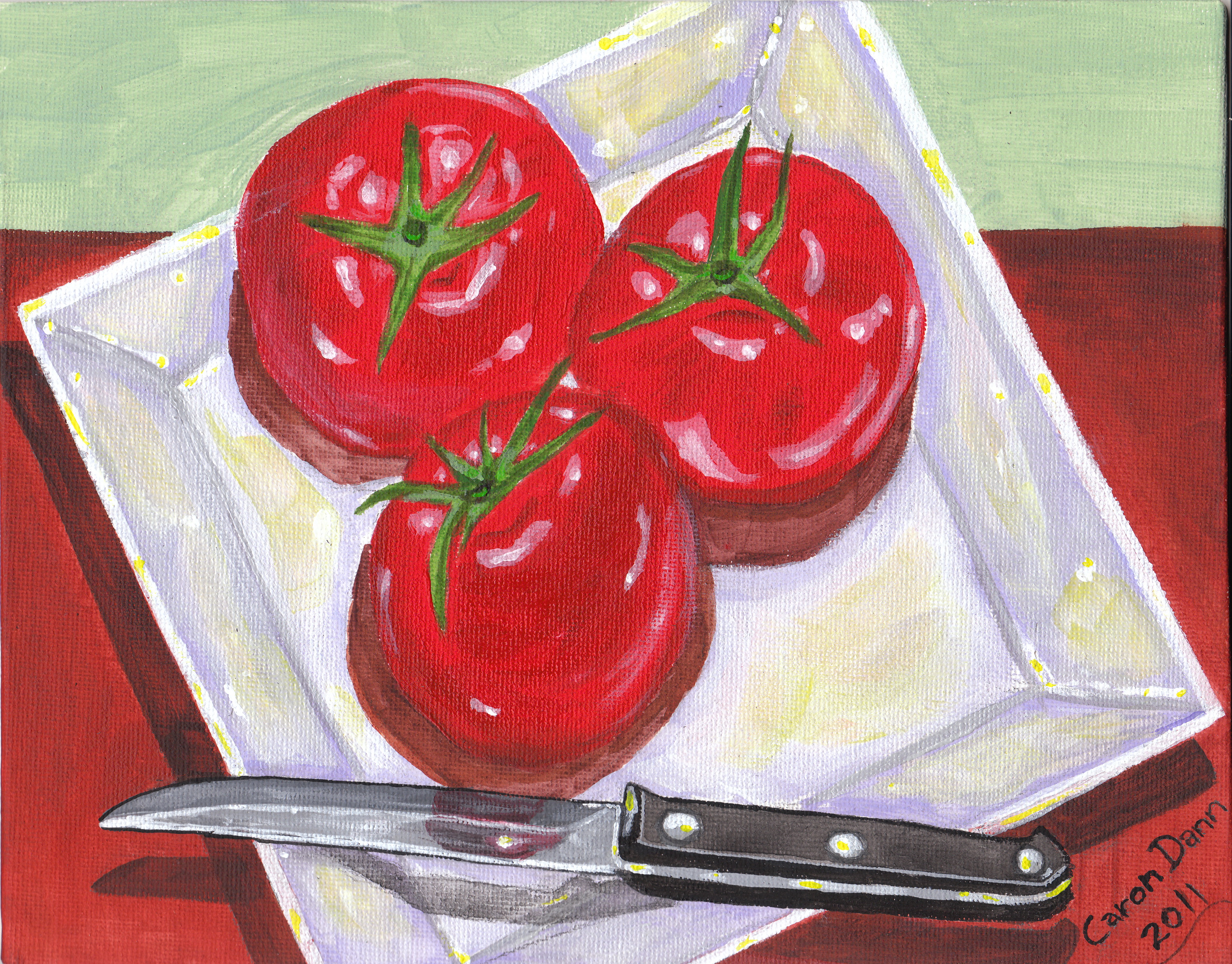
I might, however, make my beloved a special dinner: so instead of shopping for a card with a big red heart, I’ll more likely be buying a big red tomato today! I like that better.

My preferred Valentine's Day symbol.  Picture: Caron Eastgate Dann 2014

My preferred Valentine’s Day symbol.
Picture: Caron Eastgate Dann 2014

I’m not averse to receiving a dozen red roses, and my husband has often had them delivered to me on special occasions, such as our wedding anniversary. But they are outrageously expensive, and—truthfully—on Valentine’s Day, I’d rather have the money!

The Valentine’s Day supporters would say that makes me unromantic, but why? Because I don’t want to join the party with everyone else? Well I say, two’s company and anything more is just a crowd.
In addition, I don’t like the way a commercialised enterprise makes a significant proportion of the population feel sad, inadequate or lonely.

A good friend remarked to me today that although he appreciated exactly what commercial rubbish Valentine’s Day was, because reminders of it were everywhere you looked, it still had the power to make people feel sad if they were single but would prefer not to be.
I come from New Zealand, though I now live in Australia. Growing up, I can’t remember ever celebrating Valentine’s Day there. I knew about it, because I lived in the US for a few years when I was aged 10-12, and it was big even then, in the 1970s.
Back then, the done thing was to give a Valentine’s Day card to every student in your class, which I did in the first year. Only trouble was, I inadvertently missed out one girl: Erin was her name. She was a nice girl, though quiet, and I always felt bad that I’d forgotten her. I hope she isn’t now writing a post somewhere about how she was forever traumatised because at school she was the only person left out of Caron’s Valentine’s Day card delivery. Sorry, Erin!

Over the last few years particularly, the pressure to celebrate days such as Valentine’s has become much greater than it used to be. Weeks, and sometimes even months before the day, shops are full of reminders. You feel like a heel if you don’t participate. Now don’t get me started on the commercialisation of Mother’s Day, Father’s Day, Christmas and Easter…

The secrets of great cooking

Timing is the most essential element of successful cooking, according to my husband, Gordon, and I agree with him. But there’s another: ingredients. What to cook, what to combine, how to make something of seemingly nothing, what is best cooked fresh and when you can make do with frozen or canned ingredients are some of the necessary decisions.

I notice that famous TV chefs such as Jamie Oliver and that competitors in TV cooking competitions such as My Kitchen Rules all use packets of frozen peas in recipes, for example. Not that this would affect me, since frozen peas are one of the few foods I detest, and have done since, as a toddler, I stole a packet from the freezer and ate the lot.

I was reminded of how important ingredients are to cooking by today’s topic for the Daily Post At WordPress.com’s Daily Prompt, which is “Ingredients” (you can access the many interesting posts on this topic here). I’m fascinated by this subject, and since I took up painting three years ago, ingredients for recipes have featured in a number of my paintings. Some of them you’ve seen before, but I thought I’d gather my ingredients-based paintings together and present them on this one page.

My first painting, acrylics on treated board, in which I had to be brave, load the brush with paint and go! © Caron Eastgate Dann 2011

My first painting, acrylics on treated board, in which I had to be brave, load the brush with paint and go!
© Caron Eastgate Dann 2011

A quick pastel sketch on coloured paper. I don't have a fascination with knives, truly: they are just great subjects to try out new-found painting techniques. © Caron Eastgate Dann 2011

A quick pastel sketch on coloured paper. I don’t have a fascination with knives, truly: they are just great subjects to try out new-found painting techniques. This one has special sentimental value (explained in the last painting, below).                              © Caron Eastgate Dann 2011

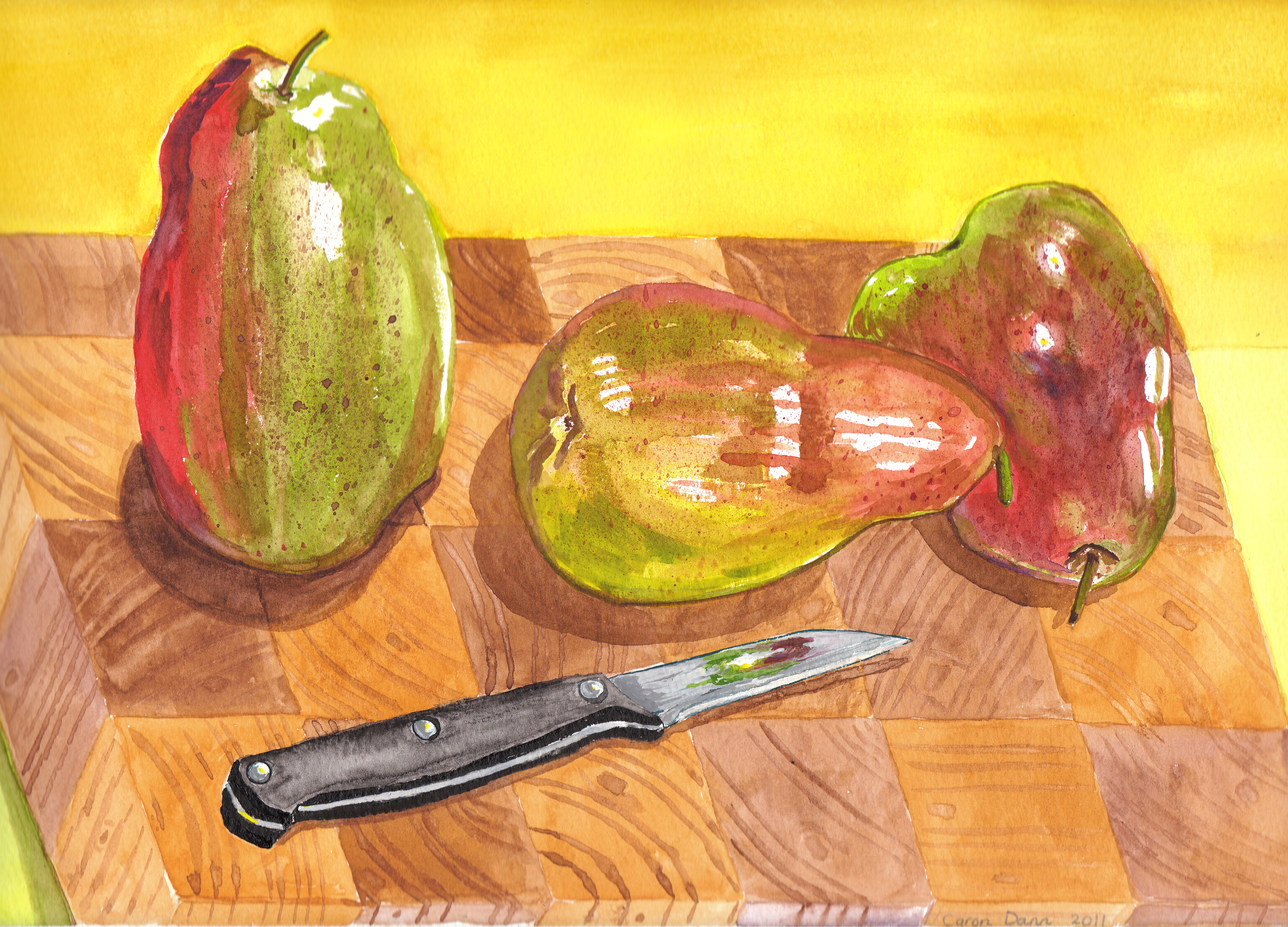
"Pear-Shaped", watercolour. I bought these beautiful pears in season and couldn't resist painting them. This was my first attempt at a watercolour painting. © Caron Eastgate Dann 2011

“Pear-Shaped”, watercolour. I bought these beautiful pears in season and couldn’t resist painting them. This was my first attempt at a watercolour painting. © Caron Eastgate Dann 2011

"Only On His Day Off", acrylics on canvas board. © Caron Eastgate Dann 2011

“Only On His Day Off”, only the second painting I did, acrylics on canvas board. © Caron Eastgate Dann 2011

"Waiting For Thai Tonight", acrylics on canvas board  © Caron Eastgate Dann 2011

“Waiting For Thai Tonight”, acrylics on canvas board
© Caron Eastgate Dann 2011

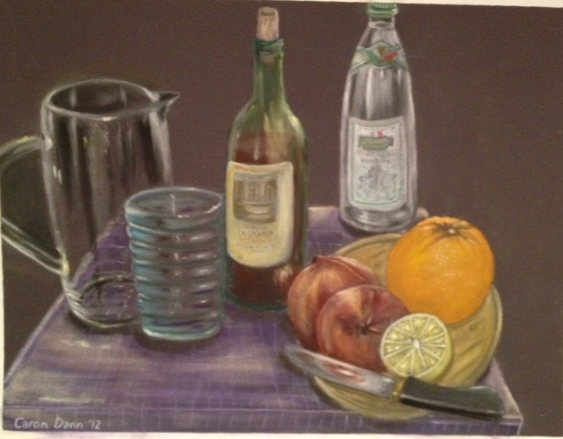
"Making Sangria", Pan Pastels on treated paper © Caron Eastgate Dann 2012

“Making Sangria”, PanPastels on treated paper. For this painting, I sourced all the ingredients, including a bottle of Spanish wine that we went to a specialist shop to buy. The great thing: I got to drink it after, so it was an incentive to finish the painting!
© Caron Eastgate Dann 2012

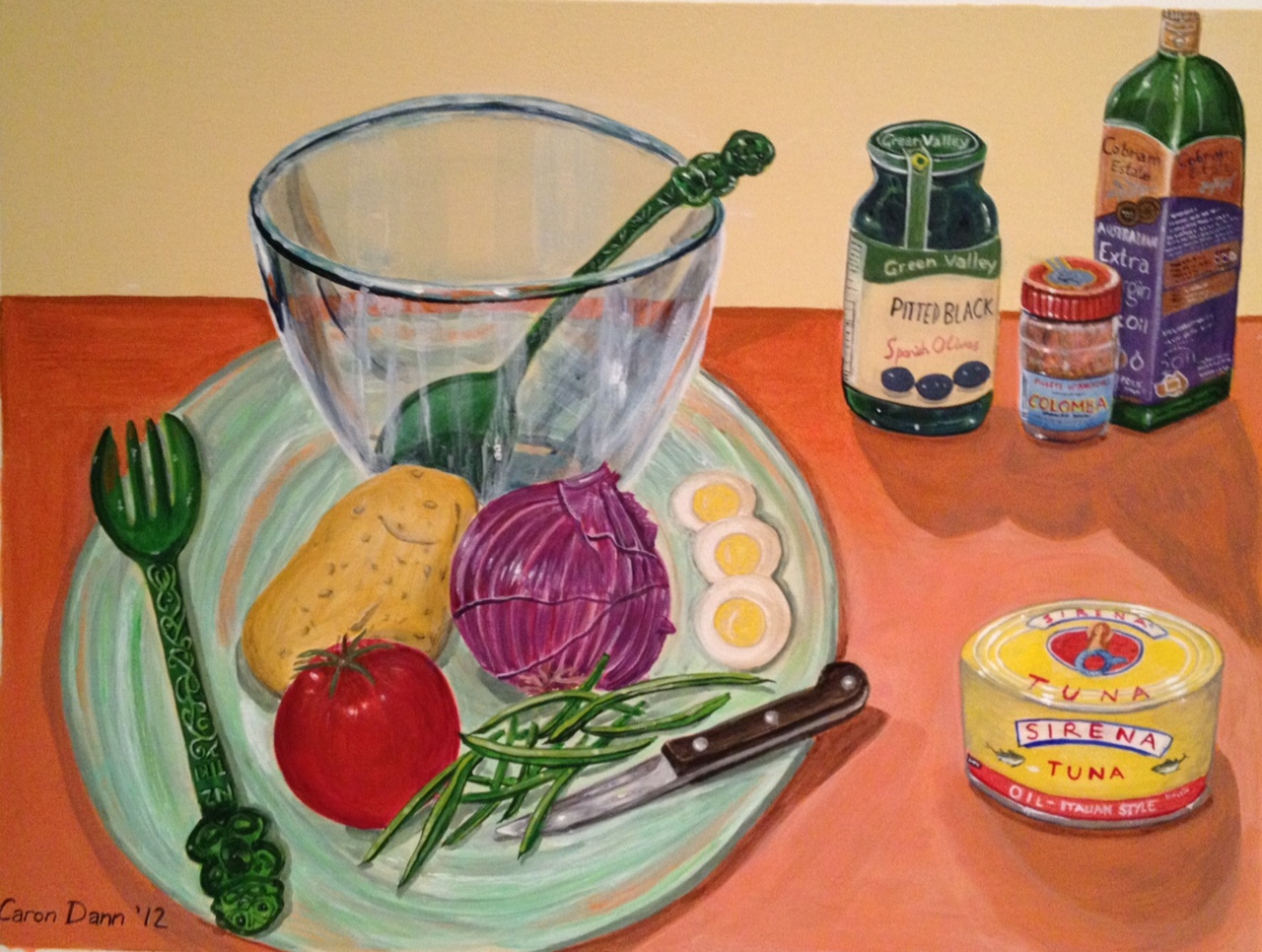
"Making Salad Niçoise", acrylics on treated board. This picture includes my favourite salad servers, plastic tiki-decorated souvenirs from New Zealand.  ©Caron Eastgate Dann, 2012 ©Caron Eastgate Dann, 2012

“Making Salad Niçoise”, acrylics on treated board. This picture includes my favourite salad servers, plastic tiki-decorated souvenirs from New Zealand.
©Caron Eastgate Dann, 2012

"Fruity Still Life", watercolours on paper. This was just a quick sketch, and I'm not very experienced in watercolours, so it's rather wonky: but I don't mind that! ©Caron Eastgate Dann, 2012

“Fruity Still Life”, watercolours on paper. This was just a quick sketch, and I’m not very experienced in watercolours, so it’s rather wonky: but I don’t mind that! ©Caron Eastgate Dann, 2012

"Apple Day", PanPastels on treated paper. The apples were three different varieties I bought for this picture. The willow-pattern china was given to me by my late grandmother.  ©Caron Eastgate Dann, 2013

“Apple Day”, PanPastels on treated paper. The apples were three different varieties I bought for this picture. The willow-pattern china was given to me by my late grandmother. The knife in this picture is very special, as it was given to me decades ago by my late father. It has a permanent place in my kitchen.
©Caron Eastgate Dann, 2013

Long-Ago Interviews: Lord Jeffrey Archer, author

In a previous career, I was a journalist who specialised in writing about the entertainment industry, celebrities, books and authors. I did this from the 1980s until 2008, when I became a university lecturer in media studies and journalism. In this series, “Long Ago Interviews”, I want to share some anecdotes from some of my more memorable interview subjects.

In the mid-to-late 1980s, I was books editor at the Sunday Star newspaper in New Zealand (now the Sunday Star Times). I had moved back to the big city, where I was brought up, after paying my dues from the age of 17 working at rural newspapers at Waipukurau in Hawke’s Bay and Warkworth, north of Auckland. I was still only in my early 20s when I became books editor of this major newspaper, but in those days, because we started so young, we were quite accomplished by age 23 or 24.

An example of my Sunday Star books page from 1986. Unfortunately, I no longer have a clipping of my Jeffrey Archer interview.

An example of my Sunday Star books page from 1986. Unfortunately, I no longer have a clipping of my Jeffrey Archer interview

Books editor

When I say I was books editor, this was an extra duty. I was primarily employed as the TV-page writer/editor, and before that the arts writer/editor of the Auckland Star Monday to Saturday. When the new Sunday edition was being planned, I sent the Editor—the big man upstairs who we lowly reporters barely ever saw—a proposal for a books page in the Sunday Star, because management had asked for ideas from staff and were prepared to give everyone a go. My proposal for a weekly books page was accepted, but it was additional to my role as arts editor then, later, TV editor. They paid me an extra $50 a week, but as all book lovers would know, it wasn’t about the money. I would be thrilled with anticipation every day as boxes of new books were delivered from publishers hoping to get a mention on the page.

Each week, as well as reviews by myself and other journalists happy to grab a free book (they got paid for reviews too, by the way), I wrote a news story about the book industry and did an interview with an author. It was a broadsheet newspaper, so there was lots of room.

As you can imagine, I was very busy, basically doing two jobs. As TV editor, every day I had to write a page of interviews and stories about local TV, and I also had to type out the program guide with witty comments! On Saturdays, I produced a TV lift-out. Then Sunday was thrown into the mix, though I’m not sure now if it was a dedicated TV page or just a news story or two.

“Mr Archer doesn’t go to interviews; you go to him”

Jeffrey Archer in 1998. Picture courtesy London School of Economics.

Jeffrey Archer in 1998. Picture courtesy London School of Economics.

One of the interviews I remember vividly from this time was with the British author, Jeffrey Archer (now Lord Archer, but back then, plain old “Mr”). Before I write further, let me say I do not agree with his politics at all, and I wouldn’t comment on his private life, of which there are many versions (for an interesting article on truth versus fiction in his life, click here). Nevertheless, I have to say he was a most charming interviewee, humorous and talkative. In addition, he is one of only a very few among hundreds of authors I have interviewed who sent me a personally signed letter  after the interview, thanking me for my time. I still have that letter.

Jeffrey Archer was extremely famous in the 1980s, and few authors could match his sales. He is perhaps best known for Kane And Abel, of which a 30th anniversary edition was released last year, and which alone has sold 37 million copies, according to Archer himself on his blog. I’ve read several of his books and enjoyed them immensely.

Anyway, Archer’s publishing company’s publicist had called me to set up an interview time, assuming I would go to his hotel. When I said that I was actually too busy to go out to an interview that day and that Mr Archer would have to come to the Star building to see me, the publicist was aghast:
“Mr Archer doesn’t go to interviews; you go to him,” she said.

I said that unfortunately, then, I would have to pass on the interview. She then got back to me with the exciting news that the author would indeed go to the journalist.

He duly arrived. I met him in the foyer, and up the rickety elevator we went in the ancient but quaint Auckland Star building, to an interview room on the editorial floor. He was with a young male assistant, who I prefer to think of as a sort of manservant (and I’ll tell you why in a moment).

Now, when I say interview room, think monk’s cellar. These rooms were just cubbyholes, really, with only a small table and a couple of chairs inside. Nothing on the drab grey walls, rather musty smelling, no windows. They were like interview rooms you see in those old hard-boiled cop movies. Nevertheless, I got him a bad cup of instant coffee in a paper cup and away we went.

Ask a rude question…

In the 1980s, young people still mostly lived by a lot of rules about how to behave in company and, especially, to have respect for their elders. You did not talk about money, religion or politics, as a rule, and you never asked a woman over 30 her age. But as journalists, we had to forget these rules, and we used to have to ask what I saw as tough questions, which you always kept until last. For Jeffrey Archer, the tough question I had to ask was, “How much money do you earn from your writing?”

He laughed and told me he had no idea. I don’t believe that for a moment, but he qualified it with some good material for my story. This is not the exact quotation, as unfortunately, I no longer have the clipping, but he answered something like this: “Let’s just put it this way. I have enough money to go anywhere I want to and to buy anything I want without having to check if there is enough money in my bank account.” He told me he had Louis Vuitton luggage, which was very impressive. He also told me that the sole reason he had started writing his first novel, Not A Penny More, Not A Penny Less, was because he desperately needed money to stop himself going bankrupt.

One’s manservant has the pen

Archer signs books in Bangalore, India, 2009. Picture: Mike Lynch.

Archer signs books in Bangalore, India, 2009. Picture: Mike Lynch

Another thing that has changed in journalism is that, in those days, you would never ask a celebrity for their autograph if you were a professional reporter. You would never show that you were “star struck”. This is the one time I broke the rules: I asked Jeffrey Archer if he would sign my paperback review copy of his book First Among Equals, which was what he was in New Zealand to publicise. He agreed, then held up his right arm with palm outstretched. Immediately, the “manservant” took a pen from his pocket and placed it in Archer’s hand. Archer signed the book, and handed the pen back to the assistant. I still have that signed paperback: you can see Archer’s signature and find out what happened to my copy of the book here.

I say “manservant”, because in New Zealand, we had nowhere like as rigid or apparent a class system as existed in England. No one else I knew or had interviewed had ever had someone else to carry their pen for them, including the then-Prime Minister, David Lange, who I met at the Beehive (as the Parliament Buildings executive area is known) in Wellington in the 1980s. Well, whatever the real reason the assistant had the pen, it makes a good story and is something that has stuck in my memory all these years.

You still have to fix the fence or, Dear Architects: Let’s Drag Houses Into the 21st Century

Technology can't fix a broken fence

Technology can’t fix a broken fence

As I was having breakfast one morning, I heard someone next door hammering nails into the fence. This was a good thing, I thought, since our fence was about to fall down and the landlord was not interested in fixing it. Unfortunately, they weren’t working on the fence between us and them, but between them and the next dwelling. Oh well.

It got me thinking, though, about the fact that fences still need to be fixed and painted, in the same way they’ve always needed to be.

This, despite the amazing technological advances of the 20th and 21st centuries; despite the fact that I can write an email and send it to someone in Iceland and have an answer from them in a few moments; despite smart phones with apps for everything from spirit levels to measuring your heartbeat to doing your shopping; despite reports of 3D printers being touted as the next great thing that will be able to grow body parts and print cars; despite all this, you still have to fix the fence. And when you do it, you still usually need a hammer and nails, pretty much the same gadgets our forebears were using thousands of years ago. There’s not an app to do that, now, is there!

There must be a better way.

All around me, I see in our house and in the houses of everyone else I know, design from a bygone era of servitude. This was the era when rich households all had servants to work full-time on cleaning and maintaining a property, while not-so-rich households had women to work in this role, even when they took paying work as well.

Out with grouting, tiny tiles and difficult shower doors

Out with grouting, tiny tiles and difficult shower doors

Today, few people have servants; few women accept that their entire role in life is to clean up after others, acknowledging that, even if they work at home full-time, they should still be able to have some time off, the same as any other worker. In such a time, we should be making houses that need a minimum of maintenance. Architects, engineers, designers, and builders, please take note!

*I don’t want shower cubicles with nooks and crannies that collect soap and mould. I don’t want tiles with grouting that collects dirt, then discolours and cracks.

*I don’t want fancy “period style” doors that collect dust. For example, each of the doors inside my rented townhouse has 91 separate surfaces to clean. The front door is the same, and there is also a decorative screen door (see picture). Ditto cornices and skirting boards. I blame the penchant for Victorian style in all its fussiness. Although mine is a late 20th-century house, it was built in Victorian style, which has been very fashionable for a few decades.

Our Victorian-style front-of-house security door: a dust collector.

Our Victorian-style front-of-house security door: a dust collector

*I don’t want wooden fences that warp and spring out of their nails. I don’t want to have to paint a fence every few years.

I have seen pictures of amazing houses designed by top architects that have all smooth surfaces that need little maintenance—but they have multi-million-dollar price tags. That’s well and good, but I’m talking about houses for the ordinary person.

My idea of the perfect house would be the lowest maintenance place possible: no fancy edges round the walls or light fittings, no tiles with grouting. The decorative touches could then be added via soft furnishings, beautiful artwork and sculptures…which would all need cleaning, I know.

Don’t get mad…

Ever heard the missive “Don’t get mad, get even”? I agree with the first half of this statement, because getting mad serves no positive purpose at all. When you get angry, your stress levels go way up, you do and say things you haven’t properly thought out and that you’re usually sorry for later. Also, you make the place unpleasant for those around you.

I’m not talking about a situation in which your safety is threatened—getting angry for survival is different. I’m talking about everyday life: the times we thump the table at a pathetic or biased story on the TV news; that we grimace or gesture at a driver on the road who’s done something stupid; or that we yell at our partner for something trivial.

There was a mega-selling book that came out in 1997 called “Don’t Sweat the Small Stuff”. I never actually read this book, but I loved its title. This is because, much of the time, I DO sweat the small stuff, and know I shouldn’t. My brother once made the comment a few years ago, “Oh, Caron will worry enough for all of us”. Ever since then, I’ve tried to stop worrying so much, because worry can so easily lead to anger. I don’t always succeed, of course.

Think of all that energy we expend on being angry, and how much better placed it would be directed to constructive things. Instead of yelling at poorly constructed stories on trashy current affairs shows, for example, I should paint a picture or go for a walk.

The Crayon Files

“Rays’ Ways”, pastels,  ©Caron Eastgate Dann, 2011

Speaking of pictures, surrounding yourself with beautiful art is a great way to help you feel less angry and more peaceful. You can even make your own art using inexpensive materials. Give it a go—you’ll be surprised what you can do, even if you haven’t tried since childhood. The picture on this page of rays under the sea was one of the first I did when I took up art three years ago, and it always makes me feel peaceful.

I’ve written this post in response to Kozo’s monthly challenge over at Bloggers for Peace. The challenge is to write about the one thought you will focus on this year to bring more peace. So, instead of “Don’t get mad, get even”, I would like to change that saying to, “Don’t get mad—get happy”. I think the world would be a much better place if everyone kept this in mind during their everyday lives (with the aforementioned exception, of course). Over at her blog Delightfully Different Life, the writer D. S. Walker also answered this challenge, and explains how happiness can be found in simple ways.

Cauliflower is the new rice!

My rogan josh, complete with cauliflower rice.

My rogan josh, complete with cauliflower rice

I love pasta, rice and, to a lesser extent, mashed potato, but in our household I am trying to reduce our carbohydrate intake.

We both love to cook and can happily spend hours in the kitchen preparing meals. We’ve been using cauliflower mash to substitute for potato mash for a few years now, and it works beautifully, particularly when done in the snazzy mini-food processor we bought for $30.

Recently, I found that cauliflower could double for another of our staples, and that was white rice. Surprisingly, it was on a Jamie Oliver cooking show that I first heard about cauliflower rice. Here is my version:

Take about a third of a medium cauli for two people. Make sure it is super white and firm. Take off as much of the stalk as you can. Put it in a food processor and whiz until it becomes like grains of rice. Make sure there are no big bits left, and if there are, take them out. But don’t process so much that it congeals. The grains should be separated.

Tip the grains into a microwave-safe dish with a ventilated lid. Very important: do not add water.

Microwave on high for about five minutes. Oliver says seven minutes, and other recipes I’ve seen say four, but it will depend on how much you are cooking, the power of your microwave oven, and what your taste is. For two people, I cook it for four minutes, then test it.

Now use as you would rice: this is a lovely base for a curry, for example, and you can see in the picture above my cauliflower rice with rogan josh, made for dinner last night.

You can also make cauli rice into a sort of pilau. Fry some diced vegetables, such as chopped onion, capsicum, mushroom, garlic, herbs and spices, in a little oil of your choice until golden, then add cooked cauli-rice, stir to heat and serve.

Briefly, here are the other substitutes I use for high-carbohydrate foods:

cauliCauliflower mash

As cauli absorbs a lot of moisture when it cooks, it’s better to microwave or steam it, but you can simply boil it if you want to. Make sure the cooked cauli is very tender, but not waterlogged. The food processor on pulse does the best job, and adding a little cream cheese to the mix does wonders. Half a teaspoon or so of powdered chicken stock can also be good.

If you’ve boiled the cauli, it will make quite a sloppy mash, but this can be delightful served on the dinner plate in a little ramekin with a knob of butter for the naughty.

Zucchini pasta

For a fettuccini substitute, use zucchini (courgette). Take a vegetable peeler and shave long strips from the zucchini, avoiding the inner seeds. You’ll probably need one medium zucchini per person. Then blanche quickly in boiling water—it will take only about one minute, or maybe even less. The trick is that it must be al dente but not raw, so experiment with a few pieces first. If overcooked, the strips will break up.

Drain the strips and treat as you would regular pasta, that is add some seasoning and a few drops of olive oil if you like.

Serve topped with your favourite sauce. A light tomato-based sauce works well, with parmesan and parsley on top. Or, fry in olive oil a few tablespoons of breadcrumbs, a garlic clove, some dried or fresh chilli slices, and an optional anchovy fillet or two. Dribble the sauce liberally over the zucchini pasta and serve with a wedge of lemon on the side.  Season to taste, of course, but remember, anchovy is very salty.

Egg wraps

Bread has such a central place in the western diet, it’s hard to get away from it. This is particularly so at lunchtime, when it seems so easy to grab a couple of pieces of lovely sourdough or a crunchy roll and fill with ham, cheese, tuna, or whatever else is on hand.

For a brilliant alternative, I take one egg per person, break and mix well together in a small bowl. Season and add a little water, no more than a teaspoon for every two eggs, and mix again.

Take a small non-stick fry pan—mine is 14cm across at the base—and spray lightly with oil, turning to medium heat. You should need to use the oil only once during the cooking time.

You fry the egg wraps exactly as if you were cooking crepes: spoon in a small amount of egg and then quickly tilt the pan so the egg covers the entire base. If you’ve overestimated, tip the excess back into the bowl. If you’ve underestimated, add a little more. But this must be done within a few seconds! The wrap will take 30 seconds or less: it’s ready when the edges start to peel away from the pan. You should easily be able to nudge the wrap from the pan and on to a waiting plate.

Continue until all the egg is left. You will probably have three wraps per person, depending on the size of the eggs.

The wraps can be served with hot or cold fillings. Simply treat the way you would a bread wrap, and fill with whatever you want. We like smoked salmon, cream cheese and capers, for example. These can be easily transported to work or school for a portable lunch.

Happy eating, and I’d love to know your suggestions for other substitutes.