What Not to Resolve on New Year’s Eve

OK, this was actually taken at the fireworks display for July 4 this year over Oahu, Hawaii, but fireworks are fireworks! Image by Gordon Dann, 2013.

OK, this was actually taken at the fireworks display for July 4 this year over Oahu, Hawaii, but fireworks are fireworks!
Image by Gordon Dann, 2013.

It’s New Year’s Eve in Australia, and all through the land, people are making grandiose declarations, commonly known as New Year’s Resolutions.

“I’ll go on a diet and lose 30kg. I’ll never drink calorie-laden fizzy drinks again”;

“I’ll read a book a day, every day”;

“I will never eat ice-cream or chocolate again”;

“Instead of coffee or tea, I will drink water only”;

“I will go to the gym five times a week”.

And on it goes. Sadly, we are just setting ourselves up to fail when we make such sweeping resolutions. (Very important note: I am not talking here about when people are addicted to a harmful substance and they need to give it up forever—that’s a whole different story).

So, instead of making ridiculously unattainable goals, make a tiny change or goal you can stick to. Mine are going to be:

1. Try to read more books than last year;

2. Try to cut out unnecessary foods/beverages and lose 5kg during the year;

3. Exercise more. Instead of a daily 15 minute walk, try to extend it to 30 minutes a couple of times a week.

Writing-wise, I have only one main goal, and that is:

1. Finish the draft of the novel I’m working on now.

Of course, I have other goals each week, month, year. But those are the main ones, the ones I want to concentrate on. I suffer from a lack of focus in that I’m often trying to do too many things at the same time, and I end up finishing none of them.

So happy New Year, everyone, and we’ll meet again in 2014.

The World’s Most Romantic Present

Rom1Of these three, which do you think would make the most romantic gift? The French perfume, the diamond and Burmese ruby ring, or the pencil sharpener?

Yes, you’re right: the correct answer is…the pencil sharpener. For me, anyway.

This is pretty much my favourite present this Christmas, given to me by my husband, Gordon. I’ll tell you why it’s romantic.

Nearly three years ago, I took up art as a hobby. I use lots of media, including pastel pencils, and I’m about to start using coloured pencils.

Now, I think doing art is quite romantic in itself. Out of a few tubes, cakes or pencils of colour, a piece of paper or board and some brushes or sponges, you can create pictures that move people to cry or laugh, that remind them of their favourite things, that inspire them to become creators themselves. Potentially, anyway, if you’re Leonardo Da Vinci. In contrast, my paintings are much further down the evolutionary scale and very much those of a novice without wings. But you get the idea.

Anyway, I am always having trouble with my pencils. The leads are always breaking off, new pencil sharpeners quickly become blunt, or aren’t quite the right size, or don’t sharpen to a point. In the last year, I’ve probably bought 10 pencil sharpeners. Gordon has become used to me walking round the house, looking for another sharpener, and muttering about how useless they all are. I have entire conversations with myself about pencil sharpeners. Only artists will understand what I mean. And they do: there are lots of online discussions about pencil sharpeners, I’ve discovered. If you can’t get a sharp point on your pencils, it can seriously affect the quality of your art.

Romance2Furthermore, I recently bought these expensive coloured pencils which are sold unsharpened. To be fair, this set comes with its own little pencil sharpener that is quite good. However, it is laborious using such a small implement: I managed to sharpen three out of 72 before I got sick of it!

Anyway, when I opened my presents at Christmas, the one with the free-standing pencil sharpener was very exciting. All the online forums talk about the X-Acto sharpener, and here was one for me, complete with its vacuum mount and its eight-hole choice for pencil sizes.

This will make my little creations easier and better. More importantly, we will be a more peaceful household minus the mad ravings about the hazards of pencil sharpening.

Thanks, Gordon

‘Tis the season

I’m with Goldfish over at Fish of Gold: I’m not much good at parties these days. I haven’t hosted a party for years, and the only ones I go to are those connected with very important events, such as weddings, engagements and special birthdays.

When I was young, I loved parties. The dressing up, the social interaction, the laughing, the music, the dancing. Now, you couldn’t pay me to leave the comfort of my home at night, pay zillions for taxis and stand around making small talk to people while the music’s so loud, we can hardly hear ourselves think.

So when I read that the last Bloggers for Peace challenge of the year was to plan a party “that will ripple peace to the world”,  I groaned.

Then I started to think about it: is there any requirement that a party have a specific number of people, or that it even needs to be away from home? No, I don’t think there is.

 What is it? Why it's my novelty snow dome bottle stopper, of course, and it comes out only at this time of year.


What is it? Why it’s my novelty snow dome bottle stopper, of course, and it comes out only at this time of year.

So, my peace party would be this: gather together the loved ones in your house or invite some dear friends or family over. No texting, checking Facebook or other anti-social activity while this is going on.

Cook a beautiful but simple meal. In the words of one of my friends: “make a salad, bake some potatoes, and put some steaks on the barbecue. Other ideas are to make a huge paella that everyone can dig into; or serve a steaming platter of spaghetti marinara with salad and crunchy bread.  Include something sweet at the end, even if it’s just ice cream (have you SEEN the fancy flavours now available? Lemon meringue, coconut lime, and passionfruit pavlova are among them).

Open a bottle of wine—or, if alcohol isn’t your thing, make luxurious hot chocolate (here’s a stunning Jamie Oliver recipe). Put on your favourite music—not too loudly—and talk to each other. Tell jokes, laugh, talk about the people you miss, talk about the funny things you have done together.

If you celebrate Christmas, consider having a low-key day like this. It will be peaceful and relaxing, not too expensive, and you’ll avoid the stress of the “more is more”, overly commercialised stupidity that has hijacked the season.

If we all spent less on holiday celebrations and had our own peaceful, modest parties instead, then donated the money saved to some effective charities, we could go a long way to making the world a better place for millions of people.

Austerity and writing

How frugal is too frugal? It depends on your circumstances. About 10 years ago, I remember being horrified when a TV reporter advising people how to save money said that forgoing buying a coffee Monday to Friday would save $750 a year. I would, I reasoned, rather have my daily cappuccino than $750.

A decade on, however, I’m starting to see how much sense that makes, and now I buy only one hot drink a week (chai latte is my choice these days) or fewer.

cheese-finalI thought about that story of saving money again this week while I was at the supermarket. I often purchase pre-cut cheese slices (natural ones, not the over-processed rubber ones in cellophane) and pre-grated cheese. This is purely because they are convenient for sandwiches and recipes respectively. (I know my foodie friends will gasp in horror when they read this. Oh well.)

But comparing prices in the supermarket, I calculated roughly that I would save $150 a year if I bought cheese in blocks rather than pre-cut. That doesn’t sound much, but it is a jolly good night out for two, or a bucket-load of new books, or three bottles of Moët champagne… In return, I have to spend one minute slicing or grating cheese each time I use it. I can do that.

Moving on from that, there must be lots of other ways I could save money just by changing my buying habits slightly.

In reality, any savings I make are likely to go straight to my credit card rather than on champagne. I need to take austerity measures at this time of year, because there is very little academic work from December to the start of March.

On the positive side, it is a wonderful, peaceful time to get some writing done. I’m working on a novel and, from tomorrow, I will aim to write 2000 words a day, most days.

Because of my austerity measures, I will not be going out much to restaurants, going to the theatre or flying away for a weekend in Queensland. In other words, there will be few distractions.

Instead of gadding about, I will be hunkering down, weathering the lean times for another year and…hopefully, at the end of summer, I will have the first draft of my new novel done. That will be a major achievement, since I’ve been researching this topic in various ways for 20 years, and recently, finally, came up with what I think is the perfect formula for the book.

The toy I always wanted…but was afraid to ask for

When I was a child, there was one toy I always wanted but never received. I would visit toy stores and go straight to the aisle where they sold…the Barbie dolls.

Me as a New Zealand schoolgirl in my blackwatch tartan summer uniform

Me as a New Zealand school girl in my blackwatch tartan summer uniform.

To me, this strangely proportioned doll was the last word in sophistication and glamour, an adult doll who had a boyfriend, super fashions, makeup, a camper van and various exciting professions. In contrast, I was a little girl from New Zealand who liked playing with baby dolls, reading Famous Five books and dressing up her long-suffering cats in bonnets and booties.

When we went to live in Los Angeles for a couple of years, my desire was fed even more. Instead of the small independent toy stores with narrow aisles and teddy bears that I was used to in New Zealand, there was the mega-store Toys R Us. This was a mixture of heaven and hell for kids: heaven because of all the amazing stock it had, and hell because there was so much you wanted but would never get.

I hoped that I would receive a Barbie doll for Christmas or my birthday (which are within two weeks of each other), but to no avail. Then, when I was 11, my American friend Andrea, already into fashion and makeup and talking about boys, laughed her socks off when she saw the doll collection in my room. “You still play with DOLLS?” she said incredulously. “A Barbie might be OK, but…BABY DOLLS?”

I put those dolls away after that, but I still always sneaked around to the Barbie aisle whenever we went to a toy shop.

And as a school girl in America, free of uniform...but still wanting a Barbie doll!

And as a school girl in America, free of uniform…but still wanting a Barbie doll!

So, I grew up, and got my own exciting profession, boyfriend (then husband), fashions and makeup. When I was in my 30s, my mother and I were talking one day and I told her about my great childhood longing for a Barbie doll.

“But you never asked for one,” she said. It had never occurred to her that I would want one, and she probably didn’t think such a doll was really appropriate for a little girl, anyway.

I realised then that I had just hoped that somehow she’d know I wanted a Barbie. But she was right: I’d never expressly asked for one. In the 1970s, we children weren’t allowed to whine about toys we wanted, especially when so many children around the world were starving, as our parents constantly reminded us.

When I was 41, I received a special present from my mother: I finally had my Barbie doll. What’s more, it was a mermaid Barbie, because my mother knew I was fascinated by mermaids. “Now don’t say I never gave you a Barbie!” she said. And here it is:

mermaid

This post was written in response to the Daily Prompt word a day challenge, here, which asked, “Was there a toy or thing you always wanted as a child, during the holidays or on your birthday, but never received? Tell us about it”. I got inspired when I read a post by Fransi Weinstein, about a fabulous pair of shoes she coveted as a teenager. You can access her post here.

Christmas accomplished

This post about the ridiculous over-commercialisation of Christmas mirrors my sentiments exactly. I wonder how it is that so many people have been so taken in by advertising, so that Christmas has become for them this huge hurdle each year.

candidkay's avatarcandidkay

I have a beef with the whole holiday hoopla.

A beef I might not normally share but since I have the luxury of a platform (this blog) and an entire large container of Costcopeppermint bark next to me, why not? Grab a cuppa’ and join me.

I blame TJ Maxx. (Ok, Marshalls and HomeGoods are in there too, but let’s not get all technical about it.)

Not really. Not entirely. But their ad team should really get a shot in the arm of good ‘ole holiday spirit. I mean, what’s with this “Christmas. Accomplished.” ad campaign? The one where they tell you to “out-gift” everyone? The one that intimates any together, Christmas-savvy shopper will go to all lengths to buy not just perfect presents, but perfect presents in copious quantity. Oh, and the decorations to go with them.

How did I miss the memo on Christmas being a…

View original post 579 more words

My (un)natural enemy: Old Father Time

Tick tock, tick tock...time is getting away. Photo ©Caron Eastgate Dann

Tick tock, tick tock…time is getting away.
Photo ©Caron Eastgate Dann

“Time has got the better of me”

“Time got away on me”

“Where has the time gone?”

“Look at the time!”

In my bid to live a peaceful life, I am constantly assailed by this most human of ailments: worry about time, both long-term and short-term. There is, it seems, never enough time to do all the things I have to do as well as all the things I want to do.

This column is written in response to this month’s Bloggers for Peace challenge over at Everyday Gurus. Kozo asked participants to confront their greatest enemy. You can read more on that and what others thought here.

The truth is, I think Old Father Time is best not confronted at all: ultimately, we will never beat him. So let’s just ignore him. Some enemies are best unfaced, unacknowledged, uncredited.

I saw a wonderful story on a current affairs show this week. It was about a group of seniors aged 67-97 who do hip hop dancing: yes! The group, Hip Op-eration, have this year competed in the World Hip Hop Dance Championships in Las Vegas. These people are so full of life, it gave me a great boost. If you want to see more about the challenge, click here. One of the responses I particularly liked was this one, from Breathing Space, about the enemy within.

Funnily enough, this week I lost my watch. It’s in the house—somewhere—yet it is nowhere to be found. Is someone trying to tell me something?

Home alone

Do you do things a bit differently when your partner or whoever you share your house with is away?

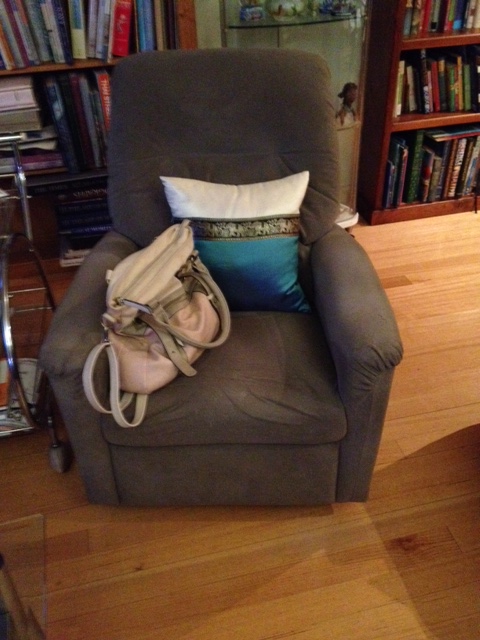
Home1Come on, admit it. When you’re home alone, you lick your plate clean, leave the bathroom door open, never put the seat down (if you’re a guy), watch dreadful reality shows and eat instant potato with butter and parmesan at midnight.

Only one of those things applies to me. Ok, two of those things apply.

I do live a bit differently when it’s just me. And much as I love my husband’s company, cooking and conversation, sometimes it’s nice to be alone for a few days.

home2Even the cat catches on. Lucy Locket always sleeps on my side of the bed when we’re both home, but when  my husband’s away, she takes over HIS side of the bed. She would never do this when he was home. I’m trying to coax Lucy Locket to sit on his special chair, then I will take a photo and send it to him in a message, just to mess with his mind. Bwahahahahahah!

Alternatively, the special chair makes a handy stand for my handbag while its usual occupant is absent.

So, for the next few days, I will have my paints out all over the dining table, and I won’t bother to put them away, because I won’t be eating at the table. I will eat in front of the TV or in bed or beside my computer: no need to be sociable.home3

There’s one thing most people would do when home alone, though, that I can’t: I would never leave the bathroom door open when taking a shower. I always have to lock it and take a phone in there, just in case. There are two reasons for this strange behaviour: 1) that classic shower scene from the movie Psycho; and 2) My house was burgled once WHILE I WAS IN THE SHOWER,  yes it was, and even though that was nearly 20 years ago, the horrible thought of it has never left me.

A note about security: people reckon cats are pretty useless protectors and, I agree, they would run away to save themselves first before defending their owners, unlike many dogs. However, this means that I know that if Lucy Locket is just sitting round, or curled up happily in her bed, there are definitely no intruders or strangers near our house. So if I hear a funny noise, all I have to do is check the cat to reassure myself that it’s nothing.

Call me a Kiwi—but not a bird or a fruit

Photo © Caron Dann, 2013

Photo © Caron Dann, 2013

When I was five, my family and I left our South Pacific island home of New Zealand and went to live in England. My school, in Heslington, York, had a Christmas school performance and I coveted the role of the angel, because I would get to wear a lovely white satin gown and a tinsel halo. I was very upset not to get that role. Instead, I would be part of the procession, which celebrated all different nationalities of the British Empire. To add insult to injury, they made me parade in dressed as an Australian, complete with a hat with corks on strings (worn in Australia to ward off flies). I hated that: they didn’t understand that Australia and NZ, though collectively known then as “the Antipodes”, were very different countries. I can still remember walking in that procession, to the applause of all the parents seeing their little darlings dressed up so prettily, but feeling so humiliated, I wanted to cry. The teachers felt sorry for me and let me take the angel costume home for the weekend.

Ironically, I have ended up spending much of my life living in Australia, and I love it. Although I was born in NZ, I’ve spent a little less than half my life there. I’ve also lived in the US and Thailand.

But I identify most of all with being a New Zealander—or Kiwi, as we’re colloquially known. I’m at least sixth generation, which for a pākehā (white NZer) is a lot. The name “Kiwi” is, of course, after our unique national bird, the kiwi. Americans in particular might know better the fruit, which they call “kiwi” as well, but we always call “kiwi fruit” now. When I was growing up though, it was known as a “Chinese gooseberry”, because it is native to China, not NZ—the Kiwis just came up with a brilliant marketing idea!

I love being a New Zealander, and even though I haven’t lived in my home country since 1988, I go there every year or two. I always enjoy flying in and seeing that green, green grass of home, to steal a line from a famous song.

Australians and New Zealanders can tell each other apart in a moment by our accents. But much the same as Canadians and Americans, we often get mistaken for the other by outsiders. I knew I must have picked up some Australian vowel sounds a few years ago, when someone in Auckland, NZ, said to me, “Are you Australian?” But most Australians can pick me straight away as a Kiwi.

As well as nuances in our accent, we have lots of different sayings and terms for the same thing, and that’s what I illustrated in the photo on this post. So, “jandals” in NZ are called “thongs” in Australia, and “flip flops” in England. They’re those rubber sandals held on with a thong between the big and second toes.  The term “jandals” is never used in Australia, except by New Zealanders who want to be laughed at, but I’ve gone back to it. The word is perfect for this type of footwear, and was originally a trademark made in the 1950s from a description of the product’s origins, “Japanese sandals”.

We have a few NZ shows on TV in Australia now, and this has put me in touch again with our vernacular. If we like something a lot, we say “Choice!”, but we often pronounce it like “Choooooooooiiiiice!”. (The opposite is “Stink!”). And if we’re cool with arrangements, such as “I’ll pick you up at 7 and we’ll go to the movies”, we say “sweet AS”.

This post was written for Rara’s International Label Day post, in which participants identify themselves with labels, which I reckon is choice! Anyway, if you want to take a look at all the other cute labels in that post, you can access them here, OK? Sweet as!

My Favourite Old Recipe Books

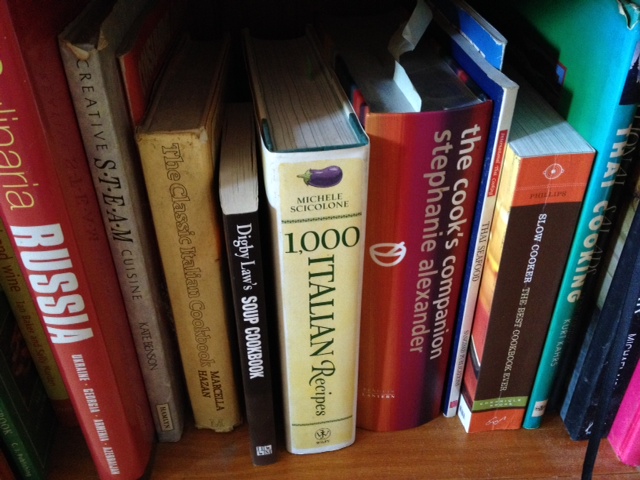
My recipe books take up two shelves of a big bookcase, and I have culled them to just the ones I use or am likely to use.

My recipe books take up two shelves of a big bookcase, and I have culled them to just the ones I use or am likely to use.

Remember the days when if you had a whim to cook something—beef stroganoff, say—you would have to trawl through your cook books, knowing the best recipe was…somewhere?

These days, I can simply google it and come up immediately with the right recipe via the internet. I put my iPad in the cook book stand in the kitchen and away I go.

But you know what? I still love my old recipe books. I still occasionally buy a new one. I have had some of these books since the 1980s when I was first starting out on my own and when I knew little more about food than grilled meat and three boiled veg (orange, green, white).

In the first flat I lived in at 17, my flatmate, Heather—who was nine years older—cooked for us on nights one and two. On the third night, we got home from work (we were both reporters, on rival newspapers) and she said, “Well, I cooked the last two nights, so you can do tonight. I’m going out to mow the lawn. Call me when it’s ready.” And off she went.

I was shocked: I don’t think I’d realised I’d have to cook. I probably hadn’t even thought about it, because Mum and Dad always cooked at home and I was too busy studying.

I can’t recall now what I made in entirety, but I remember calling out the window to Heather, “Umm—how do you cook potatoes?” She put the mower on idle and said, “Peel them, put some water in a pot and boil them till they’re soft,” before roaring away from me with the mower.

Heather didn’t stay long, and I soon had a new flatmate, Jan, who was my age but much more cluey about things domestic. Jan introduced me to the world of recipe books and I was soon serving 1980s wonders such as apricot chicken and potato-topped salmon bake.

These days, there are many fantastic and hilarious websites and blogs devoted to retro recipes: but I prefer my own little corner of history in my bookcase and I often still use my favourite old cook books. Coming up are just some of my favourites. Note that these are not my favourite coffee-table recipe books—this is a whole different category that I should write about some time. These are some of my favourite books that I actually use all the time for everyday meals. They are splashed, stained and creased with the efforts of preparing many meals past.

rec4The New Zealand Radio and Television Cookbook, edited by Alison Holst (1981)

This book was given to me by my godmother when I was 21, and I still use it all the time. It’s great if you want to cook a hearty beef casserole or vegetable soup, and has an “Eastern and Polynesian” chapter which—despite the unsophisticated grouping together of a very wide number of cuisines—is actually pretty useful still. Here we find recipes for sukiyaki, Indonesian barbecued duckling with gado gado salad and rempeh.

Alison Holst is one of my homeland New Zealand’s most famous cooks, and any book she writes or edits is accessible, easy to follow, and fail-safe. For this book, recipes were contributed by “listeners and viewers” throughout NZ.

The preface points to a bygone age when, supposedly, women were the only ones cooking in the domestic sphere (not in my family though—my parents shared the cooking, and my grandad did a fair bit at his place, too). The preface is worth quoting in its entirety, if only for its antiquated sentiments:

“This book contains a wide selection of recipes, favourites sent in by listeners and viewers from one end of New Zealand to the other—farmers’ wives and city women; those who cook for one or two and the mothers of large, hungry families; women who buy just what they fancy and those who watch their food budget carefully; young cooks and women with years of cooking behind them…”

Country Cooking: Regional and traditional recipes from Europe and North America, edited by Heather Maisner (1982)

Almost all my adult life, this book has been my go-to for traditional and authentic menus from Europe and America. It’s an artistically produced book, with historical photos and information about food production. So, if I randomly let this book fall open, I come across the “Spain and Portugal” chapter, from which I would choose vieras guisadas (Galacia) baked scallops, Sopa de almendras (Andalusia) almond soup, and paella Valenciana (Valencia).

rec6A Vegetable Cookbook, by Digby Law (1986)

This is my vegetable bible. I got this book in 1986 when I was literary editor of the Auckland Star and interviewed the author. I still use this book most weeks. It lists vegetables alphabetically, explains how to cook them simply, then for each has 6-10 recipes, which range from the well known, such as ratatouille and moussaka, to the exotic, such as choko relleno, “an unusual dessert from Mexico”. There are no photos, just the odd line drawing of a cabbage or an onion. Law’s Soup Cook Book is also excellent.

rec7South-East Asian Cookery: An Authentic Taste of the Orient, by Sallie Morris (1989)

I bought this unpretentious little paperback in 1991, when I was living in Thailand. Its recipes range from the highly complicated to the divinely simple, such as kha-yan-kyin thee thoke (Burma)—green tomato salad; raam long song (Thailand)—meaning “Rama’s bath”, a beef curry on a platter of green leaves; and goong pahd gratiem (Thailand)—prawns with garlic. There are a few coloured photos, but these are of produce for sale in markets and so on rather than of the recipes themselves.

rec3The Top One Hundred Pasta Sauces, by Diane Seed (1987)

I started to get interested in cooking Italian food when I met my dear Italian friend, Rosa, at my first job in Australia in 1988. We’re still great friends after 25 years! She opened my eyes to a whole new world of cooking—olive oil, pasta, olives, fresh garlic, chilli and more. This was probably the first Italian cook book I bought, way back in 1989, and I still use it today. Some of its standout recipes, which I have probably made 50 to 100 times each, are penne al cavolfiore (penne with cauliflower), spaghetti con zucchini, and the supremely simple tagliatelle con cipolle (tagliatelle with onion sauce).
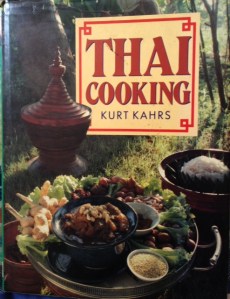
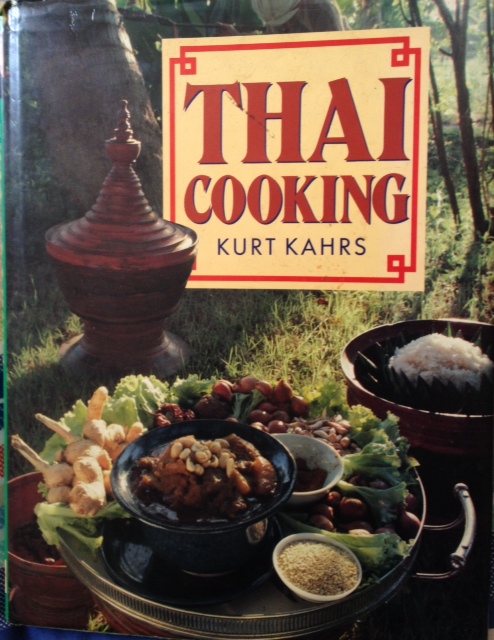
rec9Thai Cooking, by Kurt Kahrs (1990)

When I was first going to live in Thailand in 1990, I didn’t even know what the food would be like—this was before the craze for Thai food had hit Australia and the time when Japanese food, not Thai, seemed to be the most trendy international cuisine here. Before I left, my mother bought me this book and I’ve used it ever since.

I have lots of Thai cook books, since it is my particular area of interest, including two amazing books by Thomson  (describe and photograph all as a montage). But I keep going back to favourite recipes in Kahrs’s book: the khao op sapparod (pineapple baked rice), the khai phad met ma Muang (chicken fried with cashew nuts), and the lab kai (spiced minced chicken salad) among them. This book has photos for each recipe, too.

Rec2Country Cooking: Regional and traditional recipes from Europe and North America, edited by Heather Maisner (1982)

Almost all my adult life, this book has been my go-to for traditional and authentic menus from Europe and America. It’s an artistically produced book, with historical photos and information about food production. So, if I randomly let this book fall open, I come across the “Spain and Portugal” chapter, from which I would choose vieras guisadas (Galacia) baked scallops, Sopa de almendras (Andalusia) almond soup, and paella Valenciana (Valencia).

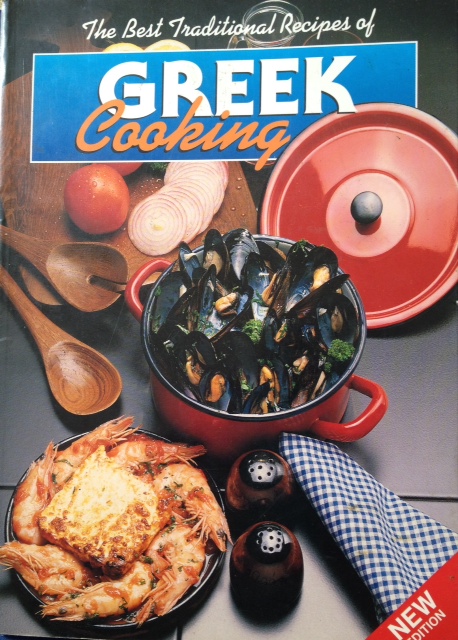
rec5The Best Traditional Recipes of Greek cooking, Editions D. Haitalis (1990s)

I bought this little gem in Athens in 1996. It has no date of publication, but the cover states that it is a “new edition”. I love Greek food, and this is the only cook book I need, really. It is full of marvellous authentic recipes of a much wider range that your average Australian Greek restaurant serves. One of my favourites is Spanakóryso, simply “spinach rice”. I make this every Christmas: don’t ask me why only at Christmas, it just seems to fit as a lovely side dish that can be eaten hot or cold. There is an error through this book, in that I think they have confused in translation the words for “teaspoon” or “tablespoon perhaps” and “teacup”: thus, we have recipes calling for “2 teacups of olive oil” in a rice dish. The book includes colour photos of many of the dishes.
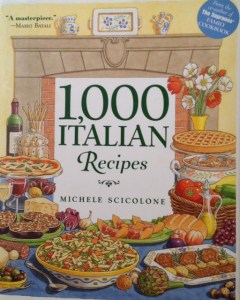
rec81,000 Italian Recipes, By Michele Scicolone (2004)

This is a newer acquisition, given to my husband and me for a wedding present in 2006 by our foodie friend Kenny over at Consider the Sauce. If you have only one Italian cook book, make it this one. It is full to the brim of authentic regional recipes, many of them simple and requiring just a few ingredients. There are no pictures, but there are wonderful descriptions of how the recipes came to be.
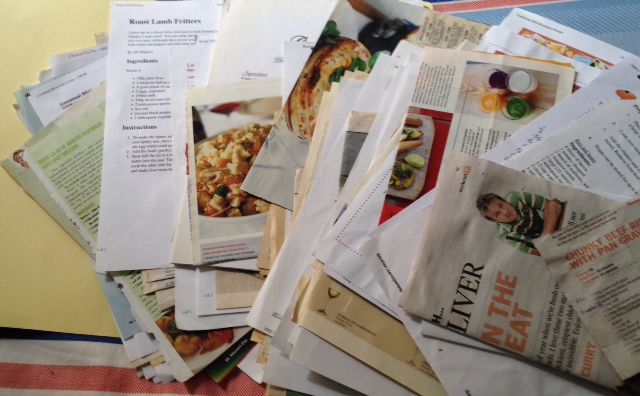
rec1The dreaded clippings folder

Probably everyone had one of these, full of recipes we’ve clipped from newspapers, magazines and printed out from websites. Believe it or not, I recently cleaned this out, throwing away years-old recipes I’d never made and now had no interest in. But there’s lots of interesting stuff in here—it’s like a lucky dip. It can take some time, though to find a particular recipe. “Now where is it? I know it’s in here somewhere…”