
These are the best photographs I’ve ever seen of Burma, magnificent in their composition, their juxtapositioning, and in capturing the moment. I walked into Burma from Thailand in the 1990s for a day, but these make me want to go back and take a proper look.
New Zealand paints a rainbow
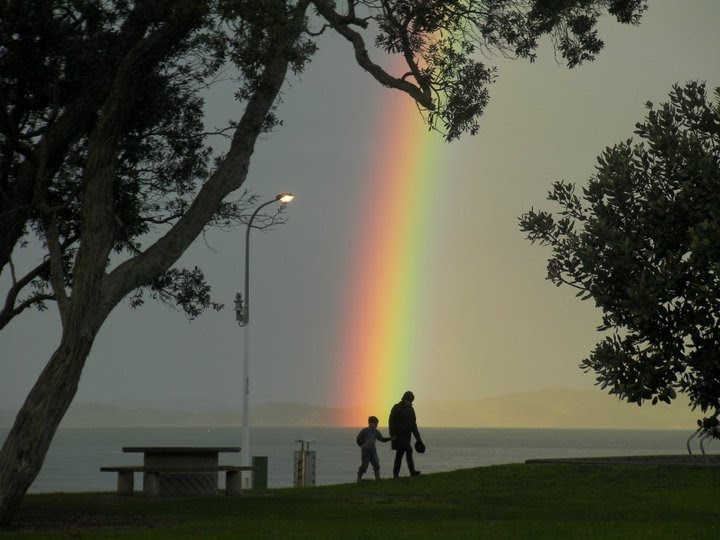
Maraetai Beach, Auckland, NZ. From Tomwsulcer & Haley Sulcer
I was thrilled to hear yesterday that my country of birth, New Zealand, agreed in Parliament to legalise same-sex marriage. This makes it the first country in the Asia-Pacific region to do so.
Although I left NZ in the late 1980s, I have never changed my nationality, I visit often and I still feel very much a New Zealander. So I am proud when I hear that NZ has taken such a big step toward equality of all its people.
NZ has many problems, like any other country, such as a growing economic division between rich and poor, outrageous real estate prices in major cities, an over-emphasis on commercialism, corporate greed and materialism in some quarters.
But it also has, at heart, a people with a generous spirit, people who believe in equality, be it in regard to gender, race or sexual orientation.
Like Flick, the “little engine that could” in the children’s story, NZ to me is the “little country that could”. This group of dots in the Pacific Ocean has certainly made its mark on the world, and I wanted to celebrate some of those firsts in my blog today. There are, of course, many more, but these are a few that I know of:
- 1893: First country to achieve universal suffrage when it gave women the vote.
- 1894: First county to enact a national minimum wage—Australia did not do this until 1907, and the US until 1938.
- 2001: First country in which women simultaneously held its three top positions of power—they were, then, the Prime Minister, Helen Clark; the Governor-General, Dame Silvia Cartwright; and the Chief Justice, Sian Elias. In fact, the top five positions were held by women if you add the attorney general Margaret Wilson and the leader of the opposition, Jenny Shipley.
- 2013: First country in the Asia-Pacific region to legalise same-sex marriage (and 13th in the world).
There are lost of firsts in terms of inventions, technology and scientific advances, too:
- 1882: First country to ship refrigerated meat (to England).
- 1884: William Atack was the first sports referee to use a whistle to control a game.
- 1919: Ernest Rutherford split the atom.
- 1954: William Hamilton invented the jet boat.
- 1961: Arthur Lydiard invented and popularised the method of fitness training known as “jogging”.
- 1987: A. J. Hackett invented bungy jumping.
NZers also invented the spring-free trampoline, the Zorb, the blokart, the circular hairpin, the cycling monorail. More: NZ innovations
But going back to yesterday’s step forward regarding human rights, I believe that in order to achieve a peaceful world, we must treat people equally. All people must have the same opportunities to live in safety and comfort, to pursue happiness, to be educated, to earn a living, and to marry the person they love. Parliament broke into song yesterday (Pokarekare Ana, a traditional love song) when the results of the vote were announced. If you missed this very moving moment, catch it here: NZ legalises same-sex marriage
I hope, too, that this step forward will prompt politicians in Australia to do the same. So far, both the federal government and the opposition are saying they will not. But it’s only a matter of time, surely.
Life in the fast lane or, revenge of the madding crowd

Platform 1, Flinders St station: Yes, it’s 7.55am and I am rushing to my second train connection of the day. Picture: Caron Dann
I thought I had left the rat race behind years ago. But for the last month or so, I have found myself having to travel to work with all the other madly scurrying rodents who must be at their desks before 9am.
I have to take two trains and a bus to get to work. It’s better than driving in peak traffic though, and parking would cost me more than $100 a week, not to mention petrol. Public transport costs me a mere $30, and for some of the journeys I can get a seat and get emails done or do some reading.
Although I live in a big city, I’ve had the luxury over the past eight years or so of being able to work from home a fair bit, or being able to travel out of peak hour to work.
When I do have to be at work early—which is four days out of five at the moment—it always astounds me just how many people there are everywhere, all trudging off to work at pretty much the same time. As they march off the train to the exits, tickets in hand to “touch off” through the gates, there’s a rhythmical stamp to their progress.
In my teens, I visited Melbourne, Australia, and was entranced by life there in what I saw as the fast lane. When I was in my mid-20s, I left New Zealand to live in Melbourne. I loved the thought of being a city worker. I felt cosmopolitan, sophisticated, excited and energised by the throngs of people, the sky scrapers and the daily rush.

St Paul’s Cathedral, Melbourne CBD, 1981: scenes like this impressed me enough as a teenager to make me move to Melbourne in my 20s.
I got a job in corporate publications at the HQ of a big bank in one of those city sky scrapers. It made me feel very “New York” when I’d get a takeaway coffee and raisin toast or a doughnut for breakfast (I could eat such things in those days). From my 23rd-floor office, I had a sweeping view of the city.
In the 1990s, I went to live in a much bigger city, Bangkok, and revelled in its great mix of culture, history, modernity and tradition.
In the 2000s, I was based in the small seaside town of Sorrento (Victoria, Australia, not Italy!). Whenever I had to go to Melbourne, the noise of the crowds and the traffic would accost my ears and I would wish to go home immediately.
I’ll never forget one fine Friday afternoon in Sorrento. I was out on a boat with some friends, and we were fishing, the three of us lolling on the deck, cutting up bait and drinking tea from a thermos. The sea was like glass, and all we could hear was its gentle lapping against the boat. On the horizon, we could just see the hazy cityscape of Melbourne. My friend squinted towards it: “There are people in all those buildings, sitting at desks and working as we speak,” he said. “Glad I’m here.” And we went back to our fishing, with no more than the thought of fresh King George whiting for dinner on our minds and whether or not to put parmesan in the crumb.
Now, I live quite close to the city centre (16 minutes by train), but far enough away that I can’t see or hear it. I can still appreciate a great CBD: a night-time skyline, cathedrals, beautiful book stores, the perfect coffee. But the daily drudgery of having to queue up, push, rush, open bags for security, have tickets checked, and so on leaves me cold. And don’t get me started about rudeness, aggression, people who don’t keep left up stair wells and round corners, and people who rush past you to grab a seat before you get it.
When I go to a city, I’d like it to be not because I have to travel through it at some ungodly hour for work, but because I’m visiting to sample all it has to offer. And therefore, it wouldn’t be at peak times. Count me out of the rat race.
Beg, Borrow, Steal – Art, copyright and the internet
Here’s a thought-provoking take on the controversial question of copyright and how old laws need to be revised to accommodate the internet.


When Shakespeare plays were originally performed, it was not allowed for audience members to bring in paper for fear that they would write down and steal the plays. To counter this, furtive audience members would go to performances and each remember different sections of the plays, then meet later and write down all they could remember. Each section was then stitched together, and the works were stolen regardless.
With the development of the printing press, pirated material began to be spread rapidly. Action was taken politically to attempt to stop intellectual property from being copied or stolen. In 1662 the Licensing of the Press Act was passed to restrict the reprinting of material without advance permission from the owners. This act planted the seed for the establishment of copyright law.
View original post 830 more words
The sound of music
This post is in response to A Word in Your Ear’s Word A Week Challenge—Music
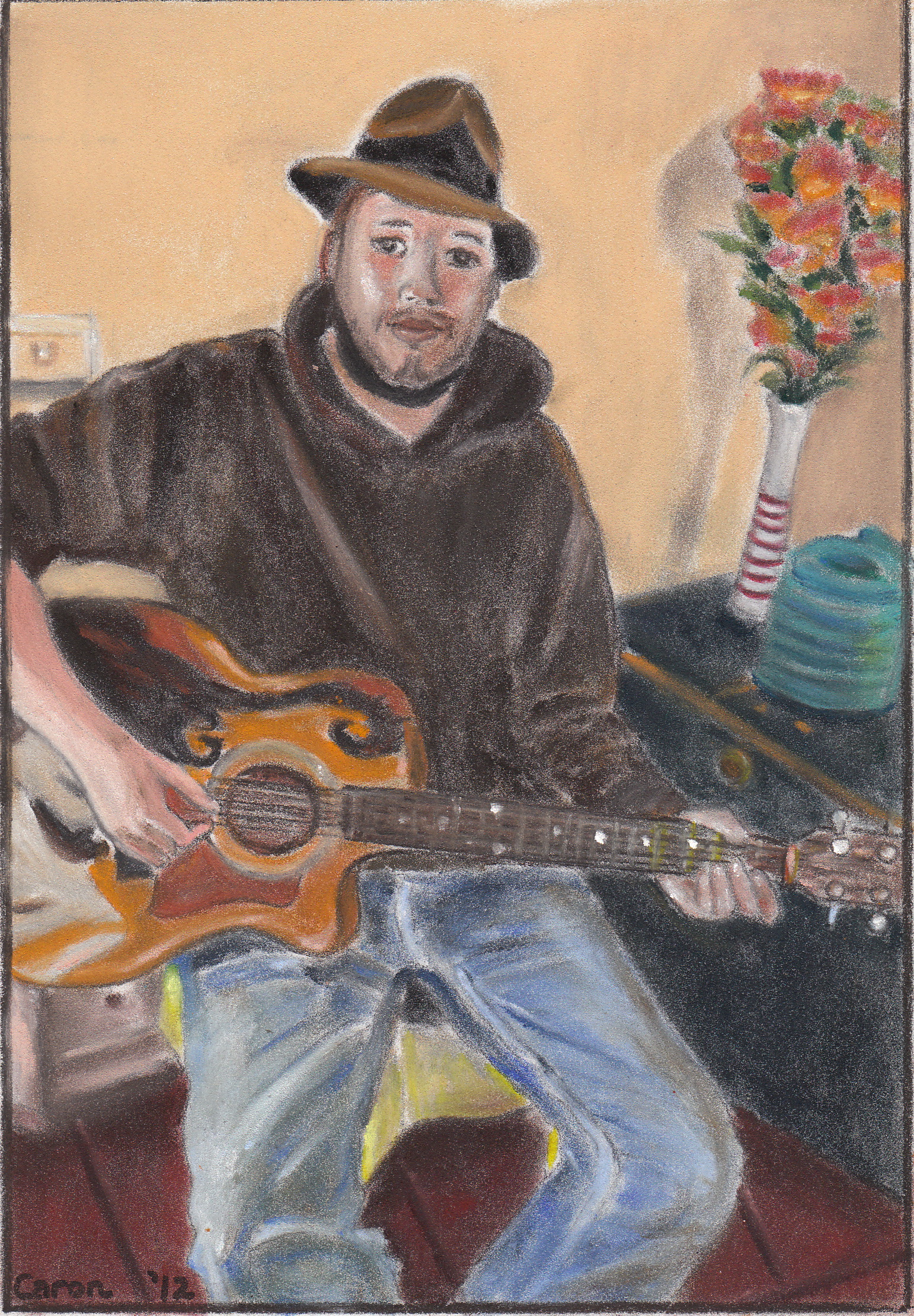
“The Musician”, pastel painting of Vorn Doolette, by Caron Eastgate Dann
I once interviewed one of Australia’s most successful performers, who had started as a folk singer but moved on to stand-up comedy. He was equally good at both, and I asked him why he chose the latter over the former.
“Well, if you’re good at stand-up, you can always get a gig and it’s possible to make a living,” he said. “But with music, you can be the most talented musician in the world, better than everyone you hear on the radio, and still not be able to pay your bills.”
Although choosing music as a career is about answering a calling, of course it has to be treated as a business if it is to be a source of income. I like the way musicians and other performers, and their supporters, are inventive when it comes to forging a career.
Late last year, my friend Sally organised a music concert in her apartment, featuring her friend Vorn Dolette, a wonderfully quirky folk-with-a-twist singer-songwriter from South Australia. Twenty of us attended the event, paying $20 each for the concert and substantial nibbles, and everyone bringing whatever they wanted to drink.
The result was an intimate performance, highly professional yet much more personal than going to a commercial venue. All the money collected goes to the performer, instead of most going to middlemen.
Afterwards, I did a pastel painting of Vorn during his concert, using a photo I took on the day as a reference. I gave the original to Sally to thank her for hosting such a special event.
Pets for Peace
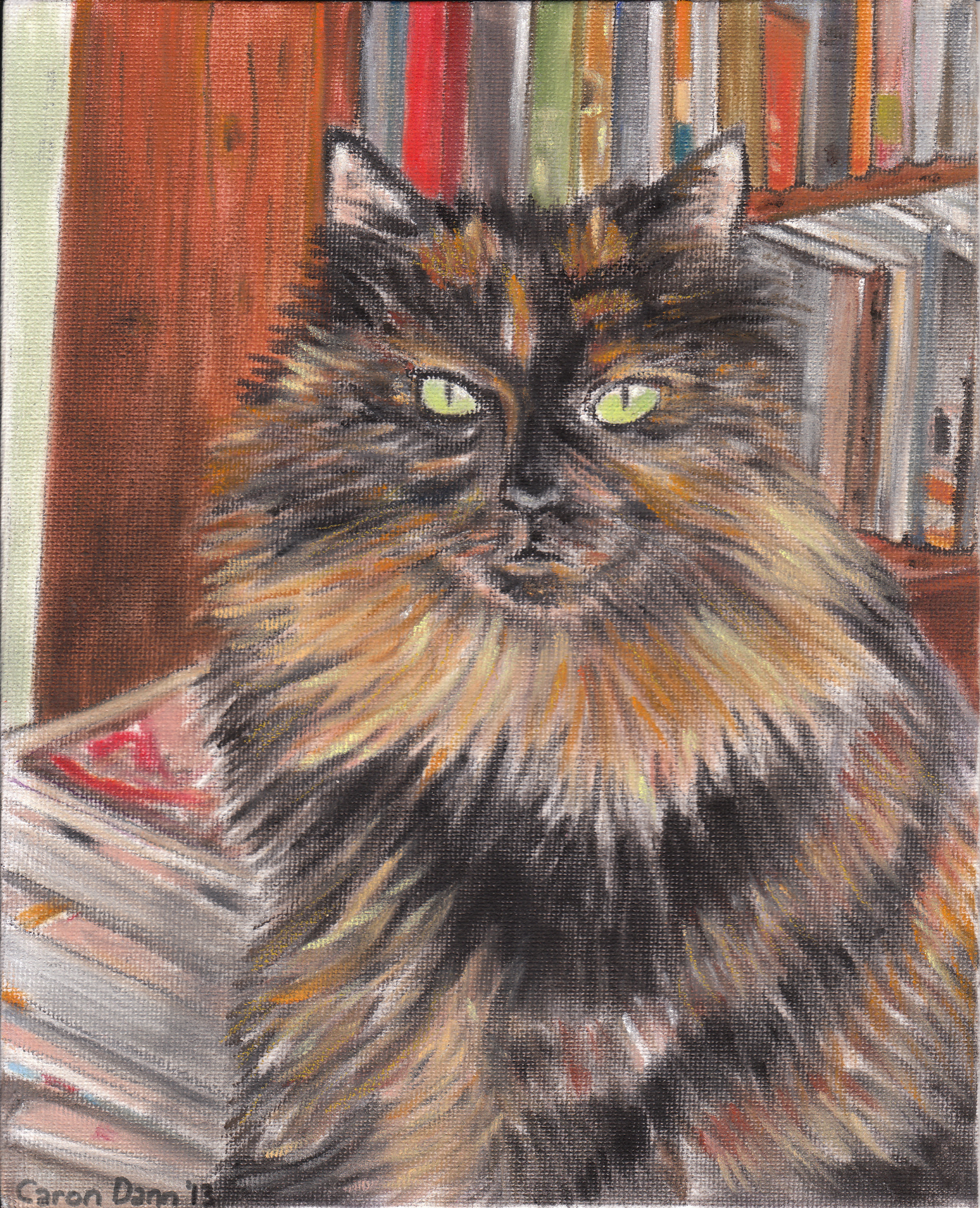
My pastel painting of my cat, Lucy Locket, who sits with me while I work
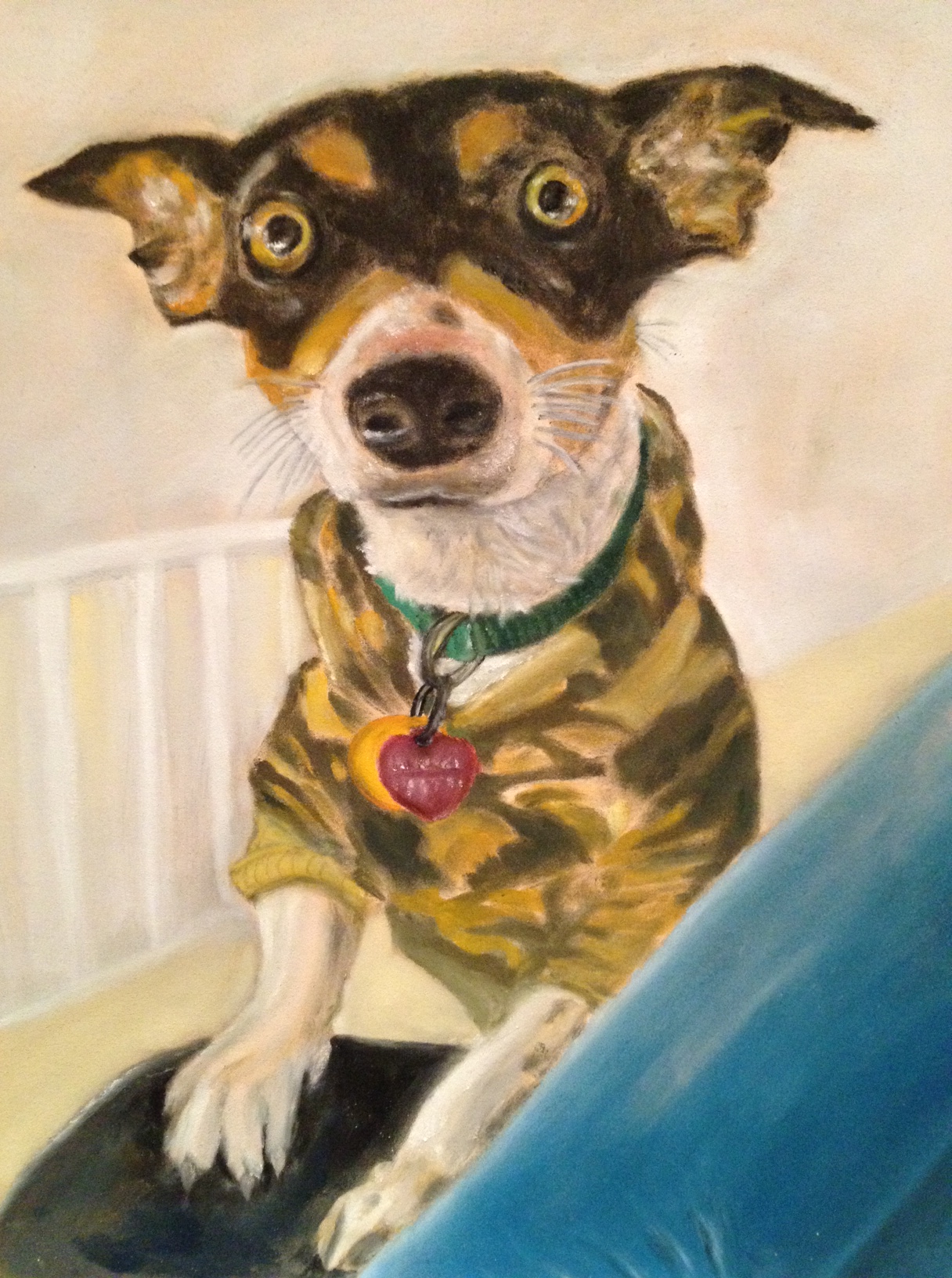
“Maggie”, my brother’s dog, rescued from an animal shelter
These two pets don’t know each other, but my mother calls them her “grandchildren”. The dog is Maggie, who lives in the US with my brother and his wife. The cat is Lucy Locket, who lives with me in Melbourne, Australia. I share my paintings of them in this post, in answer to Kozo’s Bloggers for Peace challenge this month on raising children so they know the value of peace.
In order to truly promote peace in the world, you have to be a person who knows inner peace. I believe there are few experiences in our everyday lives that give this sort of peace as much as owning a pet does.
The undying love of a dog who thinks you are perfect, no matter what; the companionship, elegance and spirit of a cat who thinks you are part of its litter (or perhaps its servant); the sweetness of a small bird that will sit on your shoulder and mimic your sounds: these are pets I have known.
I’m a cat person. I’ve owned cats since I was very young. Times have changed since I was a child and we put the (un-neutered) cat OUT for the night. These days, my cat is an indoor being, perfectly happy in our townhouse. She has an enclosed courtyard to play in, and to wistfully watch birds strut across high-up roofs. She could, if she wanted, climb the fence and run off—but she never does.
As for Maggie, my brother’s dog, she’s an American rat-terrier. They acquired poor Maggie from an animal shelter. When she had been brought in, there were signs she had recently had puppies, but no trace of the puppies. Her claws were very long and she was malnourished. After that awful start, Maggie now has an idyllic life and is devoted to her owners.
If you have a pet, you have responsibilities to look after it, to keep it safe and to give it the affection it deserves. In return, this pet will be your greatest companion.
It doesn’t matter what you look like, whether you’re fat or thin, whether you’re rich or poor, whether you did well in school, whether you are popular or not, or whether you are talented at anything. As long as you look after it—which means training, of course, especially for dogs—your pet will love and respect you.
These are good lessons for children to learn: that love and care given will result in love and care back, and that life is about much more than material things.
Living in Tomorrowland
I have a long time to work before I could consider retirement—around 20 years—and I probably won’t be able to afford to retire then anyway. I’ve always hated the word “retirement”, and thought it would never apply to me.
Instead, I’ve decided that I’m not going to wait until I retire to do the stuff a lot of people take up at that time. I’m going to somehow find the time to do it now.
Two years ago, I took up painting. Instead of sitting in front of the TV in the early evening, I now get out my easel and paints, or whatever other medium I’m using. I’ve just started an online art course from the London Art College, and I hope this will help me improve.
In the two years since I started my new hobby , I have completed more than 40 paintings. Except for the last month, when long work hours have had to take precedence, I’ve painted on about five nights a week. You can see lots of my work on other posts of this blog tagged “art”. The pictures at the top of my blog pages are all detail from paintings I’ve done, too. Here’s a charcoal drawing I did recently:

Charcoal drawing by Caron Eastgate Dann, featuring the first native-American ballerina, Maria Tallchief, as Firebird for the New York City Ballet in 1949. The reference was a black & white photograph in the 1987 book Ballerina, by Mary Clarke & Clement Crisp.
The Retiring Sort, a blogger I follow who has just celebrated her first anniversary free of work, has issued Future Challenge – Enjoying the Fun Stuff to ask bloggers to consider what they would like to do in the future or in retirement, no matter what age they are now. I think it’s a worthy topic to think about, whether you’re 20, 40, 60, 80 or older.
I say that the future is here and you shouldn’t put off these things to some far-off time when you will be “retired”. I’ve known people who have then missed out on their greatest desires, because in the meantime they’ve become ill or even died, or their circumstances have changed (such as having to become carers for grandchildren, for example).
The thing is, we never know what we’ll be able to do in future and how long we’ll be able to do it for.
One of my other ambitions was to write a blog. I had been introduced to this world by my friend Kenny at Consider the Sauce, and I wanted to try it. Despite being paid to write all my adult life, I shook off the shackles of professionalism and jumped in to the blogosphere…and here I am.
Of course, we are all time poor, and it’s hard to find time to do the basics, such as cleaning and maintenance, let alone the fancy stuff. It’s amazing though, how it is possible to find this time if you have to. Here are some ideas for clawing back some time:
*Cook in a more simple way. Not every meal has to be a “recipe”. Even if you have guests, as a friend of mine advises: “Throw some steaks on the barbecue, make a salad and bake some potatoes in the oven. They all love it”. Provided they’re not vegetarians, of course. I have lots of simple but wholesome meals I can do in a jiffy. Here’s another: slice some zucchini and fry gently in olive oil until brown on both sides; throw in some garlic and chopped fresh chilli (optional) towards the end of frying; meanwhile, boil some pasta until al dente. Combine the two, season with salt and pepper, and serve with parmesan and parsley. Sometimes I add low-fat salami to the zucchini.
*Watch less TV. I even stopped watching the news closely on some nights, though it is still on in the background. I found that the TV news wasn’t telling me anything new that I hadn’t read on line already.
*When you are watching TV, get up EVERY ad break and do something. I often paint in the ad breaks. It’s amazing how a dabble here and a dabble there can turn into a painting eventually.
*Get off line. Limit your Facebook and other internet access to certain times of the day. I do not always practise what I preach here.
*If you take public transport, get a tablet computer and use part of the commute time to send emails and so on.
*If you drive to work, consider swapping to public transport. I did that this year. Even though I have to take two trains and a bus to work most days, it takes about the same time all up as driving. The huge benefit, besides being cheaper, is that the time is my own, so I use it to read books—I can get up to 50 pages a day read—and to do my emailing and keep up with social networking.
I really want to finish writing my second novel, too. I don’t like to write at night, so somehow I’m going to have to find the time to do that. I’m thinking that less TV late at night would be the smart thing to do so that I could go to bed earlier, get up earlier on the days I’m not working, and get that novel written.
But I really like staying up late when it’s not a work night. So, I have a decision to make, don’t I?
Letter FROM my 17-year-old self
Magazine columns, websites and blogs lately have taken up the idea of asking a columnist to write a letter to their teenage self, given the wisdom they have today. My version of this is a bit different: it’s a letter from my teenage self, caught in a time warp and forgotten about for 30 years, a surprising blast from the past.
The occasion was the 30th reunion of graduates from my one-term journalism certificate course at Auckland Technical Institute (now AUT), which I was travelling to New Zealand to attend. My former classmates were coming from throughout New Zealand, from Australia and the US. From memory, about 18 of the 23 graduates were there.
We had two tutors: the formidable Geoff Black and his younger sidekick, Colin Moore. Geoff had died years before, but Colin was in his 60s, still writing and very active.
Colin was delighted to be invited to our reunion, and had made plans to attend. Sadly, just a few weeks before the reunion, he was killed in an accident, crushed between his boat trailer and his van on a boat ramp at Taupo Bay in the Far North (not to be confused with Lake Taupo).
When Colin’s children were going through his belongings, they found he had kept some of his materials from his one term of teaching at ATI so long before. Among them was an exercise we had done at the end of our course, when we’d been asked to write a paragraph about our strengths and weaknesses, likes and dislikes during the term. Colin’s children kindly contacted us and said they would send these papers to us, which would be even more poignant given it was our reunion.
I looked forward eagerly to receiving mine, written by manual typewriter on a piece of old-size journalist’s copy paper. When I received it, I was disappointed that mine seemed so juvenile. My feelings were easily hurt, I said, and I hated the thought that people might be gossiping and laughing about me—though there would have been absolutely nothing in my life for anyone to gossip about in those days, to be sure!
I thought of myself as grown up then, but instead, I reveal myself as a typical mid-teenager. In fact, I exhibit the same characteristics for which I find myself criticising young people today: lack of interest in or knowledge of current affairs, won’t watch the TV news despite wanting to be a journalist, dislike of formal tertiary study (such as lectures and exercises), and an over-emphasis on obtaining money.
My description of myself as putting on a “sweet little reporter act” to “grease people up” was perhaps something I had seen in a movie and was romanticising about: most politically incorrect, these days, but I had done a lot of acting training as a child, after all.
This is what my paper said, strengths and weaknesses on one side, likes and dislikes on the other:
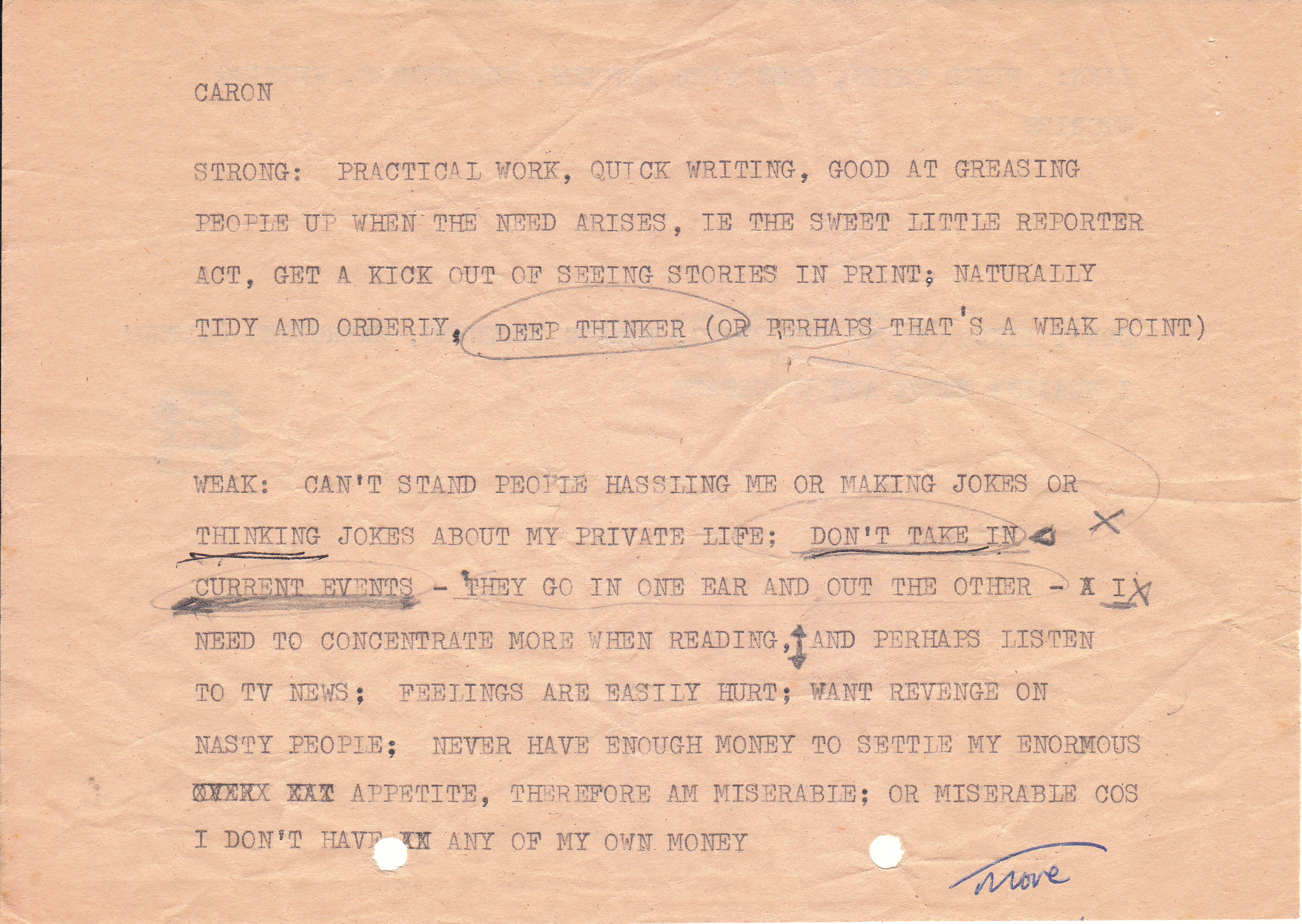
Strong
Practical work, quick writing, good at greasing people up when the need arises, i.e. the sweet little reporter act, get a kick out of seeing stories in print; naturally tidy and orderly, deep thinker (or perhaps that’s a weak point)
Weak
Can’t stand people hassling me or making jokes about my private life; don’t take in current events – they go in one ear and out the other – I need to concentrate more when reading and perhaps listen to
TV news; feelings are easily hurt; want revenge on nasty people; never have enough money to settle my enormous appetite, therefore am miserable; or miserable cos I don’t have any of my own money.

Like
Field trips, newspaper layouts, lunchtimes, writing stories
Don’t like
Court reporting, boring lectures, exercises (Altho’ I realise these are important. [sic]
The hand-written marks on the paper show my tutor did actually read it. Oh, another thing it reveals: contradictions. In “strengths”, I claim to be a “deep thinker”, yet in “weaknesses”, I say information goes “in one ear and out the other”. Colin was clearly perplexed at this, and circled it.
It seems strange that I typed this all in capital letters. But perhaps it shows I felt like shouting with frustration, as many teens do. At 17, I wanted to get on with my life, leave home (to the dismay of my family, though they supported me) and be the best journalist I could be. I knew that to do all that, I would need a living wage. I also had a weakness for beautiful and expensive clothes.
I really did wish for more than money in those days—for a start, I thought that one day, I would be a top broadcaster with my own news show, or editor of the New York Times, or a famous actor, or a scriptwriter of films. As a teenager though, perhaps I was too embarrassed to write these things. Teens often give ridiculous or non-descript answers to adults’ questions. For example, when my brother was a teenager, if my mother asked him what he’d done at school that day, the answer would be “Stuff”.
So, if I could write to myself today, what would I say? Well, I’d probably give myself the same sort of advice my parents gave me back then…to which, for the most part, I refused to listen. As my mum says, although “they don’t know what they don’t know” you can’t tell them—young people have to make their own mistakes.
Although I was disappointed at first, all those years later when I was older and wiser, in what I’d written on the scrap of copy paper, now, a couple of years later, I think it has more to say to me than I at first thought. More than anything, it teaches me to be more tolerant of young people, because once upon a time, I was just like them.
New York, 1968: “Love, Daddy”


My mother recently gave me some old cards and letters she’d kept, and among them was this wonderful postcard that my late father had sent me when I was a little girl, in 1968. Dad was in the New Zealand army, but we were living in England where he was doing some research at York University, and he had gone to New York on business. This might well be the first piece of mail I ever received addressed to me personally.
It is dated 24.6.68, and he writes:
Dear Caron,
My hotel is just along the road from this big building, and after lunch today, I am going to go right up to the top. I will take some movies, and you will be able to see them when I get home. Love, Daddy.
It reminded me of a much earlier letter I have, from another father to his young child. It is addressed to “My dear little man”, and it was written by my grandfather, Captain Freddy Eastgate, to his son, my father Harold Eastgate (later Captain as well). Dad was 5 when this letter was written to him by his dad, who was a career army man. Years after this letter was born, my grandfather would be away for seven years at the Korean War and with the army in Japan.

Hut 150
Trentham M. C.
Saturday 16-5-42
My Dear Little Man,
I thought you would be almost better by now. I sent you a small parcel last Sunday but it doesn’t seem to have arrived there yet. There is nothing in the camp much to buy or send to little boys. I hope you are getting better. Try and be a good boy and help Mummy as much as you can. I am going to try and get home to see you next week end. You try and get better by then aye.
Cheerio for now.
Lots & lots of love from
Daddy xxxxxx
I wonder now what was in the parcel and if Dad received it. Dad kept quite a few things from when he was young, so it’s possible whatever it was is still among his possessions, most of which my mother kept.
You’re never too old to dance
 I went into a gift shop at my local plaza, and ahead of me was a very old lady on a walker. She was little and stooped, and didn’t appear to take much trouble about how she dressed. She was wearing an old cardigan and her hair was a little dishevelled. She handed over some money, then turned to make her way slowly out of the shop. I noticed that her eyes were shining.
The assistant had to tell someone. “See that electronic juke box in the window, the one with all the flashing lights? She’s put it on layby and she’s only got two more payments to make. She’s saving money each week from her pension.”
Is she buying it for a grandchild or something?” I said.
“No—it’s for herself, she says.”
The juke box was $999, an enormous amount of money for a pensioner to pay, even by layby (paying it off in fortnightly instalments).
The old lady was, the assistant said, the most unlikely purchaser for such a thing, and not only because of the expense. “I think she’s suffering from dementia a bit—we couldn’t believe she’d actually see all the payments through.”
I took a picture of the juke box that day, the one at the top of this post.
A few weeks later, I visited the shop again. The juke box was still in the window. “Has she paid it off yet?” I asked.
“Not yet—one more payment. She asked us to put some music on it. I used a flash drive to download a whole lot of songs, which I’ll give to her and all she needs to do is plug it into the juke box,” the assistant continued. “She says she’d like all the old hits from the 1940s and 1950s.”
Another few weeks went by. I walked past the shop and noticed the juke box was gone. I had to know.
“She paid it off today and it’s being delivered to her flat,” the assistant said. “Now she wants more music.” She rolled her eyes.
I have an enduring vision of the old lady young again and accompanied by a handsome beau, playing her juke box and, in her mind, dancing the night away to Chuck Berry, Jerry Lee Lewis, Bo Diddley, and the Platters.
Rock on—you’re never too old to dance.
A White Sports Coat…And a Pink Carnation
 The Crayon Files