The World’s Most Romantic Present

Rom1Of these three, which do you think would make the most romantic gift? The French perfume, the diamond and Burmese ruby ring, or the pencil sharpener?

Yes, you’re right: the correct answer is…the pencil sharpener. For me, anyway.

This is pretty much my favourite present this Christmas, given to me by my husband, Gordon. I’ll tell you why it’s romantic.

Nearly three years ago, I took up art as a hobby. I use lots of media, including pastel pencils, and I’m about to start using coloured pencils.

Now, I think doing art is quite romantic in itself. Out of a few tubes, cakes or pencils of colour, a piece of paper or board and some brushes or sponges, you can create pictures that move people to cry or laugh, that remind them of their favourite things, that inspire them to become creators themselves. Potentially, anyway, if you’re Leonardo Da Vinci. In contrast, my paintings are much further down the evolutionary scale and very much those of a novice without wings. But you get the idea.

Anyway, I am always having trouble with my pencils. The leads are always breaking off, new pencil sharpeners quickly become blunt, or aren’t quite the right size, or don’t sharpen to a point. In the last year, I’ve probably bought 10 pencil sharpeners. Gordon has become used to me walking round the house, looking for another sharpener, and muttering about how useless they all are. I have entire conversations with myself about pencil sharpeners. Only artists will understand what I mean. And they do: there are lots of online discussions about pencil sharpeners, I’ve discovered. If you can’t get a sharp point on your pencils, it can seriously affect the quality of your art.

Romance2Furthermore, I recently bought these expensive coloured pencils which are sold unsharpened. To be fair, this set comes with its own little pencil sharpener that is quite good. However, it is laborious using such a small implement: I managed to sharpen three out of 72 before I got sick of it!

Anyway, when I opened my presents at Christmas, the one with the free-standing pencil sharpener was very exciting. All the online forums talk about the X-Acto sharpener, and here was one for me, complete with its vacuum mount and its eight-hole choice for pencil sizes.

This will make my little creations easier and better. More importantly, we will be a more peaceful household minus the mad ravings about the hazards of pencil sharpening.

Thanks, Gordon

The Steampunk Capital of the World: who would have thought?

Steampunk HQ in Oamaru's Victorian precinct.  Picture ©Caron Eastgate Dann 2013

Steampunk HQ in Oamaru’s Victorian precinct.
Picture ©Caron Eastgate Dann 2013

There was a surprise waiting for me on my recent trip to Oamaru, a coastal town of 13,350 people in North Otago on New Zealand’s South Island. I’d known before going that it had a “Victorian precinct”, an old part of the town down by the docks that had been restored as a tourist area to show off its handsome 19th century buildings.

What I didn’t know is it had also become steampunk territory: in fact, it is the declared “steam punk capital of the world”.

What is steampunk? It’s basically an art and aesthetic movement inspired by the industrial revolution and Victorian times, with an added science fiction element: think Jules Verne and H. G Wells originally, and more recently, Phillip Pullman. There are also films, TV shows, plays and music that are considered “steampunk”, including, for example, Rock ‘N’ Roll Train by the Australian band AC/DC and—wait for it—Justin Bieber’s version of Santa Claus is Coming to Town, as seen in the 2011 film Arthur Christmas.

This was a brilliant marketing idea for Oamaru, and people come from all over the world to see the precinct. I went to Oamaru this month during a week spent in Dunedin (where I was born but spent only the first three weeks of my life).

There is an annual  Steampunk NZ Festival here too, the next from May 30 to June 2, complete with an “absinthe night” and penny-farthing lessons. Tickets are pretty reasonably priced—$200 for an adult passport to everything, including food, for example. Read more on this here.

I have a few relatives in and around Oamaru, so after morning tea with my first cousin-once-removed, Ella, who has lived in the town for all of her 80 years, I took a 10-minute stroll down the hill to visit the Victorian precinct. Here’s what it looked like as I was walking towards it:

Approaching Oamaru's Victorian precinct from ??? St.  Picture ©Caron Eastgate Dann 2013

Approaching Oamaru’s Victorian precinct (starting with the last building on the left) from Wansbeck St.
Picture ©Caron Eastgate Dann 2013

The precinct is very busy on weekends, but I visited on a weekday, when it was quiet and when the shopkeepers had time to chat to each other and me. Steampunk here seems to be, for many, a way of life rather than just a style.

Steampunk Oamaru's main street.  Picture ©Caron Eastgate Dann 2013

Steampunk Oamaru’s main street.
Picture ©Caron Eastgate Dann 2013

There are loads of extraordinary galleries here, including the most famous, owned by Donna Demente, a top NZ artist who has settled in Oamaru. She is attributed with driving much of the fine-arts revival in the town, including the annual mask festival. I visited her wonderful Grainstore Gallery, which even allows visitors to take photos, so here are mine:

Donna Demente's Grainstore Gallery, Oamaru. Picture ©Caron Eastgate Dann 2013

Donna Demente’s Grainstore Gallery, Oamaru.
Picture ©Caron Eastgate Dann 2013

Donna Demente's Grainstore Gallery, Oamaru. Picture ©Caron Eastgate Dann 2013

Donna Demente’s Grainstore Gallery, Oamaru.
Picture ©Caron Eastgate Dann 2013

Donna Demente's Grainstore Gallery, Oamaru. Picture ©Caron Eastgate Dann 2013

Donna Demente’s Grainstore Gallery, Oamaru.
Picture ©Caron Eastgate Dann 2013

There are several other steam punk-themed events through the year. If you want to know more about Oamaru’s steampunk revolution, take a look at this fabulous video I found on by Anna Repp:

The first book I bought

The first hardback book I remember buying myself was A Little Princess, by Frances Hodgson Burnett, for the princely sum of $3.25 in 1975. I remember seeing this book in the window display of a children’s bookshop in Mission Bay, Auckland.

I was living with my grandparents for a year while my parents were overseas, and they had sent me some money for Christmas. I spent the bulk of it on this book, and it still sits in my book case today. I thought the cover quite the most beautiful I’d seen. I had first been entranced by this story when I saw on TV the Shirley Temple movie adaptation from 1939.

My edition of The Little Princess was published by Platt & Munk in 1967, though I didn't buy it until 1975. The dust jacket says the artist is Stewart Sherwood, a 24-year-old Canadian, who despite his youth had already won many awards for advertising art and had been published in books and magazines across the US and Europe. (Googling Sherwood reveals he is still an artist, painting designs for books, cards and collectable plates. You can see more of his artwork here). This is why I always like books with dust jackets: they contain information not elsewhere in the book. One library I frequent infuriates me by removing all the dust jackets, instead of covering them and leaving them with the book.

My edition of The Little Princess was published by Platt & Munk in 1967, though I didn’t buy it until 1975. The dust jacket says the artist is Stewart Sherwood, a 24-year-old Canadian, who despite his youth had already won many awards for advertising art and had been published in books and magazines across the US and Europe. (Googling Sherwood reveals he is still an artist, painting designs for books, cards and collectable plates. You can see more of his artwork here). This is why I always like books with dust jackets: they contain information not elsewhere in the book. One library I frequent infuriates me by removing all the dust jackets, instead of covering them and leaving them with the book.

I saved my pocket money to buy books from the age of seven. Dad gave me 10c a week, pitiful even in those days. My parents didn’t really believe in the concept of pocket money, but conceded this miserly amount when I insisted. I then made a case that, because I was older than my brother, I should receive more than him. Dad reluctantly gave me 11c a week, provided I never divulged the raise to my brother. How I wanted to gloat to my brother…but couldn’t, lest the extra 1c be removed.

This edition, published in 1970 by Green Knight (but first published in 1942 by Hodder & Stoughton) has a list of prices for different countries of the British commonwealth on the back: UK 3/- (shillings) or 15p, Australia and New Zealand 45c, South Africa 40c, Canada 65c.

This edition, published in 1970 by Green Knight (but first published in 1942 by Hodder & Stoughton) has a list of prices for different countries of the British commonwealth on the back: UK 3/- (shillings) or 15p, Australia and New Zealand 45c, South Africa 40c, Canada 65c. The book was illustrated by Eileen Soper (1905-1990), who was also a writer and illustrator of children’s books in her own right, and a founding member of the Society of Wildlife Artists in the UK.

My favourite paperbacks were the Famous Five and Secret Seven series, written by Enid Blyton in the 1940s. I loved the idea in them that children could make a difference, could have a whole world beyond the realm of their parents, and could go on exciting adventures without the presence of adults.

I always keep price tags on the books I buy, and have done since I was a child, because I find pricing very interesting years later.

I still have one of the first books I bought, Five on a Treasure Island, which the back cover tells me cost 45c in the early 1970s. I had to save my pocket money for five weeks to buy one of these (with enough change to buy several 3c lemonade ice-blocks in the summer). I would read the book in a day, then read the best bits again, and prepare for the almost interminable wait of five weeks between purchases. It was always worth the wait!

Call me a Kiwi—but not a bird or a fruit

Photo © Caron Dann, 2013

Photo © Caron Dann, 2013

When I was five, my family and I left our South Pacific island home of New Zealand and went to live in England. My school, in Heslington, York, had a Christmas school performance and I coveted the role of the angel, because I would get to wear a lovely white satin gown and a tinsel halo. I was very upset not to get that role. Instead, I would be part of the procession, which celebrated all different nationalities of the British Empire. To add insult to injury, they made me parade in dressed as an Australian, complete with a hat with corks on strings (worn in Australia to ward off flies). I hated that: they didn’t understand that Australia and NZ, though collectively known then as “the Antipodes”, were very different countries. I can still remember walking in that procession, to the applause of all the parents seeing their little darlings dressed up so prettily, but feeling so humiliated, I wanted to cry. The teachers felt sorry for me and let me take the angel costume home for the weekend.

Ironically, I have ended up spending much of my life living in Australia, and I love it. Although I was born in NZ, I’ve spent a little less than half my life there. I’ve also lived in the US and Thailand.

But I identify most of all with being a New Zealander—or Kiwi, as we’re colloquially known. I’m at least sixth generation, which for a pākehā (white NZer) is a lot. The name “Kiwi” is, of course, after our unique national bird, the kiwi. Americans in particular might know better the fruit, which they call “kiwi” as well, but we always call “kiwi fruit” now. When I was growing up though, it was known as a “Chinese gooseberry”, because it is native to China, not NZ—the Kiwis just came up with a brilliant marketing idea!

I love being a New Zealander, and even though I haven’t lived in my home country since 1988, I go there every year or two. I always enjoy flying in and seeing that green, green grass of home, to steal a line from a famous song.

Australians and New Zealanders can tell each other apart in a moment by our accents. But much the same as Canadians and Americans, we often get mistaken for the other by outsiders. I knew I must have picked up some Australian vowel sounds a few years ago, when someone in Auckland, NZ, said to me, “Are you Australian?” But most Australians can pick me straight away as a Kiwi.

As well as nuances in our accent, we have lots of different sayings and terms for the same thing, and that’s what I illustrated in the photo on this post. So, “jandals” in NZ are called “thongs” in Australia, and “flip flops” in England. They’re those rubber sandals held on with a thong between the big and second toes.  The term “jandals” is never used in Australia, except by New Zealanders who want to be laughed at, but I’ve gone back to it. The word is perfect for this type of footwear, and was originally a trademark made in the 1950s from a description of the product’s origins, “Japanese sandals”.

We have a few NZ shows on TV in Australia now, and this has put me in touch again with our vernacular. If we like something a lot, we say “Choice!”, but we often pronounce it like “Choooooooooiiiiice!”. (The opposite is “Stink!”). And if we’re cool with arrangements, such as “I’ll pick you up at 7 and we’ll go to the movies”, we say “sweet AS”.

This post was written for Rara’s International Label Day post, in which participants identify themselves with labels, which I reckon is choice! Anyway, if you want to take a look at all the other cute labels in that post, you can access them here, OK? Sweet as!

Odd Things I Own #1

My home is a sanctuary: when I close the door, I’m in my own private and safe world, shared with my husband and cat. I have all my books around me, plus a lot of quirky mementos, souvenirs and collectables. More than quirky, some of them are patently odd, but that’s why I like them. Here are a few of them:

Osbourne dolls

You’ve had a quick glimpse of my Ozzy talking-head doll before; now meet the whole family: Ozzy, wife Sharon, and children Kelly and Jack. These were sent to me by  a TV network to promote the reality show The Osbournes in 2002. They talk—or did. The batteries on three have worn down and I suppose I should get them replaced. Sharon still says “Shut the —- up and go to bed”, “The wicked witch has nothing on me”, and “Did anyone feed the dogs?”

Osbournes talking-head dolls

Lucky leprechauns

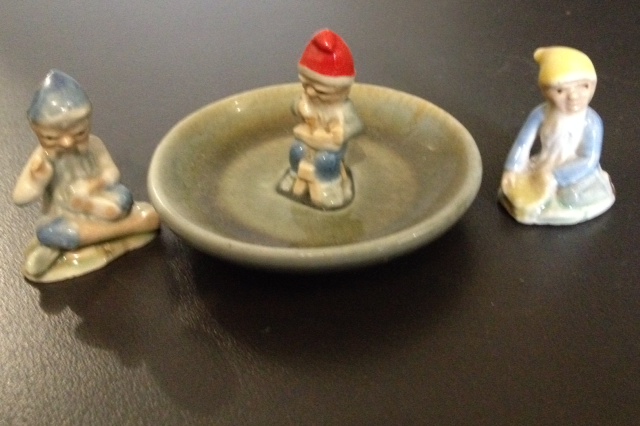
When I was a girl, my paternal grandmother gave me three little Wade Irish Porcelain leprechauns, which she said were lucky, but only if you had all three. They had red, yellow and blue hats. I took these leprechauns everywhere with me, through various countries, many houses and flats. Then, in 2000, a cleaner broke one of them, knocked the head clean off the red one, and the head had just disappeared. A short while later, I happened to look into the window of an antique shop, and there I saw a little red-capped leprechaun. He was sitting on a small dish, but no matter, I had to have him, and my set was complete again.

photo 2

Lou and Andy from Little Britain

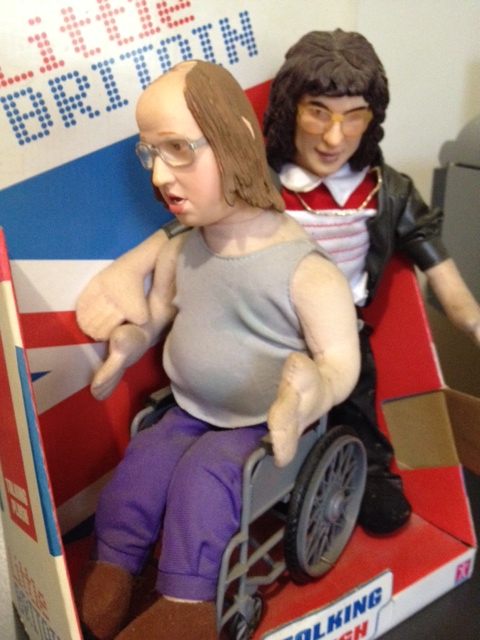
If you’ve seen the British comedy show Little Britain, you’ll already be laughing at these plush toys of two of the most popular characters: Lou (right) in his fake-leather jacket and gold chain, carer to Andy, who’s only pretending to be in a wheelchair. If you squeeze Andy’s hand, he says some of his famous lines: “I don’t like it—I want that one”, “Yeah, I know”, and “MONSTER TRUCKS!”. And not to forget carer Lou’s “What a kerfuffle”. My husband bought me these two because he knew how much I enjoyed the show.

photo 1

Mini shopping trolley

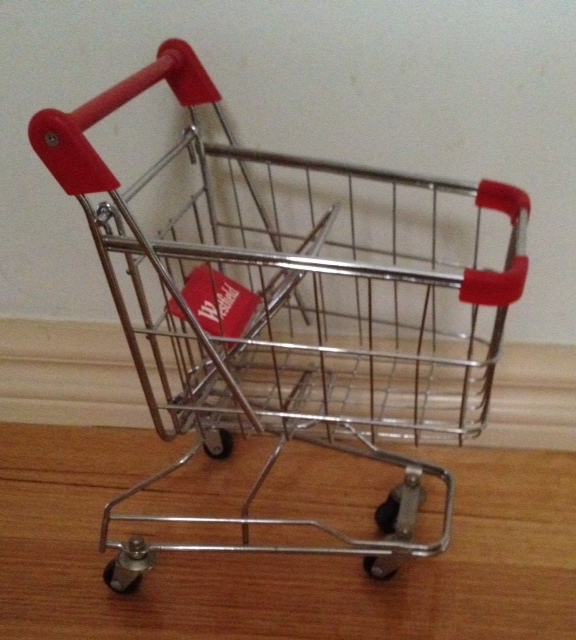
This was sent to me by a PR company about 10 years ago to promote a shopping centre. It’s a perfect working model in every way. At the moment, I use it to house a mermaid doll or two (that’s a story for another day), but I always thought it would make a great alternative fruit holder in the kitchen.

photo 5

Coral and Lucy Locket

My cat, Lucy Locket, puts up with my odd possessions and knows which toys in the house are hers and which are mine. She’s not that fond of Coral the witch, but I love her. Coral is a handcrafted witch doll from Wellington, New Zealand, who was given to me by my lifelong friend, the New Zealand actor Yvette Parsons. Have a look at this clip of Yvette talking early this year about one of her current touring productions, Dolly Mixture, which features a strange lady of a certain age who loves collecting dolls…

As for Lucy Locket, she’s in this post because, by her very species, she is decidedly odd.  Someone who perfectly describes the oddness of cats is fellow blogger Goldfish from Fish of Gold. In a guest post on Merbear’s blog Knocked Over By A Feather, Goldfish said, “…all cats are whack-a-doodle. Every single one of them is weird as all get out. They may be insane in different ways, but all cats are completely deranged, and when you get down to it, it’s totally bonkers that we allow them in our homes.”  You can read more of her post about the weirdness of cats here.

LucyCoral

Shower cap cat

A present from my mother that is…well, just odd. But there’s something about it that I really like—its madness, I suppose.

photo 4

Plenty more where they came from. Watch this space…

Sideshow alley and the silver dollar

The Caryon Files

At the Royal Melbourne Show, 2013. These days, it’s $5 a game (five balls). There aren’t many prizes there worth more than that… Picture by Caron Eastgate Dann, 2013

When I was a girl living in Auckland, New Zealand, we went to the Easter Show every year. What fascinated me most  was the sideshows section: the clowns with open mouths that you dropped table-tennis balls down in the hope of getting enough points for a soft toy; shooting tin ducks as they rolled out in a row; trying to fish things out of paddling pools; throwing rings around various prizes…I loved it all.

I particularly liked the rows and rows of cheap trinkets for sale. My favourite was the doll on a stick. I don’t know why: maybe it was the glitter that made them look so appealing. Anyway, I never got one. But then again, I probably never asked for one. Children didn’t, in those days. You just hoped your parents would somehow know that you desperately wanted something, and that they would magically buy it for you.

I was reminded of this because this week, my husband and I went to the Royal Melbourne Show. I haven’t been since I first moved to Australia more than 20 years ago.

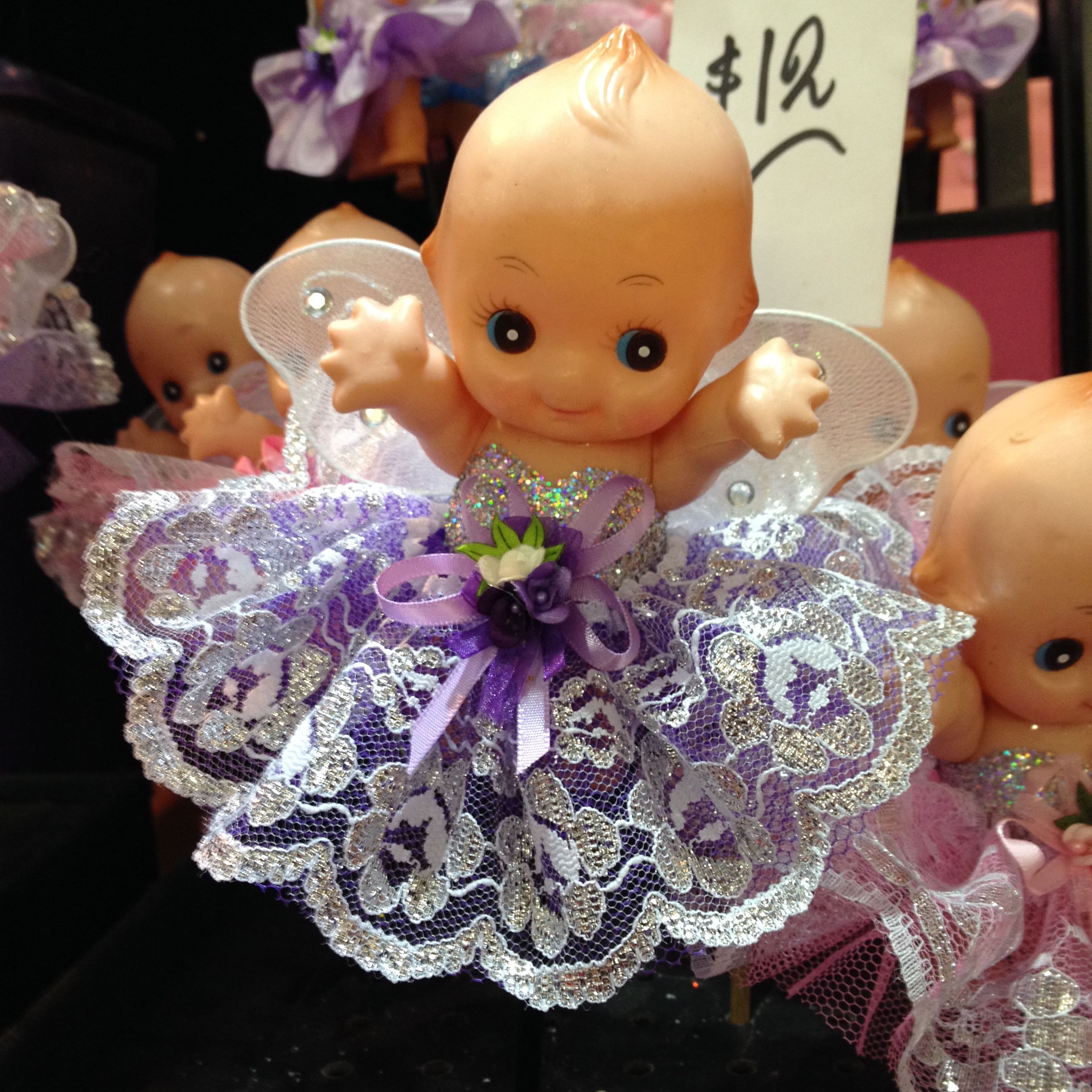
And there they were: the glittery dolls on sticks. There were Kewpie dolls, mermaids, fairy dolls and more. I could have one for $8 or $12.

I didn’t buy one. Instead, I took these photos, which as my husband remarked, we could send to our digital photo frame that sits in our living room:

Picture by Caron Eastgate Dann, 2013

Picture by Caron Eastgate Dann, 2013

IMG_2129

Picture by Caron Eastgate Dann, 2013

Despite all those childhood memories of candy floss (cotton candy), dolls on sticks and clowns in a row, I think the music died for me in regard to sideshow alleys the day I learned a lesson about longing for valueless trinkets.

We were living in Pacific Palisades, Los Angeles, and I was 11. One weekend, there was a local fair and my brother and I were allowed to walk down the road to it. We both had a couple of dollars saved up, and that would be enough for some games and some forbidden confectionery (our dad was a dentist).

At one toss-the-hoop game, I was mesmerised by a plush soft toy that I was determined to get. I was nearly there, just narrowly missing it on my last attempt. The stallholder felt sorry for me.

‘You can buy it, if you want,” he said.

“How much is it?”

“A dollar.”

I was crestfallen. I had nowhere near a dollar left. Then I thought of a great idea, and a way to get that toy.

“Would you accept a silver dollar?” I said. “I have one at home. I could go and get it.”

The stallholder should have said no. Instead, he said, “Well all right, if you want to do that.”

For those who don’t know, a silver dollar was a US coin, some versions of which were made of 40% silver and 60% copper (thus worth more than its face value). They were made by the US mint for collectors, and were not much circulated. My grandparents had visited us in LA from New Zealand recently, and we’d taken them to Las Vegas. My grandmother put a small amount of money in a slot machine and…out came tumbling 20 Eisenhower silver dollars. She gave one to me and one to my brother. It was the sort of thing you would keep forever because your grandma gave it to you.

But off home I went, into my little box of treasures, fished it out and back to the show with it, where I paid for my coveted toy.

You know, I can’t even remember today what that toy looked like. I do remember many years later, as an adult, throwing it away in disgust because I wished I’d kept the silver dollar.

I inherited the other silver dollar from my brother, Phillip, who died at a young age. But it just wasn’t to be. Years later, thieves broke into my house and stole just about everything portable, including my jewellery boxes with their sentimental bits and pieces, Phillip’s silver dollar among them.

So now I go to shows and just look. I keep my dollars in my purse—even though they’re not glamorous Ike silver dollars, but just plain old Australian copper $1 coins.


I, Robot or, “Danger, Will Robinson! (“Exterminate! EXTERMINATE!)

The Space-Robo, made in Japan by Tomy, 1969.

The Space Robo, made in Japan by Tomy, 1969, and bought for my brother.

When I was a kid, robots were all the rage. Before the digital age, before the time of personal computers, they had a kind of mystique about them.

This was encouraged by the romanticisation of robots on screen as either heroes or villains. The loyal bodyguard-type robot in the 1960s series Lost in Space, which I saw in endless repeats in the 1970s, was endearing and long-suffering, as Dr Smith referred to him variously as a “Neanderthal ninny”, a “blithering booby”,  a “nickel-plated Nincompoop”, a “tintinnabulating tin can” and many more sensational insults (you can see more of them here).

On the other hand, the robot-like daleks in Dr Who were just about the scariest things ever to me as a child. This is one of the earliest TV series I remember—and I didn’t even watch it. In fact, I refused to watch it with Dad, so horrified was I by it and everything about it—even the opening music. In the middle of the night, I sometimes awoke, imagining a dalek was coming to get me, screaming “Exterminate! EXTERMINATE!” as it came inescapably closer. Interestingly, although the daleks appeared to be robots, they were actually supposed to be cyborgs, that is a biological entity enclosed by a protective metal shell. Whatever—to me, they were robots.

Then there was the demonic H.A.L. 9000 in the 1968 film 2001: A Space Odyssey (“Dave, this conversation can serve no purpose any more. Goodbye”), which I didn’t see until the 1980s. Today in 2013, H.A.L.’s most chilling lines are featured on a phone app I have.

We imagined, in the 1970s, that by the year 2000, real robots would be attending to our every need. Robot servants would be cooking and cleaning for us, so we were free to go off to school or work in our personal flying car. Blame The Jetsons for that one!

I was reminded of “the robot age” of the mid-to-late 20th century yesterday, when I visited my mother. I happened to go into her spare room, where she stores toys from her three children’s youths. I spotted the robot pictured above, and it brought back memories of long ago. This one belonged to my late brother Phillip, and came complete with flashing lights and battery-powered action.

While researching this story, I came across The Old Robots Web Site, dedicated to the first wave of robotics. It includes an impressive array of “educational and personal robots” from the 1940s-90s, which you can see here. On this website, I discovered that the robot at my mum’s house is a Space Robo from 1969, made in Japan by Tomy, and part of the “Lighted Magic Dial” series.

We were living in England then, but Dad had been on a business trip to New York, and I think it was probably there that he bought the Space Robo, which is now, apparently, a rare collector’s item. I wish we had kept the box!

In praise of the beige cardie

In one of my favourite blogs, Coming of Age, by the Australian journalist Adele Horin, I read recently that the epitome of dowdy, middle-aged dressing is a long beige cardigan. Oh no, I thought, I love a long beige cardie. In fact, I was wearing mine as I was reading that blog.

When I was growing up in New Zealand, you didn’t hear the term “beige” for clothes: it was called “fawn”. Beige has become synonymous with boring, but I’ve worn beige all my adult life—or colours that approach it—including in my late teens, 20s and 30s, when I was considered quite a snazzy dresser and spent most of my disposable income on clothes.

There were the Chanel-inspired beige and black court shoes; the beige full-circle skirt and matching top; the beige safari suit from my favourite shop, Hullabaloo, in Queen St, Auckland, that cost me a fortune when I was 16 and which I had to pay off over about two months (called “lay-by” in New Zealand).

And now, the long beige cardigan. Hmmm. To be honest, I usually only wear this garment when I am working from home. Here it is:

"Beige cardie in sanguine, sepia, burnt sienna, raw umber and titanium". PanPastels and Charcoal on pastel paper. © Caron Eastgate Dann, 2013
“Beige cardie in sanguine, sepia, burnt sienna, raw umber and titanium”. PanPastels and charcoal on pastel paper.
© Caron Eastgate Dann, 2013

I sketched it using pastels and charcoal—none of them called “beige”, but rather sanguine, sepia, burnt sienna and raw umber, mixed with titanium.

I have had many beige cardigans, some of them rather swish-oh. A beige jacket is also a great choice when white is too stark and black too dark. And beige trousers are a trans-seasonal wardrobe staple, when white is too summery and black too wintery.

Googling this colour tells me there is no actual one hue that is beige. It is a generic name for a whole range of light browns. Beige is a neutral that looks good with just about any other colour, including black, brown, white, green, orange, purple and navy. I once had a bespoke beige suit that I wore to work with a turquoise Thai silk blouse.
Beige is my friend. So I wonder how it came to be considered boring, dowdy and “middle aged”?

The perfect inventions: top 11

Apart from the ancient essential inventions, such as the wheel and fire, and the obvious modern inventions, such as antibiotics and X-rays, and world-changing new media, such as the internet and computers, what are the inventions that make our everyday life better than it would otherwise be? What are the inventions that just can’t be beaten? I’ve made a list of some of my favourites. To make the list, they had to have longevity, be sturdy if not unbreakable, be cheap and provide an essential function. Here, then, are my top 11 inventions, in no particular order.

 1.Transistor radio: you need never feel lonely and a couple of batteries will last for a very long time. I have a transistor in the bathroom. Steam from the shower doesn’t bother it, I don’t need to pay anything or use up any data to listen to live radio shows at any time of the day or night. I can get news, real current affairs, interviews, travel updates, music, talkback, lifestyle information, comedy and more. Even my cat likes to sit and listen to the radio.

Radio Lucy: my cat likes to listen to the radio. I've heard they also like a CD, and there are some specially made for cats. That might be taking it a bit far. Picture © Caron Eastgate Dann, 2013.

Radio Lucy listens to the morning pet show on the radio. I’ve heard they also like a good music CD, and there are some specially made for cats. That might be taking it a bit far.                                  Picture © Caron Eastgate Dann, 2013

2. Ballpoint pen: doesn’t go forever, but goes for a long time. Tiny, and never needs batteries. A $20 bundle of pens from the Post Office shop has so far lasted me 10 years. Granted, I don’t hand-write much these days, but there are doodles, occasional lists, scribbled reminders, class rolls. Great books have been written with one of these. Roald Dahl wrote by hand in his garden shed. Students with late essays would never be able to use the excuse that their “computer broke down”.

3. Paperback book: probably the most dodgy on the list, because people will say that ereaders have superseded it. Well, not necessarily. I love my Kindle and my iPad for reading, too, but they have limitations. Obviously, with the iPad, its battery life is a problem (though some flights now allow you to recharge). And with the basic Kindle, although the battery life is great, you still can’t operate electronic gadgets when a plane is taking off and landing, meaning you have to find something else to read then. I often take a paperback, as well as my Kindle, for the no-electronics times. And marginalia, although it can be made electronically, is just not the same. I recently found a text I’d had to read as an undergraduate student, and in the margin, I’ve written in pencil, “Soooooo tedious”.

4. Automatic analogue watch: all you have to do is wear it every day and it just goes. Or you can wind it up. No battery ever needed. My father had the same automatic watch almost all his life (though he owned lots of other watches, too).

5. Toothbrush: I’m talking the manual kind over the electric. I recently went back to this old fashioned gadget that never needs charging or a battery, is easy to clean, is good for three months or more, and is very cheap—the one I just bought cost $1.

6. Plastic comb: minimal cost, you use it every day and it fits in your purse or pocket. All you have to do is wash it every so often. I’ve had the same comb for more than 20 years, and now it has sentimental value.

7. Automatic kettle: most of us still have one, even though we can heat up water in the microwave quicker. My twentysomething brother doesn’t have one though, so perhaps times are a-changing.

8. Electric non-stick toasted sandwich maker: a meal in five minutes, barely any mess, maximum satisfaction and you can pick one up for $30 or less. You can also make omelets in the compartmentalised ones. I like the sandwich-press style these days, which you can also use as a mini grill.

9.  Digital camera: ‘new’ technology but so much better than film cameras (for everyday snapshots at least—proper photographer/artists might have a different opinion). The concept of putting a camera in our phones was brilliant. It’s so easy now to illustrate my blog, for example.

10. Scissors: imagine if they didn’t exist. We could still cut things, but it would be a pain. I have scissors in just about every room of the house. They’re cheap, simple, and although they are sharp, there’s much less chance you’ll accidentally injure yourself with them (unless, as the old saying goes, you run with them—even then…).

11. Dried pasta: lasts for ages without refrigeration, is very cheap (from 65c a packet), filling and incredibly versatile. The simplest of pasta dishes is also my favourite: for two people, boil half a packet (or less) of dried spaghetti in salted water until just al dente, then drain it (do NOT rinse). Meanwhile, in a deep-sided fry pan, heat two tablespoons or so of olive oil (or 1 of olive oil, one of butter) and, on low heat, add a couple of cloves of finely chopped garlic and fresh or dried chilli. Fry for a few minutes until the garlic starts to brown, then add one or two bottled anchovy fillets with a little of their oil, and a squeeze of lemon. Fry for a couple of minutes, stirring to break up the anchovy. Add the spaghetti and stir well in the sauce until it is piping hot. Serve  garnished with parsley, black pepper and parmesan, and you have aglio e olio, superb, simple and tasty comfort food.

Old Gadgets

It’s strange to think that something that was made as recently as 2000 could now be a relic of the past, a strange reminder of technology most of us no longer use.

I teach media studies and communications at a university, and I’m interested in the links between creativity and technology. One of my hobbies—ironically, to get away from that world—is painting.  I’ve been doing a series I call “Old Gadgets”.

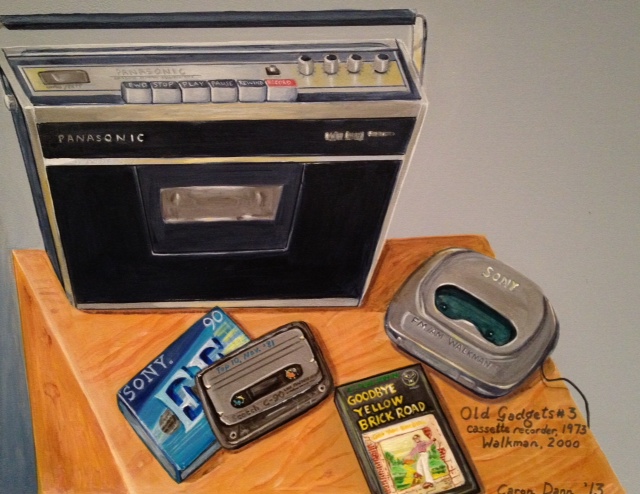
My latest painting in this series, finished last night, is “Old Gadgets No. 3”, which features my mother’s Panasonic cassette player-recorder. It was state of the art when my parents bought it in 1973 at the Santa Monica mall in Los Angeles, where we were living at the time. At the same time, I got a smaller cassette deck, which I was very proud of but which is long gone. Now I wish I’d kept it!

Old Gadgets #3: Panasonic cassette player-recorder, 1973; Sony Walkman, 2000. Acrylics and Faber-Castell Pitt artist pens on treated board.
Old Gadgets #3: Panasonic cassette player-recorder, 1973; Sony Walkman, 2000. Acrylics and Faber-Castell Pitt artist pens on treated board. © Caron Eastgate Dann, 2013

The Sony Walkman in the painting was bought by my husband to take on an overseas holiday in 2000. Remember when cassette players used occasionally to “eat” the tape, and you had to carefully unravel it?

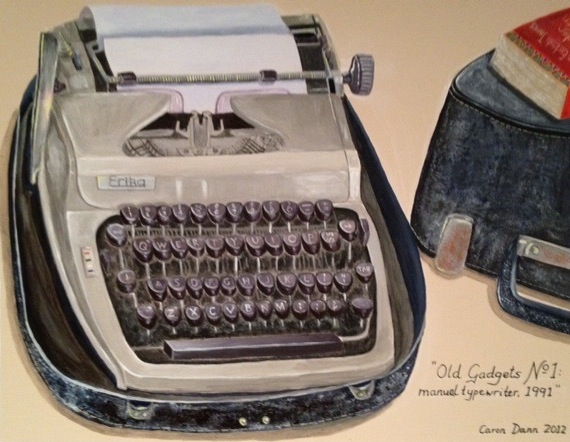
Old Gadgets No. 1: my manual typewriter, bought in Bangkok, 1991. On the case is the German version of my novel, The Occidentals (Das Erbst Der Schwestern). I wrote the first draft of this novel many years before it was published, on this typewriter. Acrylics on board.

Old Gadgets No. 1: my manual typewriter, bought in Bangkok, 1991. On the case is the German version of my novel, The Occidentals (Das Erbst Der Schwestern). I wrote the first draft of this novel many years before it was published, on this typewriter. Acrylics on board. © Caron Eastgate Dann, 2012

“Old Gadgets No. 1” features my manual typewriter, which I then gave to a friend who collects such things. I bought this typewriter in 1991, when I was living in Bangkok, because we had frequent power cuts during the rainy season and I wanted to be able to keep writing. Remember how messy and annoying it was to change the typewriter ribbon?

“Old Gadgets No. 2” is my Canon Eos film camera, bought in 1999, and various accessories. I used it until 2005, but it was already well out of date then. Remember those Kodak print packs you’d pick up and excitedly see what surprise gems you had taken on holiday?

Old Gadgets No. 2: my film-era camera, 1999. Acrylics on board. The prints are from a trip I did to China in 2001. The slides are the only ones I ever took, on a trip to Vietnam in about 1996.

Old Gadgets No. 2: my film-era camera, 1999. Acrylics on board. The prints are from a trip I did to China in 2001. The slides are the only ones I ever took, on a trip to Vietnam in 1996. © Caron Eastgate Dann, 2012

I have a drawer at home where I keep old gadgets I might want to include in a painting. In the drawer are a purse-size address book, a tiny Motorola cell phone from 2003, 3D glasses that are still current but will be relics within a few years, and a TEAC external floppy disc drive unit in see-through turquoise, which matched my iMac in 1999. Apple had decided, ahead of its time, not to include floppy disc drives in its computers, so we all had to buy these little gadgets.

I wonder what the next thing I relegate to my “old gadgets” drawer will be?