Bambi, the dentist and the Mona Lisa

How lovely it was for me when last Sunday, while I was on vacation in Fremantle, Western Australia, a crown on one of my teeth fell out during breakfast.  For the rest of our time there, mostly spent seeing family on both sides, I had to be careful not to smile too widely, lest I look like a pirate.
We returned to Melbourne in the early hours of Thursday morning, and this morning (Friday) saw me at my excellent dentist, Dr L., his able assistant, Ms K., and friendly administrator Ms V. “You’ve presented me with a challenge,” Dr L. said cheerfully. I won’t go too deeply into what had to be done, save that  it involved a “slow drill” and something called a “para-post”.
It’s all completely painless, of course, thanks to local anaesthetic. I read a lot of historical novels and it’s the one thing that makes me glad I wasn’t born before the 20th century. Anyhow, although dentistry doesn’t hurt now, it’s not particularly pleasant. So, I close my eyes and try to divert my mind. I used to think about a beautiful beach—white sand, turquoise water, a yellow umbrella. Then I played too much of an iPhone app called Distant Shore, and got sick of the perfect beach.
So, what do I think of now? Bambi. That is because Bambi is the sweetest little thing in the history of fictional characters, and Disney captured perfectly this essence of sweet innocence in its portrayal of the fawn in the 1942 movie.

Bambi
I’ve been wanting to write a piece about Bambi for a while, because suddenly, everywhere I look, are images of him. The protagonist of one of the earliest anti-hunting pro-environmental novels seems to be making a comeback—if he ever went away, that is. My earliest memory of Bambi is probably the Little Golden book with the Disney animation characters, but the story was first published in German in 1923 as a novel,  Bambi: A Life in the Woods, by the Ausrian-Hungarian writer Felix Salten,  who sold the film rights for $1000 in 1933.

Bambi_book_cover
Just before Christmas, I saw a 1950s ceramic Bambi ornament for sale at a shop near me called Retro Active, which sells 20th-century memorabilia, jewellery and furniture. It was $30 but, it being Christmas and not my birthday, I thought it wasn’t good form to buy a present for myself. However, shortly after Christmas, it is my birthday, so when the shop opened after the break, I went back to buy Bambi. Guess what? Bambi was gone. I imagine that dear little deer sitting now on someone else’s mantelpiece. Since then, I have seen a Bambi lamp for a baby’s room, and a fantastic Bambi book sculpture, which you can see here.
So synonymous has the term “Bambi” become with innocence and goodness, that to say something is “like killing Bambi” is to brand it just about the worst thing possible. So I was horrified, while researching this piece, to come across a discussion thread on the internet which started with the question, “Is it illegal to shoot a baby deer?”

Perhaps Bambi is making a comeback because, in this commodified, mediatised world in which we westerners can have just about anything we want, limited only by the size of our wallets, Bambi represents what is seen as a simpler, more honest time in which the goodies and the baddies were clearly delineated.We tend to apply this sentimentality or faulty nostalgia for “a simpler time” to many long-gone eras:   I mean, it’s all very well, for example, to look back to the early 19th century through sumptuous TV mini-series of Jane Austen novels and envy the seemingly peaceful and uncomplicated rural lifestyles back then. What we don’t see are the realities of life without all we take for granted today: electricity, refrigeration, and modern medicine, for example; and anaesthetic for visits to the dentist. Before 1844, dental anaesthetic was unknown: routine, reliable local anaesthetic without too many nasty side effects was not introduced until as late as the 1940s. More about that here.

Lack of proper anaesthetic meant restorative dental work was extremely limited before the 20th century. So, if the heroine of  the 1813 novel Pride and Prejudice, Miss Elizabeth Bennet, had toothache, she would simply have had the tooth pulled out. As my late father, a dentist, told me: a real Elizabeth Bennet would have lost many of her teeth by her 20s, and those she still had would probably have been brown with rot. She would definitely not have had a mouth full of white, even teeth. I never could persuade him from his view that period dramas should present characters with teeth like they would really have had.
He was always convinced he knew the secret to the Mona Lisa’s smile. “It’s obvious,” he said of the early 16th-century painting. “It’s because all her teeth would have been rotten or missing, and she smiles that strange way because she has chronic toothache.”

Mona Lisa

In Bambi’s idealised world, all the goodies, of course, would have perfect teeth and would never need to go to the dentist. I hope this is my last dental visit until my usual six-monthly check-up is due. Fingers crossed.

Writer’s Diary #3: Into the unknown

Let your writing take you into the unknown. (By the way, I visited this jungle path, at Queen Sirikit's palace grounds on Doi Suthep, near Chiang Mai, Thailand, in November. I didn't realise until I got home that I had been there before, 20 years ago).

Let your writing take you into the unknown.
(By the way, I walked along this jungle-like path at Queen Sirikit’s palace grounds on Doi Suthep, near Chiang Mai, Thailand, in November. I didn’t realise until I got home that I had been there before, 20 years ago).

I’m not the first to say “Don’t necessarily write about what you know; write about what you don’t know”, but I am still in a minority, as conventional advice tells writers to write what they know and what they know about.

This seems strange to me, since writing is a journey of discovery, a journey into the unknown, even if you know your subject matter. There is always something mystical about good fiction writing: it is more than the sum of its parts.

More important to creative writing than knowing about your subject or theme is being passionate about them and being able to write about them in a way that no one has written before.

However, you do have to do your research. While it’s tempting to jump right into the writing, doing some research before you start is a huge help because it enables you to concentrate more on the writing when the time comes.

When I moved to Thailand in the early 1990s, I decided I would write a novel set in 19th-century Siam. I knew almost nothing then about history in that part of the world, except highly romanticised (and mostly incorrect) information from popular western culture.

When I found the Siam Society, a club in Bangkok promoting the study of South-East Asian culture and history, I was on my way. They had a library of 20,000 books, many of them on old Siam. I did six months’ research reading these books and taking notes before I started writing The Occidentals. In those days, research was not generally done on a computer screen or using the internet, and we kept track of our research using an index card system, as I wrote about here last week.

Actually, writing the first draft of my novel took me only three months—half as long as it took to do the research (though when it was accepted for publication, my editor asked me to add 100 pages, so I had to go back to my research, and I spent another three months on the addition). I wrote every day, six days a week, for five hours, 12.30-5.30pm.

The six months’ ground-work had ongoing benefits: I used it as the start of research for my PhD in the 2000s, which in turn became my second book, Imagining Siam: A Travellers’ Literary Guide to Thailand, and which has led to an academic career.

In saying don’t be afraid to write about what you don’t know, I’m in good company. For more on writing about the unknown, see this article in The Atlantic by Harvard Creative Writing Faculty director Bret Anthony Johnston.

I’d love to hear from you about your launch into the unknown for the sake of your writing.

My life in TV

Going, going, gone: some of my old TV Week clippings that I don't need any more.

Going, going, gone: some of my old TV Week clippings that I don’t need any more.

You know how an old song can conjure up images of where you were in the past when that song was popular? I have the same memories when I see old TV programs. I was an entertainment journalist from the 1980s to the 2000s, and browsing through my clippings file is like a walk through the history of Australian and New Zealand television and associated events in my own life.

I worked for Australia’s then-most popular entertainment magazine, TV Week, from 1989-1990 and from 1993-1997, becoming assistant editor in 1994. I kept all my clippings—probably about 1000 articles—from that time, and a fair few of the magazines intact, particularly the editions for which I was acting editor.

After my father died in 2006, my mother gave me their collection of seven years’ worth of TV Weeks that I had written for. This collection took up eight drawers in my home office.

Recently, I’ve been trying to streamline my household and get rid of stuff I don’t wear, don’t read, don’t look at, don’t need. As the Canadian writer Fransi Weinstein said in her blog Three Hundred Sixty-Five this month, it’s about “living simpler”.

So, some of those old TV Week magazines had to go. As journalists, we were taught from the beginning to keep all our clippings. They are a record of your work and you need them when you apply for a new job.

Today, however, no one would be interested in my clippings from so long ago. And if I need clippings for a job application, I have more recent ones that I can simply provide a website link to.

I don’t have children, so there’s no sense that I would need to keep something for posterity. Yet, always before when I’ve tried to cull this collection, I’ve become lost in sentimentality and nostalgia, and have ended up putting the mags back in the drawers.

Not this time, though. Last weekend, I got rid of 60% of the magazines in the eight drawers, plus about half of my clippings, keeping only the more notable among them. I also threw out lots of clippings from my work as a news reporter in the 1980s, again keeping only the important ones.

Now I have extra storage space in which I can accrue more stuff.

A Writer’s Diary #2: Goodbye, dear little filing system

1990s writer's filing system

Ye Olde Worlde Filing System, c1991.

Remember this? If you’re under 30, you’ve probably never seen one: it’s an index-card filing system. Before the internet, this is how we used to file our research. This is the one I compiled when I was writing my historical novel, The Occidentals, set in 19th-century Thailand.
I did six months of full-time research before I started writing the novel. This involved reading and indexing information from 42 books and hundreds of articles. Then, say, when I wanted to know about transport in Bangkok in the 1860s, I would look up the index card labelled “Transport”, and it would tell me the books, articles and page numbers where I would find the information.
Though I have not used this index since the late 1990s, I feel sentimental about it and have kept it all this time in my office. I’ve tried to throw it away several times, but something always stops me doing it. However, finally, I’ve agreed with myself, something once so useful has become just a waste of space.
So, I thought I would take a photo of it and write an obituary for my dear little filing system. Goodbye, you served me well, but now it’s time to go. Xoxo.

A Writer’s Diary #1: Finding time to write

Books by Caron Eastgate Dann (previously James)This year, I have determined that I will find time to work on my creative writing, instead of just thinking about it. This will mean writing every day, even if I am tired and overworked from my day job.

I know I can find the time because of this: nearly two years ago, I took up painting as a hobby. Since then, I have produced more than 40 finished paintings, variously  in oils, watercolours, acrylics and pastel. I paint four or five evenings a week, sometimes only for 30 minutes, sometimes intermittently over five hours.

Writing after hours is more difficult to do because in my job as an academic, I am on a computer screen much of the day, working on scholarly articles, lectures, and so on, or I am standing in front of a class of up to 60 university students. I don’t feel like writing at the end of the day. I feel like watching TV, eating pasta and painting pictures.

So, my best option is probably to get up an hour earlier and write before the rest of the day starts. Or, just make myself write at the end of the day for an hour. Sometimes I don’t feel like painting at first, but if I just set out my equipment and start, I am soon engaged by it. Maybe it will be the same with writing.

My other problem is that I have made significant (but slow) progress on two novels, and I think it is better to choose just one to work on. They are both historical novels, and one is a sequel to my first book, The Occidentals, initially published as long ago as 1999, then in German editions in 2003, 2005 and 2007. Where has the time gone?

While I’ve done much of the research for these two new books, there is always more to do. Some time, however, I have to stop researching and get writing. I constantly toy with the possibility of writing a contemporary novel, too, and my head spins with ideas.

Ideas, however, do not a novel make; constant hard work every day does. Writing a novel is like climbing a mountain: then having to revisit the mountain and climb it all over again when the editing starts.

My new writing program starts on Thursday, January 10, because it’s the day after my birthday. Also, my day job doesn’t start until February, so I should have the time I need to get a good start on my projects. I’m looking forward to a fruitful writing year.

Bloggers for Peace: Rediscovering the inner peace of childhood

This post for Bloggers for Peace is inspired by a photograph taken by my childhood friend, the New Zealand actor Yvette Parsons. She took it while lying in a hammock during her annual break on Waiheke Island, off the coast of Auckland, New Zealand. This looks like paradise to me, and she agrees. It brings back to mind those simple pleasures in life: a good book, warm weather and a gentle breeze, an unspoilt view, nothing much to do but go for a swim, read a few pages and doze the day away. It took me, in fact, back to my own childhood in New Zealand.

The view from a hammock at Kennedy's Bay, Waiheke Island, New Zealand. Picture: Yvette Parsons

The view from a hammock at Kennedy’s Bay, Waiheke Island, New Zealand. Picture: Yvette Parsons

Remember childhood, and how easy it was to find inner peace, even though you didn’t know that was what you were doing? Provided you were lucky enough to have a great childhood, like I did, peace was something you took for granted. As I see it, peace is about safety, shelter, freedom, love and comfort. I was so lucky to have found all these things at home.
To illustrate this, I’d like to share in this post some of my favourite childhood memories:
*Deep, long sleeps, and next morning bouncing out of bed, eager to meet the day ahead. On Sundays, I was told not to get up too early, so I’d lie in bed listening to the children’s requests story hour on the little red transistor radio my parents had bought me.
*Our “under the house house”. This was something my brother, Phillip, and I put together. Under our house was a basement, not big enough for an adult to stand in, but big enough for a child. It ran the length and breadth of the house and contained the wooden foundations which, upstairs, divided the house into rooms. Mum and Dad used the front space by the door to store the lawn mower and gardening equipment. They never went further back: if they had, they would have found our secret house: rooms with curtains (cadged from discarded material), book cases, tables, cusions, cups, knives and forks. It was like a giant dollhouse. Phillip and I would allow only the two neighbouring kids, a brother and sister about the same age as us, to come in. We’d think it hilarious to hear Mum or Dad above, calling our names in vain, not knowing we were right beneath them. Then we’d hear, “I don’t know where they get to”. We never did let on, and Dad eventually found the “under the house house” many years later when he was preparing to sell the Auckland house. He found it just as we’d left it, and it must have been sad for him: I had moved out of home at 17 to become a journalist, and Phillip was killed in a motorbike accident when he was 17 and I was 19.
But to continue with some happy memories from childhood:
*Finishing a homework assignment, and having the rest of the day to play.
*Sprinting across a field, running as fast as I could.
*Ice skating to disco music, skating very fast with the wind in my hair.
*Rolling over and over down the freshly mown lawn at my grandparents’ house, then sitting with my grandad on the deck, sharing his binoculars to watch the yacht races on the Hauraki Gulf.
*Reading Famous Five books under the covers, with a torch, when I was supposed to be asleep. It was like being in a tent.
*That lovely feeling that, no matter what happened, Mum and Dad would make it right. No matter how many kids were mean, or if you’d fallen over and hurt yourself, or been disappointed with a classroom grade, when you got home, you were in that magical world again, our own domain.

Here’s to a peaceful New Year: make goals, not rules

Wat Buppharam, Chiang Mai. Pen & wash, by Caron Eastgate Dann.

Wat Buppharam, Chiang Mai. Pen & wash, by Caron Eastgate Dann.

Whenever I am in Thailand, I like to visit several temples. I enjoy wandering around the compounds, and though I no longer call myself a Buddhist, I find an enormous amount of peace within them. This illustration was inspired by a photo I took when I visited Wat Buppharam in Chiang Mai in November. Just looking at it now makes me feel peaceful.

I would like to wish everyone a happy new year—tonight for us here in the Southern Hemisphere and tomorrow for others. Instead of “resolutions”, I’m going to make a list of things I want to achieve this year. That way, I will have goals rather than rules. One of those goals, of course, will be to write one post a month for the Bloggers for Peace cause.

Bloggers for Peace: Baby steps to peace on earth; or, ask yourself, “What would Jo March do?”

Road rage: don't do it!

Road rage: don’t do it!

Have you noticed lately how furious people in the street have become? I’m not talking about the obvious ones—rather, the ordinary, everyday person who could be your neighbor, your colleague, your relative. This fury—I think at the stresses of modern life—manifests in random acts of anger and retaliation, ranging from the minor to the serious. This month, for example two young women in Melbourne were abused and followed when one inadvertently brushed another woman with her bag on a tram.

My last post was about rediscovering the children’s book Little Women. I talked about how the book has strong moral overtones, and I’d like to add the thread that runs through the book of dealing with anger, the sort of anger that can bubble up as a result of minor occurrences in everyday life. The character of Jo March has to learn to control her anger, and her mother advises her to bite her lip rather than give an angry retort. Well, I have been trying this too in the few days since I finished the book. I can report that it really does work! It helps so much to keep the peace with those around you. So, next time you’re tempted to lose your temper, ask yourself, “What would Jo March do?”

I want to talk mostly in this post of the aforementioned furious people, the ones who need so little provocation to unleash an angry reaction. Here’s an example: a few years ago, I got on a tram and was fumbling in my wallet for my fare. A well-dressed thirty-something woman virtually pushed me aside, furious that I was taking a few seconds extra, purchased her ticket then grabbed the last seat, next to the machine. I smiled at her and said politely, “I was only going to take a few more seconds”. Her well-spoken reply was, “Dickhead”. I was shocked.

Everywhere, I see drivers furiously swerving and making their tyres screech in a bid to get past someone, to beat a red light, to get round an intersection before pedestrians get to that part of the road. Just a few months ago, an ambulance was rushing along the main road in my suburb, lights flashing and siren blaring. As it approached a major intersection, the “cross now” sign went for pedestrians. I was astonished to see them actually running to try to get across before the ambulance, rather than waiting for a few seconds for the vehicle to pass.

It seems to me that many wars are started because people are angry as a result of being jealous, greedy, impatient, or intolerant, or all of them. But on a much smaller scale, in our everyday lives, we also show these traits. Maybe if we could learn to be less  jealous, greedy, impatient and intolerant, we would avert not only day-to-day anger, but also the sort of anger that eventually causes huge, evil events such as wars.

What I want to say, on behalf of peace, is that we need to practise peaceful behavior every day. Now, I don’t mean not sticking up for ourselves against injustice and bullying. They are quite different matters. I mean, don’t allow small events to build up and enrage you against everyone and everything. Don’t unleash this fury when it’s not going to lead to a positive change.

So don’t toot and shake your fist at a driver who has just cut in front of you; don’t tailgate someone just because they’re not going as fast as you would like; don’t yell obscenities at someone who may have simply made a mistake.

Here’s an example of how positive behaviour can work for the better. One day, I had stepped out on a pedestrian crossing at the university where I work. A car approached and seemed about to stop, but then accelerated. At the last moment, the driver saw me and stopped abruptly. I was about to say something rude about her driving skills, when she looked me in the eye with a big friendly smile of contrition and mouthed “SORRY!” My nasty words stuck in my throat, and instead of yelling at her, I smiled back, said, “It’s OK”. Both of us, I’m sure, had a better day than we would have, had I directed my anger at her.

And finally, in this, my first post for the Bloggers for Peace cause (which you can also access via the button on the right-hand side), I’d like to share two stories of kindness that promote peace and goodwill in our community.

Firstly, last winter I was catching the train home from work one day. It was very dark outside and as we drew close to my station, sheets of rain were falling. I had no umbrella, as the rain was unexpected. So, I prepared for the walk home in the rain by saying to myself, “It’s only water”. Anyway, just as I got out on the path and started striding toward home, a young woman, a stranger, ran to catch up with me. “Would you like to share my umbrella?” she said. I gratefully accepted, and learned she was an exchange student from China.

The second story occurred when I was at our local shopping plaza. I had used the ATM to withdraw some cash, went in to the supermarket, picked up a basket and walked down the nearest aisle. Suddenly, a voice beside me said breathlessly, “Excuse me, excuse me!” I turned toward the voice: she was wearing a burqa, and all I could see were her eyes, full of concern. She continued: “You withdrew $50 from the ATM—but you forgot to take it.” She held out her hand and gave me the $50. I thanked her profusely and I felt as if there was some hope yet for humanity.

Rediscovering a book from childhood

Is it not a beautiful thing to decide, on a day off, to take up the book you are reading, and to vow to read it all at once until it is finished?
That’s exactly what I did today. Well, I had only 36 pages left, so it didn’t take long.
I’ve been reading Little Women, by Louisa May Alcott, for the first time in decades.  If you’ve been re-reading a book from long ago, I’d like to hear about it, too (see this post’s last sentence).

little-women
I’m re-reading Little Women because I intend to read March, by the Australian writer Geraldine Brooks. March takes up the story of the father of Meg, Jo, Beth and Amy. Robert March is a shadowy figure in Little Women, and little is divulged about his time away from home while serving with the Union forces during the American Civil War. Brooks takes up his story, and from all accounts, it is a masterful work, for which she won the 2006 Pulitzer Prize for fiction. It was so long since I’d read Little Women that I thought I’d best refresh my memory.

Overly sentimental?
Little Women is rather a strange book: endearing central characters, a strong moral and Christian message, a sentimentality that is too much at times, set against the turbulent times of the Civil War. Despite its almost preachy tone, it is compelling, however.
I’m most interested in the character of Jo(sephine), definitively played by Winona Ryder in the 1994 film version. The character of Jo is a reminder of how far women have come toward gaining equality. Only by acting, speaking and wishing to be a man does Jo consider she can live a valid life. And, in the 1860s, middle-class women were restricted to domestic duties. At one point, Jo tells her mother that she wishes all four daughters had been born boys. Some women broke with tradition, of course, including Alcott herself, who never married and whose income brought her family out of poverty. I can’t help thinking the English children’s writer Enid Blyton must have been influenced by Jo when she wrote her own “tomboy” character of George (Georgina) in the Famous Five series.

In places, particularly in its first half, Little Women becomes tedious with its moral lectures. At other places, however, it contains some excellent advice still relevant today. Here is my favourite:
“Have regular hours for work and play; make each day both useful and pleasant, and prove that you understand the worth of time by employing it well. Then youth will be delightful, old age will bring few regrets, and life becomes a beautiful success, in spite of poverty.” (Wordsworth Classics edition, 1993, p. 115).

Publishing history
Little Women’s book history is interesting. The first part was published in 1868—only three years after the war ended—and is partly autobiographical, drawing on Alcott’s childhood. Her father was Amos Bronson Alcott, a noted educator and writer. As in Little Women, there were four daughters in the family, and some of the events related in the story are descriptions of real events, notably in the sequel, Good Wives, Meg’s wedding (in reality that of Alcott’s sister, Anna). Good Wives was published in 1869, but the two are often published together now, although my book contains just the first. There are two more in the series: Little Men and Jo’s Boys.
Alcott, who never married, did not particularly want to write Little Women. She did so at her publisher’s insistence, and its great success made her family financially viable—just as well, because her scholarly father earned almost nothing for his work and relied on his wife and daughters to earn incomes.
One curious factor is that there are quite a few typographical errors in this book, and a few grammatical errors, too (“sung” instead of “sang” for example). You’d think these would have been fixed a century or so ago. But perhaps they crept in when books were re-keyed (and not copy-edited, obviously).

Literature in society
I work as a university lecturer and I’ve often thought it would be interesting to write an undergraduate subject called Lessons from Literature or Literature in Society. Over a 12-week semester, you would choose a number of classic books and examine the moral code of each. There would be a different theme each week. This wouldn’t be schmaltzy goody-two-shoes stuff: you could also choose a book that carried a message of evil, for example, and examine its effects. Through examining excerpts from these books, you could discuss social codes, ethics, morality and sensibility, in a bid to understand current moral systems, laws and social mores. Perhaps I will have the opportunity to do that one day.
Books with moral messages, such as parables, are still among our most popular. In the 19th century, there was A Christmas Carol; fast-forward to the 21st  century and you have The Five People You Meet in Heaven, for example.

What book or books do you most remember from childhood?
I’d like to hear what books readers of this blog remember favourably from childhood and which you have re-read. You could simply comment below, or you could post a link to your blog. Happy reading!

Have you heard the one about the journalist who wanted to be a novelist?

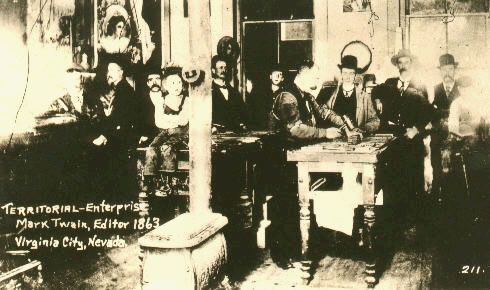
Mark Twain as editor of the Territorial Enterprise, Virginia City, Nevada, 1863

Mark Twain as editor of the Territorial Enterprise, Virginia City, Nevada, 1863

I went to a fiction writing workshop in November at which the tutor, a university lecturer, insisted that “Very few good novels have been written by journalists”. I was astounded by this statement, but said nothing during the seminar, not wanting to be seen as adversarial or—as I am a university lecturer myself—as trying to be a know-it-all and trump the teacher.
I was offended, actually, because I am a former journalist and a published novelist, and I think I’m not bad at both.
Traditionally, many young people who want to be novelists have been steered into journalism as a way of making a living but still using their writing skills. It seems most journalists I know have a manuscript half-written or ambitions to write a novel.

Anyway, this got me thinking about great writers who also worked as journalists. Contrary to what the fiction workshop tutor said, there are many great novelist-journalists. What follows is a list of just a few that occur to me. They are in no particular order and they are eclectic: that is, some are world renowned, others are much lesser known; some are from a previous age and some are current; some are literary, some populist, some both.

Ernest Hemingway
Mark Twain (pictured above)
Geraldine Brooks
Graham Greene
Djuna Barnes
P G Wodehouse
Martin Amis
Willa Cather
Charles Dickens
George Orwell
Ruth Rendell
Will Self
Linda Grant
Tom Wolfe
Susan Kurosawa

In a recent article in the Guardian on this topic—specifically on the worth of Will Self’s work—Robert McCrum examines the cliché of the journalist as unable to write good fiction:  “What lies behind this prejudice, of course, is the idea that fiction (and poetry) is a higher calling,” McCrum says. “Journalism is hack writing (it doesn’t have to be) and novelists dwell closer to the top of Mount Parnassus (well, occasionally).” Read the full article here.

A 2006 scholarly book on the subject, Journalism and the Novel, by Professor Doug Underwood, examines why so many journalists have aspired to fiction writing careers. I think it’s often the other way round: many people aspire to the seemingly more romantic and mystical calling of fiction writing first, then realise they have to make a living as well. That’s what happened to me. I was going to be a famous actor, playwright and novelist. However, making a living as a journalist is not wasted time, for journalism is a fascinating occupation that allows access to people and places that others don’t get, thus providing much material a novelist can use.

Just because someone works as a journalist doesn’t mean they can’t write good fiction: that’s faulty logic. Just because I once worked at McDonald’s, for example, doesn’t mean I couldn’t become a chef at a fine-dining restaurant; and just because I worked at Target doesn’t mean I couldn’t become a high-end fashion designer. Making a generalisation, as my erstwhile tutor did, can manifest simply as a prejudice with no evidence to support it.

So, my advice to anyone who thinks journalists can’t write impressive fiction is, read The Old Man and the Sea, Animal Farm, Huckleberry Finn, March, and The Quiet American, then get back to me.