
In Australia, everyone seems intent on buying bigger and bigger houses. In fact, I read recently that we have the biggest average house sizes in the world. But bigger is not necessarily better, as these teeny tiny Japanese houses prove.
Dear Media…
This month’s challenge at Bloggers For Peace is to write a letter to any person or group you like. As a former journalist for more than 20 years and now an academic teaching communications and journalism studies, I take a great interest in the media. While there are still some superb news organisations, so many have become harbingers of doom and gloom that I often don’t want to read or watch the news. I sometimes have to close my eyes or look away. One of my former teenage students, from the Middle East, said to me last year: “I cannot watch or read the news in Australia, because the only thing I see of my country is violence and war. We have our troubles, but that is not all we are.” While I appreciate that such things as wars and accidents and even shark attacks are news and need to be reported, I would like the media also to report some of the good things going on. I don’t mean sugar-coated fake stories about nothing much, but real stories with a positive angle. Here is my open letter to the media.
Dear Media
It seems that the ”news” these days is full of awful things: crime, destruction, neighbours against neighbours, frauds, gangsters, political mud-slinging. No wonder your readership and viewership numbers are falling; no wonder few people want to pay for your online services.
As a result of this constant emphasis on the negative, you give a warped, unbalanced view of our society as a dangerous place in every way.
Imagine a media that restored the balance and actually reported the positive above the negative. It would be like this:
What the media show us: stories about drunken or drugged footballers behaving badly.
What I want to see: stories about footballers doing good work. Some are doing degrees at university; some are doing amazing charity work; some just have interesting stories or an interesting skill apart from their sports, e.g. painting, singing, dancing; and let’s have more stories about actual sports, particularly women’s sport.
What the media show us: stories about neighbours at war
What I want to see: stories about neighbourhoods with initiatives to make their area a better one in which to live, e.g. communal gardens. There is a street down the road from me that has a little bit of open land with a tree. They turned this into a communal outdoor lounge room over summer, where families could meet, children could play and neighbours could get to know each other.
What the media show us: stories about con men and women who promise to cure cancer then rip off a person’s money; stories (really ads) about vitamins and supplements, quacks with this or that new miracle diet.
What I want to see: stories about real advances in science from around the world. Stories about wonderful inventions and their inventors.
What the media show us: horrendous stories, with pictures, about wild or domestic animals who have been mistreated, abused, tortured. Sometimes this does have a positive result, such as a story this week about a kangaroo that had been shot with two arrows (but survived), which subsequently drove the person who did it to turn himself in. However, I didn’t need to see the pictures of this poor animal a hundred times over.
What I want to see: stories about the wonders of the natural world and about responsible ownership of pets.
What the media show us: stories about road rage, drunk driving, and stupid exploits or car chases.
What I want to see: investigations into our transport systems, what is really happening, and what some real solutions might be. Stories about initiatives to improve driving habits.
I could go on and on, but I’ll leave it there for today. What sort of stories would you like to see the media do?
When you least expect it…
Sometimes, the most memorable part of an overseas trip is not what you think it will be. Instead, a random, unexpected and fleeting observation may make a greater impression on you than all your planned sightseeing put together.
Such a thing happened on my three-week visit this month to the US and Canada with my husband and mother. The purpose of the trip was mainly to visit my brother and his wife, who live in Bellevue, near Seattle in Washington. On the way there, we stopped off in Honolulu, and after nine days in Bellevue, we went on to Canada.
We were in Vancouver for four nights before our Rocky Mountaineer train trip to Banff. We planned to do some shopping, view the city from the Vancouver Lookout, and take the ferry across the water to Lonsdale Quay, North Vancouver—mainly for the ferry ride itself and its famous views of skylines and mountains.

View from the Vancouver Lookout, 168.6m above the city. Photo ©Caron Eastgate Dann 2013
A man at the desk of our hotel had suggested we catch a bus from Lonsdale Quay to Lynn Valley, where you can cross a suspension bridge, built in 1912 to swing across the Lynn Canyon 50m below. You can read more about the canyon here.
Canadians walk a lot, and their response at all times is that something is “just a short walk” or “just round the corner”. This may turn out to be four kilometres “round the corner”, however.
My mother is a healthy 74-year-old, but naturally, she can’t walk as far as a younger person. On the first bus, we went a stop too far, caught another back, and discovered the walk to the scenic area was a kilometre from there. So we took another bus that got us closer to the canyon
To get to the bridge, you alight in a residential street, and Lynn Canyon is really only a short walk away (perhaps 0.3km), hidden at the end of a marked road.
As the bus drove away, a woman in a big SUV pulled up at the intersection in front of us. She was flapping her hands around—at us, it seemed—and talking animatedly on her mobile phone. She then left her vehicle running at the intersection and got out of the car.
“Be careful, there’s a bear in the street!” she said. “Walk away now. Walk away quietly.”
She pointed to a suburban garden about 15 metres from us with an alleyway next to it. There we saw an enormous wild black bear.
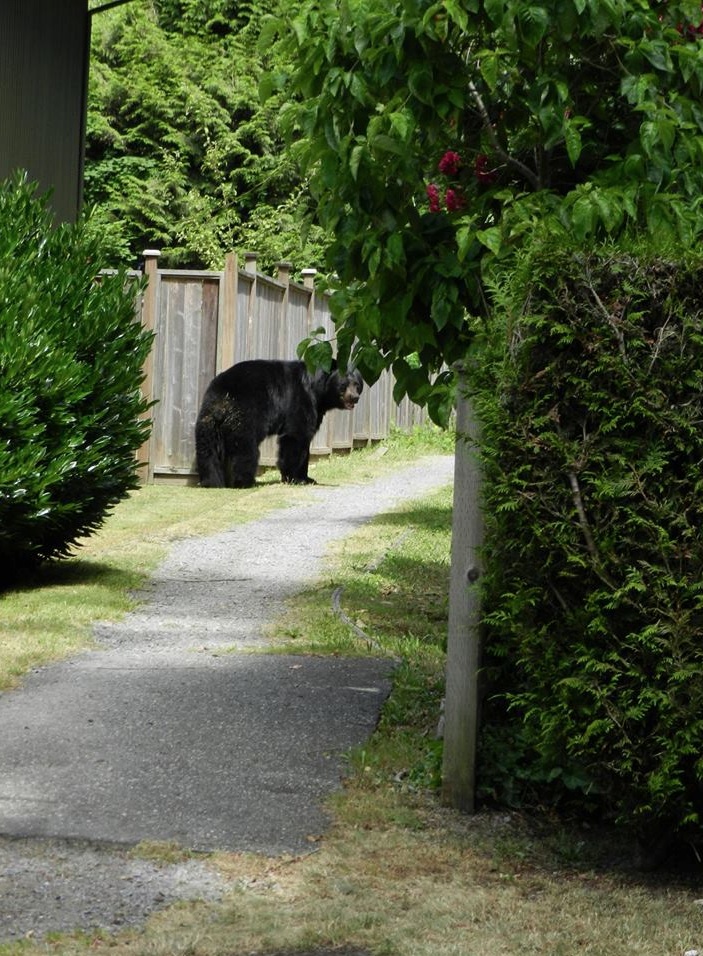
As this big black bear ambled away down this suburban path at Lynn Valley, North Vancouver, he turned to look at us, then continued on his way. Photo ©Gordon Dann 2013
Our natural inclination was first to freeze, then to take photos. She urged us to walk away in the direction of the bridge though, which we did. At the same time, the bear began ambling away down the alley—but he stopped for a moment, and looked back over his shoulder at us, as if to say, “I know you’re there”.
Later, we talked to a ranger who said bears were often sighted roaming through the suburbs, and most of the time they were OK, as long as you didn’t follow them or scare them. Apparently, they usually try to get away from people, although the woman in the SUV told us there had been several instances lately of an “aggressive bear” in the neighbourhood.
This sighting so close to us was the highlight of our trip—so unexpected, so astounding, all over in a couple of minutes.
Oh, and the bridge and views of Lynn Canyon were great too.

Lynn Canyon suspension bridge, North Vancouver. Photo ©Caron Eastgate Dann 2013
In praise of the beige cardie
In one of my favourite blogs, Coming of Age, by the Australian journalist Adele Horin, I read recently that the epitome of dowdy, middle-aged dressing is a long beige cardigan. Oh no, I thought, I love a long beige cardie. In fact, I was wearing mine as I was reading that blog.
When I was growing up in New Zealand, you didn’t hear the term “beige” for clothes: it was called “fawn”. Beige has become synonymous with boring, but I’ve worn beige all my adult life—or colours that approach it—including in my late teens, 20s and 30s, when I was considered quite a snazzy dresser and spent most of my disposable income on clothes.
There were the Chanel-inspired beige and black court shoes; the beige full-circle skirt and matching top; the beige safari suit from my favourite shop, Hullabaloo, in Queen St, Auckland, that cost me a fortune when I was 16 and which I had to pay off over about two months (called “lay-by” in New Zealand).
And now, the long beige cardigan. Hmmm. To be honest, I usually only wear this garment when I am working from home. Here it is:

- “Beige cardie in sanguine, sepia, burnt sienna, raw umber and titanium”. PanPastels and charcoal on pastel paper.
© Caron Eastgate Dann, 2013

I sketched it using pastels and charcoal—none of them called “beige”, but rather sanguine, sepia, burnt sienna and raw umber, mixed with titanium.
I have had many beige cardigans, some of them rather swish-oh. A beige jacket is also a great choice when white is too stark and black too dark. And beige trousers are a trans-seasonal wardrobe staple, when white is too summery and black too wintery.
Googling this colour tells me there is no actual one hue that is beige. It is a generic name for a whole range of light browns. Beige is a neutral that looks good with just about any other colour, including black, brown, white, green, orange, purple and navy. I once had a bespoke beige suit that I wore to work with a turquoise Thai silk blouse.
Beige is my friend. So I wonder how it came to be considered boring, dowdy and “middle aged”?
My Secret Island
When I was eight or nine, my favourite book was Five on a Treasure Island, the first in the Famous Five series, by the British writer Enid Blyton. It was already an old book, and quite dated, by then, but it captured brilliantly the concept of getting away from adults, of setting up a comfortable camp, and of endless summer days of reading, playing outdoors, and going to sleep under the stars.
As adults, we still need to get away from the adult world every once in a while. It’s why J. M. Barrie’s mythical Neverland still appeals to me.
In my mind, I have a secret island. I’ve painted it to show you what I see. It’s easily accessible by boat, but for some reason, no one else has discovered it yet. There is a simple wooden house round the back of the island: you can’t see it from this viewpoint, because I don’t want anyone else to know it’s there. All the rooms face the sea, and you can open them all up by folding back the walls. There is a large veranda that runs the length of the house.
The house is stocked with the necessary staples, and there is an abundant fruit and vegetable garden and all the seafood you like to catch. There is a deep fresh-water pool nearby with a tiny waterfall.
It’s never very hot or very cold on my island. It rains every few days, but just for an hour or so. When the sun comes out strongly in the afternoon, there is a refreshing sea breeze that blows through the house to provide natural airconditioning.
Miraculously, there is also fast wireless internet, so I can keep in contact with all my friends on social media whenever I like.
At one end of the house, there is an art studio and writing den. This is where I will write my next novel.
Well, in my imagination, at least.
Everyone needs a secret island, even if it exists only on a canvas. This is mine.

Weekly Photo Challenge: Nostalgic

Although New Zealand is still the only citizenship I hold, I haven’t lived there since the late 1980s. In fact, I have spent more of my life outside NZ than in it. However, I still feel very much a New Zealander, and I painted this picture, “Voices from Home”, to convey my nostalgia.
I included some books by authors I admire: Joan Druett and her wonderful Wiki Coffin series, Katherine Mansfield, Keri Hulme, Paula Morris. There are also a traditional flax woven bag called a kete (pronounced kae-tae); a painting bought at Coromandel; a greenstone carved pendant; a paua-shell ring; and an old book my friend Yvette bought me about the All Blacks. She bought this book for me because my great-grandfather, Harold “Bunny” Abbott, is listed in it, having played for “The Originals” in 1905.
A lot of my paintings include items of nostalgia, and I’d like to do more of them while I am learning about creating fine art.
Have you noticed that when you start to think about an old object or event, memories start to come back to you that you didn’t realise you had?
Peacetime at home

Even if you can’t afford a trip to a beach like this at Phuket, Thailand, you can still take a vacation at home. Painting in PanPastels on board, ©Caron Eastgate Dann, 2012.
This post is written in response to Kozo’s June Peace Challenge at Everyday Gurus, to write about maintaining peace at home.
In our hectic lives when every minute of the waking day seems to be filled with work, chores, to-do lists and regrets about so few items on those lists we’ve crossed off, sometimes we forget that relentlessly, every minute, time is passing us by.
We often neglect relationships with the people closest to us in the pursuit of making those very people’s lives better: trying to make more money to buy them more things, trying to achieve what we suppose are life’s goals.
Yet on our death beds, we will never be glad we made more money, spent more hours working, bought more stuff or cleaned the house more often. We might, however, regret not spending more time on just being with those we love, listening to them and facilitating peace between us.
It’s so important to replenish, rejuvenate and find a sense of joy and peace in our lives, without feeling guilty for taking time out.
I’ve compiled a list of six things I think are important to promote a sense of well being, peace and inner health: I am not saying I follow these things all the time. Too often, I too forget that the world won’t collapse if I don’t meet a deadline.
1. Recycle some stuff you don’t need. There’s something cathartic about de-cluttering your house, and even better if that stuff can go to a good cause and your trash can be someone else’s treasure.
2. Read inspiring novels. Great books teach us empathy, something that is sorely missing in this society that sees angry people constantly tooting horns, pushing in front of each other, and discriminating against their fellow people. Read the classics: anything by Charles Dickens or Elizabeth Gaskell, or Mary Shelley’s Frankenstein; read recent novels—anything by Mitch Albom, for example; read historical novels such as March by Geraldine Brooks.
3. Take a vacation, or holiday, as we call it in Australia. Of course, not everyone can afford to actually go away on vacation to an exotic tropical beach, but you could take a holiday at home, even if it’s only over a weekend. A holiday at home means you vow to do no work—not even housework—on those days; it means the majority of every day is relaxing and enjoyable—read a book, watch a movie with your family, make a picnic lunch, lie in bed reading the newspaper.
4. Be a tourist in your own city, and visit the art galleries, museums, or other places of culture you’ve been meaning to see. Go to a live theatre show, particularly if you’ve never been to one before. Small, independent theatre companies desperately need your support and can often be surprisingly affordable.
5. Contact a friend you’ve been neglecting because you’re always too busy. If we don’t keep working at friendships, they are in danger of fading away. And even if this is the sort of person you know you could pick up with again at any time, it’s sad to get out of touch and miss the events, big and small, that are important in each other’s lives.
6. Go for a walk and get to know your neighbourhood. We spend so much time at our computers, in our cars, sitting in the train or bus, that we forget to walk. I walk most days, and often towards dusk, I pass an elderly Greek couple sitting on the veranda of their neat-as-a-pin house overlooking their carefully tended garden. We nod and chat now, even though our conversations are limited by a language barrier. But no matter, we mean each other well. On another street, there’s an old black and white cat who suns himself every afternoon on the warm concrete path outside the apartment where he lives. Then there’s an old man who looks about 90, who rides an ancient bicycle to and from the shops every day. There are all sorts of modes of transport round our neigbourhood: the other day, I saw a young man casually riding a unicycle along the street. Every day, I notice something I have never seen before.
For more on establishing and maintaining a peaceful home, check out blogger Julianne Victoria’s inspirations at Through the Peacock’s Eyes, and to discover what ducks have to do with peace, see the blog My Little Spacebook.
I’m a poet and I didn’t know it!
Dear Readers,
I’ve been pondering how we start and end our correspondence, particularly electronically (which is 99% of the correspondence I get these days anyway). I made a quick list the other day of some of the greetings and closes I’ve received recently. I laughed when I read it back, because it sounds like a poem. Here is my list, which I’ve even given a poetic title:
Truly, sincerely, faithfully
Hi/Dear
Sir/Madam
Madam/Sir
To whom it may concern
How are you?
I hope you’re well
Kind, best, warm regards
Yours truly, sincerely, faithfully
All good things
In solidarity
Bye for now
Thank you
Cheers
When I was growing up, there were strict rules about letter writing. You started with “Dear so-and-so [comma]”. You then indented the next sentence on the line below. This sentence should contain a greeting: “I hope you’re well”, if it was an informal letter to a friend or acquaintance, or a statement of the purpose of the correspondence if it was a business or professional letter.
How you ended your letter would depend on your relationship with the person. If it was a formal letter, you would thank them for their attention and then sign off with “Yours faithfully” if it was a first letter on business, then “Yours sincerely” in subsequent letters. Historically, Americans use “Yours truly” and “Sincerely Yours” in the same way. There’s a link here to more on the rules, if you’re interested.
Nowadays, of course, the old rules have been relaxed, especially with the advent of emails. Hardly anyone starts an email with “Dear…” any more, particularly young people. They almost always write “Hi…”.
I always sign off with “Love, Caron” if I’m emailing close friends or relatives, or “Cheers” for colleagues or acquaintances (for want of anything that doesn’t sound as formal as “Regards” nor as familiar as “Love”). Because I write so many emails to friends and relatives, putting “Love, Caron” is almost automatic: I often double-check emails to my students to make sure I have put “Regards” and not “Love” absentmindedly, because the latter would sound weirdly inappropriate!
And I often think “Cheers” might not always be appropriate for acquaintances, because of its connotations with drinking. But as I say, I can’t think of anything else, so I use it reluctantly.
Sometimes, I just sign my name, without a closing “Cheers” or “Regards”. Then again, many people don’t bother to sign off emails at all, because their name is at the top anyway.
By the way, “In solidarity” is how staff at my union sign off, and “All good things” is the hallmark of a happy friend.
Cheers,
Caron
Amazing Stories of Trust #1: the airline and the lost baggage
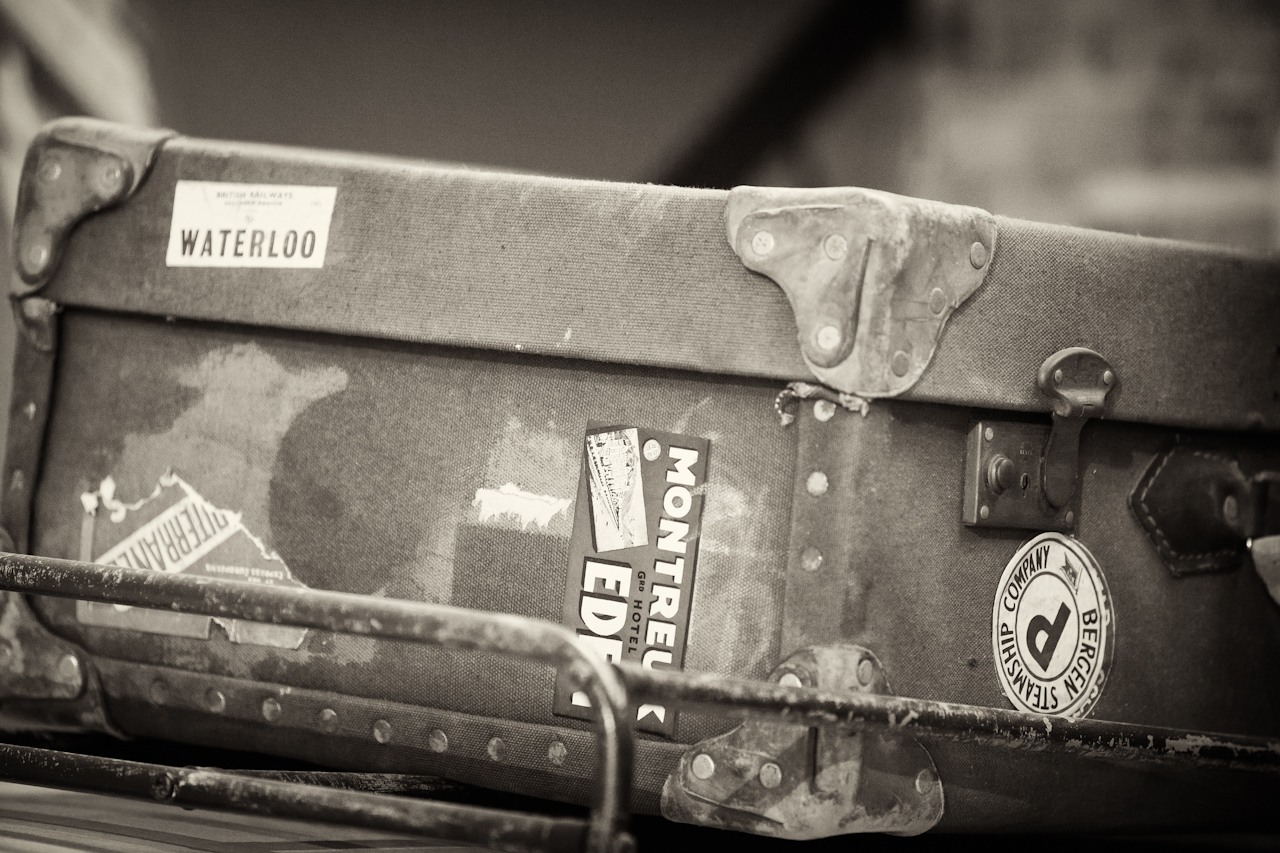
Image courtesy Mark J P on Flickr http://www.flickr.com/photos/pyth0ns/5812681105/
I don’t like to look at the past with rose-coloured glasses too much. However, one of the things I think has suffered in the last 30 years is the element of trust in one’s fellow person: the concept that most people will do the right thing most of the time.
I’m reminded of something that happened to me in 1980 in my homeland of New Zealand, when I took a flight from Auckland to Hawke’s Bay. It was only a one-hour flight, and while I arrived at Napier-Hastings airport safely, my bag was nowhere to be seen. The Air NZ staff were apologetic, and said my bag had been put on the wrong trolley and would be forwarded the next day.
In the meantime, they said they would pay for some toiletries for me to make do with. They gave me an Air NZ cash cheque and told me to go to a chemist (known as a drug store in the US) and get whatever I needed.
This was not just any cheque. Well, it was, actually. It was what was known as an “open cheque”, which was signed, leaving the amount blank for me to fill in, depending on how much it was. I could do that at the point of purchase, they said.
“How much should I spend?” I asked.
“Just whatever you need, within reason,” they said.
Even back then, this amazed me. Such trust!
I didn’t buy much: a toothbrush, deodorant, a few other minor items. The bill came to less than $10.
The next day, the airline arranged for my bag to be couriered to my house in the small town of Waipukurau, about 45 minutes’ drive from the airport.
That’s customer service, trust and great company PR all in one.
Day (463) – 4 Years of my Life
A great column in which Evan Sanders says that while university might well be the best years of your life, it’s not necessarily so: that the best years can be all the years you are living, even if there are struggles along the way. It’s a lesson in making the best of what we have.
 The Crayon Files