Call me a Kiwi—but not a bird or a fruit

Photo © Caron Dann, 2013

Photo © Caron Dann, 2013

When I was five, my family and I left our South Pacific island home of New Zealand and went to live in England. My school, in Heslington, York, had a Christmas school performance and I coveted the role of the angel, because I would get to wear a lovely white satin gown and a tinsel halo. I was very upset not to get that role. Instead, I would be part of the procession, which celebrated all different nationalities of the British Empire. To add insult to injury, they made me parade in dressed as an Australian, complete with a hat with corks on strings (worn in Australia to ward off flies). I hated that: they didn’t understand that Australia and NZ, though collectively known then as “the Antipodes”, were very different countries. I can still remember walking in that procession, to the applause of all the parents seeing their little darlings dressed up so prettily, but feeling so humiliated, I wanted to cry. The teachers felt sorry for me and let me take the angel costume home for the weekend.

Ironically, I have ended up spending much of my life living in Australia, and I love it. Although I was born in NZ, I’ve spent a little less than half my life there. I’ve also lived in the US and Thailand.

But I identify most of all with being a New Zealander—or Kiwi, as we’re colloquially known. I’m at least sixth generation, which for a pākehā (white NZer) is a lot. The name “Kiwi” is, of course, after our unique national bird, the kiwi. Americans in particular might know better the fruit, which they call “kiwi” as well, but we always call “kiwi fruit” now. When I was growing up though, it was known as a “Chinese gooseberry”, because it is native to China, not NZ—the Kiwis just came up with a brilliant marketing idea!

I love being a New Zealander, and even though I haven’t lived in my home country since 1988, I go there every year or two. I always enjoy flying in and seeing that green, green grass of home, to steal a line from a famous song.

Australians and New Zealanders can tell each other apart in a moment by our accents. But much the same as Canadians and Americans, we often get mistaken for the other by outsiders. I knew I must have picked up some Australian vowel sounds a few years ago, when someone in Auckland, NZ, said to me, “Are you Australian?” But most Australians can pick me straight away as a Kiwi.

As well as nuances in our accent, we have lots of different sayings and terms for the same thing, and that’s what I illustrated in the photo on this post. So, “jandals” in NZ are called “thongs” in Australia, and “flip flops” in England. They’re those rubber sandals held on with a thong between the big and second toes.  The term “jandals” is never used in Australia, except by New Zealanders who want to be laughed at, but I’ve gone back to it. The word is perfect for this type of footwear, and was originally a trademark made in the 1950s from a description of the product’s origins, “Japanese sandals”.

We have a few NZ shows on TV in Australia now, and this has put me in touch again with our vernacular. If we like something a lot, we say “Choice!”, but we often pronounce it like “Choooooooooiiiiice!”. (The opposite is “Stink!”). And if we’re cool with arrangements, such as “I’ll pick you up at 7 and we’ll go to the movies”, we say “sweet AS”.

This post was written for Rara’s International Label Day post, in which participants identify themselves with labels, which I reckon is choice! Anyway, if you want to take a look at all the other cute labels in that post, you can access them here, OK? Sweet as!

My Favourite Old Recipe Books

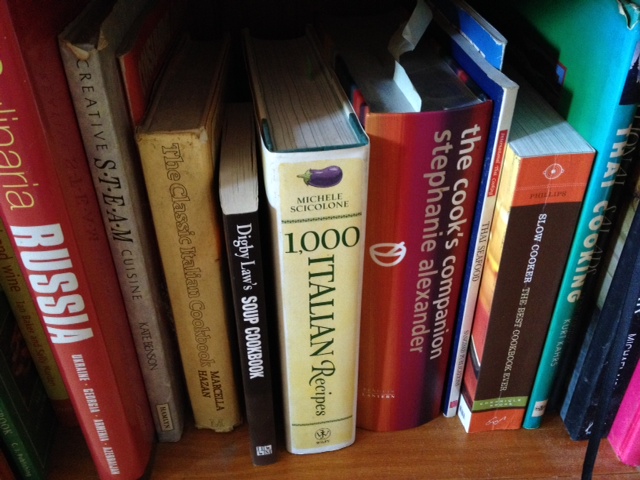
My recipe books take up two shelves of a big bookcase, and I have culled them to just the ones I use or am likely to use.

My recipe books take up two shelves of a big bookcase, and I have culled them to just the ones I use or am likely to use.

Remember the days when if you had a whim to cook something—beef stroganoff, say—you would have to trawl through your cook books, knowing the best recipe was…somewhere?

These days, I can simply google it and come up immediately with the right recipe via the internet. I put my iPad in the cook book stand in the kitchen and away I go.

But you know what? I still love my old recipe books. I still occasionally buy a new one. I have had some of these books since the 1980s when I was first starting out on my own and when I knew little more about food than grilled meat and three boiled veg (orange, green, white).

In the first flat I lived in at 17, my flatmate, Heather—who was nine years older—cooked for us on nights one and two. On the third night, we got home from work (we were both reporters, on rival newspapers) and she said, “Well, I cooked the last two nights, so you can do tonight. I’m going out to mow the lawn. Call me when it’s ready.” And off she went.

I was shocked: I don’t think I’d realised I’d have to cook. I probably hadn’t even thought about it, because Mum and Dad always cooked at home and I was too busy studying.

I can’t recall now what I made in entirety, but I remember calling out the window to Heather, “Umm—how do you cook potatoes?” She put the mower on idle and said, “Peel them, put some water in a pot and boil them till they’re soft,” before roaring away from me with the mower.

Heather didn’t stay long, and I soon had a new flatmate, Jan, who was my age but much more cluey about things domestic. Jan introduced me to the world of recipe books and I was soon serving 1980s wonders such as apricot chicken and potato-topped salmon bake.

These days, there are many fantastic and hilarious websites and blogs devoted to retro recipes: but I prefer my own little corner of history in my bookcase and I often still use my favourite old cook books. Coming up are just some of my favourites. Note that these are not my favourite coffee-table recipe books—this is a whole different category that I should write about some time. These are some of my favourite books that I actually use all the time for everyday meals. They are splashed, stained and creased with the efforts of preparing many meals past.

rec4The New Zealand Radio and Television Cookbook, edited by Alison Holst (1981)

This book was given to me by my godmother when I was 21, and I still use it all the time. It’s great if you want to cook a hearty beef casserole or vegetable soup, and has an “Eastern and Polynesian” chapter which—despite the unsophisticated grouping together of a very wide number of cuisines—is actually pretty useful still. Here we find recipes for sukiyaki, Indonesian barbecued duckling with gado gado salad and rempeh.

Alison Holst is one of my homeland New Zealand’s most famous cooks, and any book she writes or edits is accessible, easy to follow, and fail-safe. For this book, recipes were contributed by “listeners and viewers” throughout NZ.

The preface points to a bygone age when, supposedly, women were the only ones cooking in the domestic sphere (not in my family though—my parents shared the cooking, and my grandad did a fair bit at his place, too). The preface is worth quoting in its entirety, if only for its antiquated sentiments:

“This book contains a wide selection of recipes, favourites sent in by listeners and viewers from one end of New Zealand to the other—farmers’ wives and city women; those who cook for one or two and the mothers of large, hungry families; women who buy just what they fancy and those who watch their food budget carefully; young cooks and women with years of cooking behind them…”

Country Cooking: Regional and traditional recipes from Europe and North America, edited by Heather Maisner (1982)

Almost all my adult life, this book has been my go-to for traditional and authentic menus from Europe and America. It’s an artistically produced book, with historical photos and information about food production. So, if I randomly let this book fall open, I come across the “Spain and Portugal” chapter, from which I would choose vieras guisadas (Galacia) baked scallops, Sopa de almendras (Andalusia) almond soup, and paella Valenciana (Valencia).

rec6A Vegetable Cookbook, by Digby Law (1986)

This is my vegetable bible. I got this book in 1986 when I was literary editor of the Auckland Star and interviewed the author. I still use this book most weeks. It lists vegetables alphabetically, explains how to cook them simply, then for each has 6-10 recipes, which range from the well known, such as ratatouille and moussaka, to the exotic, such as choko relleno, “an unusual dessert from Mexico”. There are no photos, just the odd line drawing of a cabbage or an onion. Law’s Soup Cook Book is also excellent.

rec7South-East Asian Cookery: An Authentic Taste of the Orient, by Sallie Morris (1989)

I bought this unpretentious little paperback in 1991, when I was living in Thailand. Its recipes range from the highly complicated to the divinely simple, such as kha-yan-kyin thee thoke (Burma)—green tomato salad; raam long song (Thailand)—meaning “Rama’s bath”, a beef curry on a platter of green leaves; and goong pahd gratiem (Thailand)—prawns with garlic. There are a few coloured photos, but these are of produce for sale in markets and so on rather than of the recipes themselves.

rec3The Top One Hundred Pasta Sauces, by Diane Seed (1987)

I started to get interested in cooking Italian food when I met my dear Italian friend, Rosa, at my first job in Australia in 1988. We’re still great friends after 25 years! She opened my eyes to a whole new world of cooking—olive oil, pasta, olives, fresh garlic, chilli and more. This was probably the first Italian cook book I bought, way back in 1989, and I still use it today. Some of its standout recipes, which I have probably made 50 to 100 times each, are penne al cavolfiore (penne with cauliflower), spaghetti con zucchini, and the supremely simple tagliatelle con cipolle (tagliatelle with onion sauce).
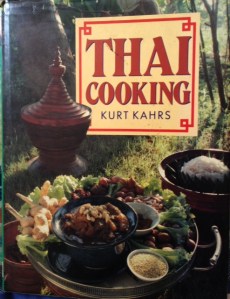
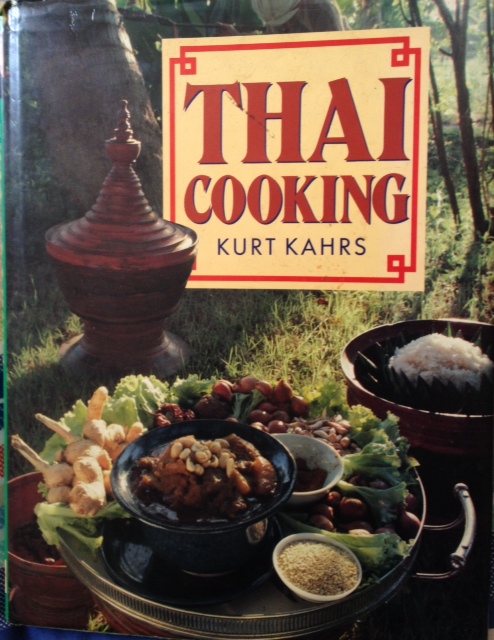
rec9Thai Cooking, by Kurt Kahrs (1990)

When I was first going to live in Thailand in 1990, I didn’t even know what the food would be like—this was before the craze for Thai food had hit Australia and the time when Japanese food, not Thai, seemed to be the most trendy international cuisine here. Before I left, my mother bought me this book and I’ve used it ever since.

I have lots of Thai cook books, since it is my particular area of interest, including two amazing books by Thomson  (describe and photograph all as a montage). But I keep going back to favourite recipes in Kahrs’s book: the khao op sapparod (pineapple baked rice), the khai phad met ma Muang (chicken fried with cashew nuts), and the lab kai (spiced minced chicken salad) among them. This book has photos for each recipe, too.

Rec2Country Cooking: Regional and traditional recipes from Europe and North America, edited by Heather Maisner (1982)

Almost all my adult life, this book has been my go-to for traditional and authentic menus from Europe and America. It’s an artistically produced book, with historical photos and information about food production. So, if I randomly let this book fall open, I come across the “Spain and Portugal” chapter, from which I would choose vieras guisadas (Galacia) baked scallops, Sopa de almendras (Andalusia) almond soup, and paella Valenciana (Valencia).

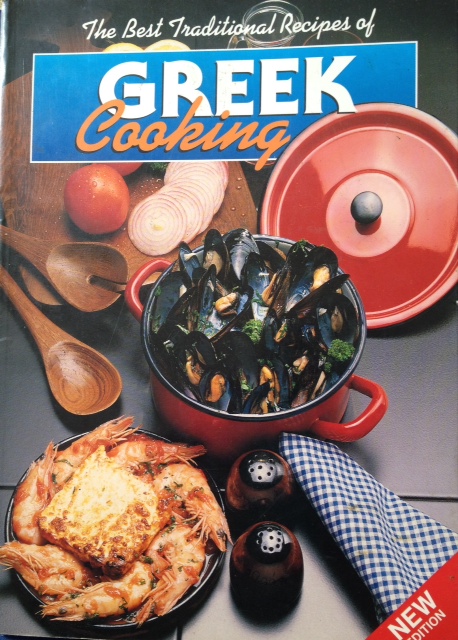
rec5The Best Traditional Recipes of Greek cooking, Editions D. Haitalis (1990s)

I bought this little gem in Athens in 1996. It has no date of publication, but the cover states that it is a “new edition”. I love Greek food, and this is the only cook book I need, really. It is full of marvellous authentic recipes of a much wider range that your average Australian Greek restaurant serves. One of my favourites is Spanakóryso, simply “spinach rice”. I make this every Christmas: don’t ask me why only at Christmas, it just seems to fit as a lovely side dish that can be eaten hot or cold. There is an error through this book, in that I think they have confused in translation the words for “teaspoon” or “tablespoon perhaps” and “teacup”: thus, we have recipes calling for “2 teacups of olive oil” in a rice dish. The book includes colour photos of many of the dishes.
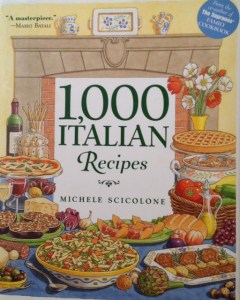
rec81,000 Italian Recipes, By Michele Scicolone (2004)

This is a newer acquisition, given to my husband and me for a wedding present in 2006 by our foodie friend Kenny over at Consider the Sauce. If you have only one Italian cook book, make it this one. It is full to the brim of authentic regional recipes, many of them simple and requiring just a few ingredients. There are no pictures, but there are wonderful descriptions of how the recipes came to be.
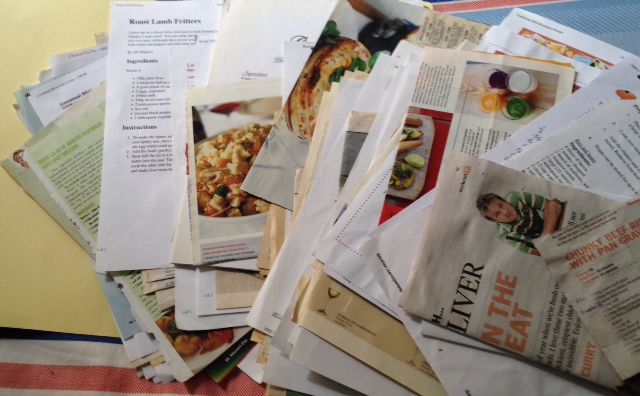
rec1The dreaded clippings folder

Probably everyone had one of these, full of recipes we’ve clipped from newspapers, magazines and printed out from websites. Believe it or not, I recently cleaned this out, throwing away years-old recipes I’d never made and now had no interest in. But there’s lots of interesting stuff in here—it’s like a lucky dip. It can take some time, though to find a particular recipe. “Now where is it? I know it’s in here somewhere…”

Life in the margins—of books, that is

I still buy print books: these are from my "to read" shelf. But half the books I buy now are for an electronic reader.

I still buy print books: these are from my “to read” shelf. But half the books I buy now are for an electronic reader.

About half the books I read now are just electronic files on a Kindle. No creases on the cover art, no dog-eared pages, no margins to write in. This is one thing ebooks cannot replicate: the stuff that happens to the book during the reading process. Somehow, electronic highlights and comments on an ereader are not quite the same.

Do you fold back your covers? Often I can’t resist, as I start a new book, pressing the cover open: a loved book is a creased book, after all.
And despite all my efforts to stop them, successive cats I have owned have ALL enjoyed chewing the corners of my books, tell-tale fang holes appearing mysteriously after I’ve been out of the room.
When I was growing up, we were taught never to write in the margins of books. So-called “marginalia” was acceptable only in a text book and then only if you owned it and you wrote in pencil. On a novel, though, the most you could do was write your name and maybe the year on the top right of the title page. It goes without saying that writing anything on library books was forbidden.
So, most of my old books are pristine: but now I wish I’d broken the rules and written my thoughts in the margins.
I made an exception when I was studying German language and literature at university. German was hard and I’d go through texts meticulously, translating every word I didn’t know. Recently, I came across one of my books from that time, a Hörspiel—a radio play— Zum Tee Bei Dr. Borsig, by Heinrich Böll. As well as copious and tedious translations in pencil, my 19-year-old self had written in the margin of one page, “Sooo boring”!
Go back further to myself as a child, aged about 13. My family and I had lived in Los Angeles for a few years and I’d acted in some TV shows and films, so I fancied myself as quite the director-producer-performer when we returned to New Zealand. Back home from Hollywood though and it was back to amateur stage shows in and around Auckland, and fierce competition at auditions.
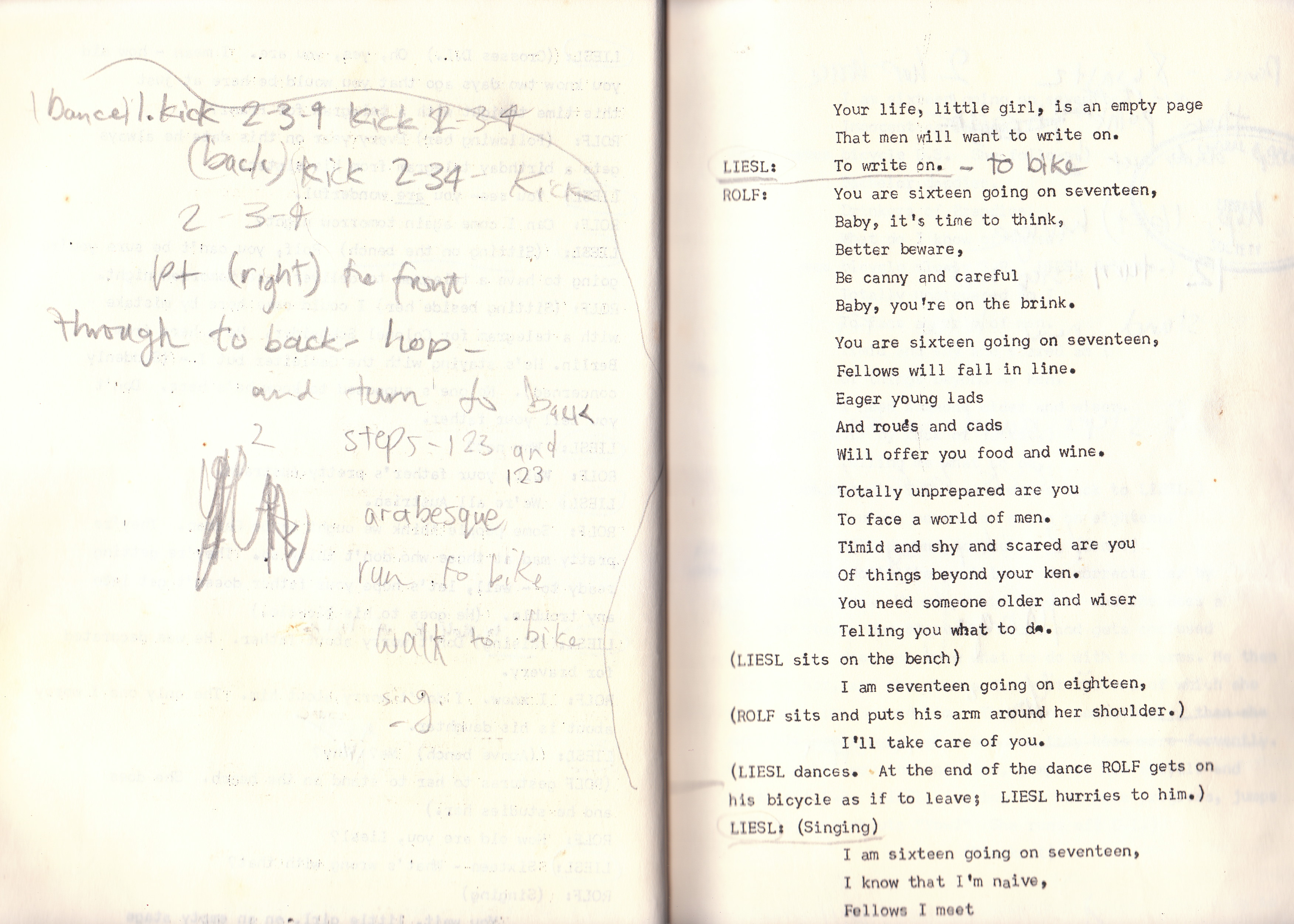
You were always supposed to give back scripts at the end of a production, but somehow,  I  still have a script from a 1970s production of  The Sound of Music, a typewritten, plain brown-covered script stamped throughout with “TGA Choral and Operatic Society Library”. Although the script says it’s published by the Rodgers & Hammerstein Music Library, I somehow doubt that, because on the title page in capital letters, it says it is “THE RODGERS AND HAMMERSTEIN LUBRARY EDITION”. Yes, a typo.
SOM-scriptUntil recently, I had forgotten about this script, but my mother found it stored in a box and gave it to me. In it is a lot of marginalia by various actors who performed in the show over the years—pencilled-in dance steps, rehearsal dates, changes to lines, stage directions and so on.

SOM-script3_0002On p. 3 is the cast list, and you can still make out my additions: I’ve obviously been dreaming (quite ridiculously) about producing The Sound of Music at school, because beside some of the characters on the list, I’ve written the names of various friends I thought might be right for the role. Never mind that we were an all-girl school, and Debbie would be cast as Captain Georg von Trapp, while Lucy would have to make do as Franz the butler, and Andrea would be Friedrich. There is no name beside the lead character of Maria—of course, I would have been secretly casting myself in that role.
SOM-script3_0001As ebooks take over (and don’t get me wrong, I love this format for its portability), and even actors use tablet computers to rehearse their scripts, marginalia like this will no longer be made. How we read our books, how, why and where we marked them: these are fascinating insights into our lives and times.

Sky high

There are some days that just make your heart soar with the possibilities that life has to offer. Today is such a day: the sky where I live in Melbourne, Australia, was so impossibly blue, I just had to take this photo of it.

Sky HighWith a temperature of 25 C (77 F), just a breath of wind, and some puffy clouds on the horizon, it couldn’t be better.

It’s Melbourne Cup day. For readers outside Australia, this is the horse race “that stops a nation”. It’s a public holiday in my state, Victoria, and at 3pm, TVs throughout the country are tuned in to watch the race. It was great to see trainer Gai Waterhouse become the first female trainer of a Cup winner with Fiorente, ridden by the amazing Damien Oliver.

(Actually, I have to say I’m not much of a fan of racing: I have a problem with any sport that exploits animals. But that aside, there is always a special holiday feeling in Melbourne on Cup day, like a carnival).

But back to the blue sky. I know the blue is just a trick of the light, but it certainly does fill me with cheer and hope for the months to come. It’s the time of year that my university teaching is finished, with just a couple more weeks of marking before I’m free.

After a few weeks’ break, I’m going to concentrate on my own writing this summer: getting stuck into my next book is my priority.

The peace to write is one of life’s greatest joys: bring it on!

If everyone in the world did this…

As I am walking round my neighbourhood, I am always dismayed to see so much litter everywhere. Fast food wrappers, household refuse, the odd shoe, socks or even underpants (yes, seen this very morning in a lane way); whole bags of garbage, dumped by the side of the road, remaining there sometimes for weeks.

This is the sort of thing I see in the streets everywhere. You might not want to pick this up...

This is the sort of thing I see in the streets everywhere. You might not want to pick this up…

...But you might be able to bring yourself to pick this up. It's a crumpled bit of paper, in among the leaves and grass.

…But you might be able to bring yourself to pick this up. It’s a crumpled bit of paper, in among the leaves and grass.

The other morning, a shopping trolley full of rubbish had been abandoned near our local train station. It was still there, days later.

In public bathrooms, people scatter paper on the floor, instead of placing it in bins provided.

On the trains, passengers leave drink bottles, remnants of their lunch, or worse.

One day, at the university where I work, I saw a group of students sitting in a circle, where they had been eating lunch. They got up and walked away, leaving all their rubbish on the ground behind them.

At the central train station, Flinders St, in the Melbourne CBD one day, I saw a child aged about four throw away the wrapper to his snack, which his mother clearly saw but did nothing about.

Litter is polluting our waterways and killing marine life, making our streets dirty and hazardous, and hampering efforts to recycle as much as possible.

In the 1970s and 1980s there were campaigns against littering. “Don’t be a litter bug”, I seem to remember one going. We should revive these campaigns, because people have obviously forgotten.

I never litter. However, when I see litter on the street, do I pick it up? Sometimes, but usually not. It’s time for me to change.

And while I’m doing that, I’d like to start a trend. Wouldn’t it be good if every one of us, no matter where we lived, picked up one piece of litter from the street each day and put it in a bin? Think how much less trash there would be in the world then. It’s something that we can do with a minimum of effort and time, it doesn’t cost us any money, and collectively, we’d be doing the world a favour.

This is one of the rules I would make for the world if I could. This is my humble dream to promote peace. In a clean world, you can see and think more clearly, so a cleaner world is a more peaceful world.  I really believe that, which is why I have written this post for Kozo’s October B4Peace challenge at Everyday Gurus, which you can read about here. Another post I really liked this month, for its simplicity and honesty, was Claudia’s, in which she implores people just to be kind to one another. You can read her post here.

So wake up and smell the roses, like this one poking through a fence on my street...

So wake up and smell the roses, like this one poking through a fence on my street…

...and this one, a bit too high to smell, but adding its beauty to the street where I live.

…and this one, a bit too high to smell, but adding its beauty to the street where I live.

Spooky little Monday morning

All year, I’ve been promising myself that one Monday, I would lie in bed until lunchtime, reading a book and thumbing my nose at the workaday world that normally rules my life.

Today, I did just that.

In an instant, my cat Lucy Locket—a main-chancer as all her species are—was up on the bed and ready for a daytime nap. Even the flash of the camera didn’t dissuade her. She was staying put for the morning too! I laughed when I saw this picture with the ghostly eyes—my spooky little cat was born on Halloween, so it’s her seventh birthday on Thursday.

Halloween birthday girl-to-be Lucy Locket gets spooky on Monday morning.  Picture by Caron Eastgate Dann

Halloween birthday girl-to-be Lucy Locket gets spooky on Monday morning.
Picture by Caron Eastgate Dann

And I did read away the rest of the morning. I’ve always loved lying on my bed and reading, since I was a small child. There’s something enormously decadent about it—yet you feel smug that you’re not wasting time, because you’re engaged with literature, after all.

What I’m reading though—oh my! It’s the wonderful novel The Luminaries, which has just won the Man Booker Prize for its 28-year-old writer, my compatriot Eleanor Catton. (I will write more on The Luminaries in a separate post when I’ve finished it).

For now, I am lost in this story set in and around the goldfields of New Zealand’s South Island in the 1860s.

While I’m reading, and the rain is falling gently outside, and the cat snuggles closer, the rest of the world has slipped away.

Odd Things I Own #1

My home is a sanctuary: when I close the door, I’m in my own private and safe world, shared with my husband and cat. I have all my books around me, plus a lot of quirky mementos, souvenirs and collectables. More than quirky, some of them are patently odd, but that’s why I like them. Here are a few of them:

Osbourne dolls

You’ve had a quick glimpse of my Ozzy talking-head doll before; now meet the whole family: Ozzy, wife Sharon, and children Kelly and Jack. These were sent to me by  a TV network to promote the reality show The Osbournes in 2002. They talk—or did. The batteries on three have worn down and I suppose I should get them replaced. Sharon still says “Shut the —- up and go to bed”, “The wicked witch has nothing on me”, and “Did anyone feed the dogs?”

Osbournes talking-head dolls

Lucky leprechauns

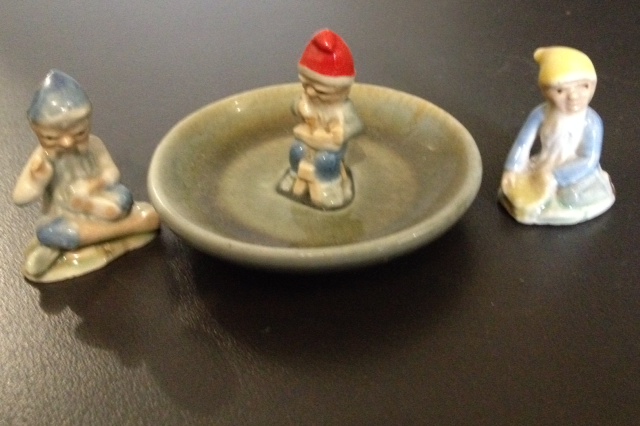
When I was a girl, my paternal grandmother gave me three little Wade Irish Porcelain leprechauns, which she said were lucky, but only if you had all three. They had red, yellow and blue hats. I took these leprechauns everywhere with me, through various countries, many houses and flats. Then, in 2000, a cleaner broke one of them, knocked the head clean off the red one, and the head had just disappeared. A short while later, I happened to look into the window of an antique shop, and there I saw a little red-capped leprechaun. He was sitting on a small dish, but no matter, I had to have him, and my set was complete again.

photo 2

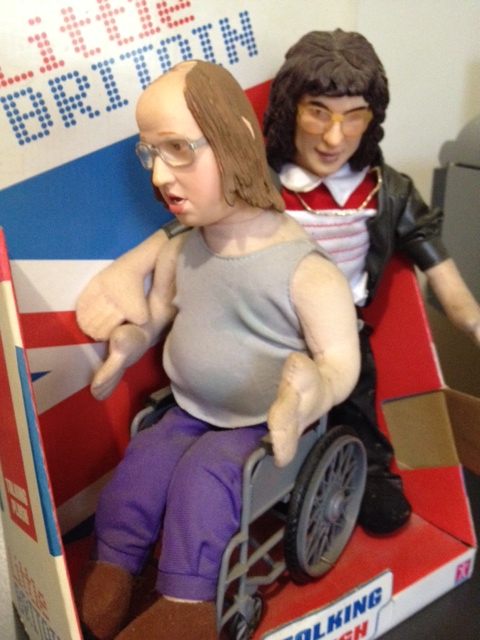
Lou and Andy from Little Britain

If you’ve seen the British comedy show Little Britain, you’ll already be laughing at these plush toys of two of the most popular characters: Lou (right) in his fake-leather jacket and gold chain, carer to Andy, who’s only pretending to be in a wheelchair. If you squeeze Andy’s hand, he says some of his famous lines: “I don’t like it—I want that one”, “Yeah, I know”, and “MONSTER TRUCKS!”. And not to forget carer Lou’s “What a kerfuffle”. My husband bought me these two because he knew how much I enjoyed the show.

photo 1

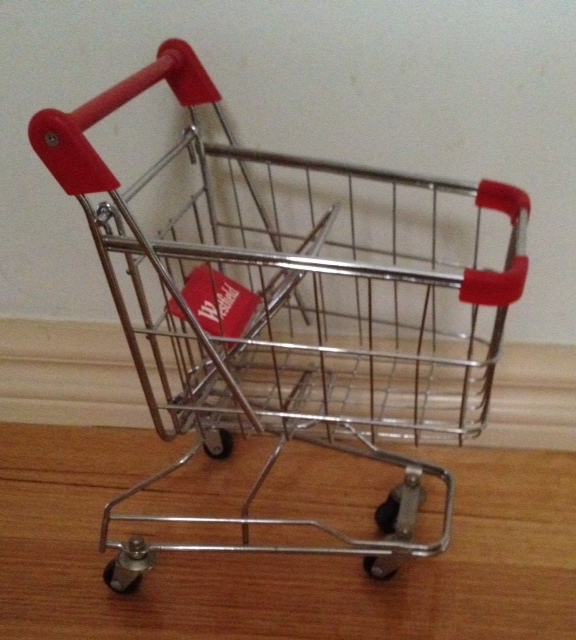
Mini shopping trolley

This was sent to me by a PR company about 10 years ago to promote a shopping centre. It’s a perfect working model in every way. At the moment, I use it to house a mermaid doll or two (that’s a story for another day), but I always thought it would make a great alternative fruit holder in the kitchen.

photo 5

Coral and Lucy Locket

My cat, Lucy Locket, puts up with my odd possessions and knows which toys in the house are hers and which are mine. She’s not that fond of Coral the witch, but I love her. Coral is a handcrafted witch doll from Wellington, New Zealand, who was given to me by my lifelong friend, the New Zealand actor Yvette Parsons. Have a look at this clip of Yvette talking early this year about one of her current touring productions, Dolly Mixture, which features a strange lady of a certain age who loves collecting dolls…

As for Lucy Locket, she’s in this post because, by her very species, she is decidedly odd.  Someone who perfectly describes the oddness of cats is fellow blogger Goldfish from Fish of Gold. In a guest post on Merbear’s blog Knocked Over By A Feather, Goldfish said, “…all cats are whack-a-doodle. Every single one of them is weird as all get out. They may be insane in different ways, but all cats are completely deranged, and when you get down to it, it’s totally bonkers that we allow them in our homes.”  You can read more of her post about the weirdness of cats here.

LucyCoral

Shower cap cat

A present from my mother that is…well, just odd. But there’s something about it that I really like—its madness, I suppose.

photo 4

Plenty more where they came from. Watch this space…

I Feel Like Letting My Freak Flag Fly*

What happens in Vegas stays in Vegas, doesn’t it? Mystery novelist and academic Margot Kinberg reflects on how we change when we are away from home.

How do you interview a hitman?

The news that one of Australia’s most notorious underworld figures, Mark Brandon “Chopper” Read, 58, died of liver cancer today, has prompted me to reflect on a series of interviews I did with him 10 years ago.

At the time, and then known as Caron James,  I was Melbourne Editor of Woman’s Day magazine. The story was to be about his wedding to childhood sweetheart Margaret.

At first, I was reluctant to do the interview. My editor asked me if I would like a body guard! I declined, saying it wasn’t that I was in any way scared, just that I had problems with the ethics of doing such a story.

Anyway, I did do it. I met Read and Margaret at his favourite pub in the Melbourne suburb of Collingwood.  He was personable and insisted on buying me a gin and tonic. Carefully, I called him “Mark”.

My interview with Mark Brandon "Chopper Read' and his wife, Margaret, in 2003.

My interview with Mark Brandon “Chopper” Read and his wife, Margaret (centre), in 2003.

“Aww, call me Chopper,” he said, “Everyone else does.”

I turned to his wife and said, “Margaret, do you call him Chopper?”

“Of course not,” she replied. “I call him Mark.” So Mark it was.

This was a true love story. Margaret had met Mark in a fish and chip shop when they were teenagers, before he turned to crime. They went out for a while, but separated. But she always loved him. She waited for him for decades, never marrying anyone else or having children. Margaret lived a blameless life, working hard and buying a little house for herself. But she never forgot her first love.

Finally, in her 40s, they got back together again, after he had married (then divorced) another woman in Tasmania and had a child, Charlie. Mark and Margaret had their own baby, Roy, in 2003 when she was 43.

After the Collingwood pub interview, I met them several more times, attending the launch of one of his books and even going to their house to see their baby. I witnessed Mark as a tender father and loving husband, and it was hard to reconcile that image with the more commonly known one, the violent criminal who spent 23 years in jail, during which he cut off his own ears.

His life of crime was covered in the 2000 movie Chopper, starring the excellent Eric Bana, which in turn helped take Bana from Australian comedian to big-ticket Hollywood movie star.

I guess, at the end of the day, you have to give Mark Brandon “Chopper” Read credit for being rehabilitated, for joining society as a writer, artist, performer. Cynics would have a lot of criticisms.

Tonight, though, I feel sorry for Margaret, who has lost a man, a husband, the father of her only child, rather than the mediatised “former hitman” and later “colourful character” as the media depicts him.