Weekly Photo Challenge: Nostalgic

20130707-104112.jpg

Although New Zealand is still the only citizenship I hold, I haven’t lived there since the late 1980s. In fact, I have spent more of my life outside NZ than in it. However, I still feel very much a New Zealander, and I painted this picture, “Voices from Home”, to convey my nostalgia.
I included some books by authors I admire: Joan Druett and her wonderful Wiki Coffin series, Katherine Mansfield, Keri Hulme, Paula Morris. There are also a traditional flax woven bag called a kete (pronounced kae-tae); a painting bought at Coromandel; a greenstone carved pendant; a paua-shell ring; and an old book my friend Yvette bought me about the All Blacks. She bought this book for me because my great-grandfather, Harold “Bunny” Abbott, is listed in it, having played for “The Originals” in 1905.
A lot of my paintings include items of nostalgia, and I’d like to do more of them while I am learning about creating fine art.
Have you noticed that when you start to think about an old object or event, memories start to come back to you that you didn’t realise you had?

Peacetime at home

Even if you can't afford a trip to a beach like this at Phuket, Thailand, you can still take a vacation at home. Painting in PanPastels on board, ©Caron Eastgate Dann, 2012.

Even if you can’t afford a trip to a beach like this at Phuket, Thailand, you can still take a vacation at home. Painting in PanPastels on board, ©Caron Eastgate Dann, 2012.

This post is written in response to Kozo’s June Peace Challenge at Everyday Gurus, to write about maintaining peace at home.

In our hectic lives when every minute of the waking day seems to be filled with work, chores, to-do lists and regrets about so few items on those lists we’ve crossed off,  sometimes we forget that relentlessly, every minute, time is passing us by.

We often neglect relationships with the people closest to us in the pursuit of making those very people’s lives better: trying to make more money to buy them more things, trying to achieve what we suppose are life’s goals.

Yet on our death beds, we will never be glad we made more money, spent more hours working, bought more stuff or cleaned the house more often. We might, however, regret not spending more time on just being with those we love, listening to them and facilitating peace between us.

It’s so important to replenish, rejuvenate and find a sense of joy and peace in our lives, without feeling guilty for taking time out.

I’ve compiled a list of six things I think are important to promote a sense of well being, peace and inner health: I am not saying I follow these things all the time. Too often, I too forget that the world won’t collapse if I don’t meet a deadline.

1. Recycle some stuff you don’t need. There’s something cathartic about de-cluttering your house, and even better if that stuff can go to a good cause and your trash can be someone else’s treasure.

2. Read inspiring novels. Great books teach us empathy, something that is sorely missing in this society that sees angry people constantly tooting horns, pushing in front of each other, and discriminating against their fellow people. Read the classics: anything by Charles Dickens or Elizabeth Gaskell, or Mary Shelley’s Frankenstein; read recent novels—anything by Mitch Albom, for example; read historical novels such as March by Geraldine Brooks.

3. Take a vacation, or holiday, as we call it in Australia. Of course, not everyone can afford to actually go away on vacation to an exotic tropical beach, but you could take a holiday at home, even if it’s only over a weekend. A holiday at home means you vow to do no work—not even housework—on those days; it means the majority of every day is relaxing and enjoyable—read a book, watch a movie with your family, make a picnic lunch, lie in bed reading the newspaper.

4. Be a tourist in your own city, and visit the art galleries, museums, or other places of culture you’ve been meaning to see. Go to a live theatre show, particularly if you’ve never been to one before. Small, independent theatre companies desperately need your support and can often be surprisingly affordable.

5. Contact a friend you’ve been neglecting because you’re always too busy. If we don’t keep working at friendships, they are in danger of fading away. And even if this is the sort of person you know you could pick up with again at any time, it’s sad to get out of touch and miss the events, big and small, that are important in each other’s lives.

6. Go for a walk and get to know your neighbourhood. We spend so much time at our computers, in our cars, sitting in the train or bus, that we forget to walk. I walk most days, and often towards dusk, I pass an elderly Greek couple sitting on the veranda of their neat-as-a-pin house overlooking their carefully tended garden. We nod and chat now, even though our conversations are limited by a language barrier. But no matter, we mean each other well. On another street, there’s an old black and white cat who suns himself every afternoon on the warm concrete path outside the apartment where he lives. Then there’s an old man who looks about 90, who rides an ancient bicycle to and from the shops every day. There are all sorts of modes of transport round our neigbourhood: the other day, I saw a young man casually riding a unicycle along the street. Every day, I notice something I have never seen before.

For more on establishing and maintaining a peaceful home, check out blogger Julianne Victoria’s inspirations at Through the Peacock’s Eyes, and to discover what ducks have to do with peace, see the blog My Little Spacebook.

The perfect inventions: top 11

Apart from the ancient essential inventions, such as the wheel and fire, and the obvious modern inventions, such as antibiotics and X-rays, and world-changing new media, such as the internet and computers, what are the inventions that make our everyday life better than it would otherwise be? What are the inventions that just can’t be beaten? I’ve made a list of some of my favourites. To make the list, they had to have longevity, be sturdy if not unbreakable, be cheap and provide an essential function. Here, then, are my top 11 inventions, in no particular order.

 1.Transistor radio: you need never feel lonely and a couple of batteries will last for a very long time. I have a transistor in the bathroom. Steam from the shower doesn’t bother it, I don’t need to pay anything or use up any data to listen to live radio shows at any time of the day or night. I can get news, real current affairs, interviews, travel updates, music, talkback, lifestyle information, comedy and more. Even my cat likes to sit and listen to the radio.

Radio Lucy: my cat likes to listen to the radio. I've heard they also like a CD, and there are some specially made for cats. That might be taking it a bit far. Picture © Caron Eastgate Dann, 2013.

Radio Lucy listens to the morning pet show on the radio. I’ve heard they also like a good music CD, and there are some specially made for cats. That might be taking it a bit far.                                  Picture © Caron Eastgate Dann, 2013

2. Ballpoint pen: doesn’t go forever, but goes for a long time. Tiny, and never needs batteries. A $20 bundle of pens from the Post Office shop has so far lasted me 10 years. Granted, I don’t hand-write much these days, but there are doodles, occasional lists, scribbled reminders, class rolls. Great books have been written with one of these. Roald Dahl wrote by hand in his garden shed. Students with late essays would never be able to use the excuse that their “computer broke down”.

3. Paperback book: probably the most dodgy on the list, because people will say that ereaders have superseded it. Well, not necessarily. I love my Kindle and my iPad for reading, too, but they have limitations. Obviously, with the iPad, its battery life is a problem (though some flights now allow you to recharge). And with the basic Kindle, although the battery life is great, you still can’t operate electronic gadgets when a plane is taking off and landing, meaning you have to find something else to read then. I often take a paperback, as well as my Kindle, for the no-electronics times. And marginalia, although it can be made electronically, is just not the same. I recently found a text I’d had to read as an undergraduate student, and in the margin, I’ve written in pencil, “Soooooo tedious”.

4. Automatic analogue watch: all you have to do is wear it every day and it just goes. Or you can wind it up. No battery ever needed. My father had the same automatic watch almost all his life (though he owned lots of other watches, too).

5. Toothbrush: I’m talking the manual kind over the electric. I recently went back to this old fashioned gadget that never needs charging or a battery, is easy to clean, is good for three months or more, and is very cheap—the one I just bought cost $1.

6. Plastic comb: minimal cost, you use it every day and it fits in your purse or pocket. All you have to do is wash it every so often. I’ve had the same comb for more than 20 years, and now it has sentimental value.

7. Automatic kettle: most of us still have one, even though we can heat up water in the microwave quicker. My twentysomething brother doesn’t have one though, so perhaps times are a-changing.

8. Electric non-stick toasted sandwich maker: a meal in five minutes, barely any mess, maximum satisfaction and you can pick one up for $30 or less. You can also make omelets in the compartmentalised ones. I like the sandwich-press style these days, which you can also use as a mini grill.

9.  Digital camera: ‘new’ technology but so much better than film cameras (for everyday snapshots at least—proper photographer/artists might have a different opinion). The concept of putting a camera in our phones was brilliant. It’s so easy now to illustrate my blog, for example.

10. Scissors: imagine if they didn’t exist. We could still cut things, but it would be a pain. I have scissors in just about every room of the house. They’re cheap, simple, and although they are sharp, there’s much less chance you’ll accidentally injure yourself with them (unless, as the old saying goes, you run with them—even then…).

11. Dried pasta: lasts for ages without refrigeration, is very cheap (from 65c a packet), filling and incredibly versatile. The simplest of pasta dishes is also my favourite: for two people, boil half a packet (or less) of dried spaghetti in salted water until just al dente, then drain it (do NOT rinse). Meanwhile, in a deep-sided fry pan, heat two tablespoons or so of olive oil (or 1 of olive oil, one of butter) and, on low heat, add a couple of cloves of finely chopped garlic and fresh or dried chilli. Fry for a few minutes until the garlic starts to brown, then add one or two bottled anchovy fillets with a little of their oil, and a squeeze of lemon. Fry for a couple of minutes, stirring to break up the anchovy. Add the spaghetti and stir well in the sauce until it is piping hot. Serve  garnished with parsley, black pepper and parmesan, and you have aglio e olio, superb, simple and tasty comfort food.

Light of my life

lampDo you have a possession that has been with you a long time and that you’d never part with? Mine is, surprisingly perhaps, this replica French art deco lamp.

I bought it when I moved to Australia as a young journalist in the late-1980s and, for me, it symbolised an exciting new life. I think it was one of the first things I bought in Australia, and it was expensive. But I had to have it, and it’s been with me ever since, to Thailand twice and to many different addresses and styles of house.

I loved art deco style (and still do), but in my 20s, I thought it THE most beautiful style. I’ve since broadened by ideas of what good style is, but art deco is still up there.  It is the reason I love the style of Napier in New Zealand, which is the best preserved art deco-style city in the world. Sadly, this is because there was a major earthquake there in 1931 and virtually the whole town had to be rebuilt.

But back to the lamp. It has been on the mantlepiece of the formal sitting room in an Edwardian house I owned in Kew, Melbourne. It has been on a side table in two marble-floored apartments in Muang Thong Thani and in Bangkok, Thailand. It has been in a flat above a fish and chip shop in the coastal town of Sorrento, Victoria (Australia).

The frosted glass backing has been broken and replaced twice. It wasn’t broken in transit, as you’d expect: you can undo the glass and pack it separately, and when reassembling it, if you do it back up too tightly, the glass breaks. But I haven’t done that for some 15 years now.

For the last 10 years or so, it has been my bedside lamp. Every night when I turn on my lamp, I find a source of comfort, like a dear old friend. If I wake in the night with a bad dream or a worry, I turn on my lamp. It’s bright enough to read by, but low enough to go to sleep by if you want.

Chances are, I will have this lamp forever.

lamp2

New Zealand paints a rainbow

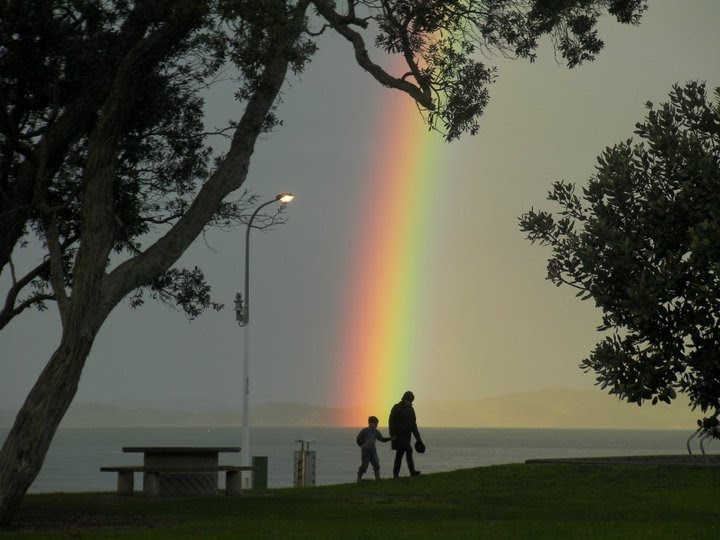
Maraetai Beach, NZ, courtesy Tomwsulcer & Haley Sulcer

Maraetai Beach, Auckland, NZ. From  Tomwsulcer & Haley Sulcer

I was thrilled to hear yesterday that my country of birth, New Zealand, agreed in Parliament to legalise same-sex marriage. This makes it the first country in the Asia-Pacific region to do so.

Although I left NZ in the late 1980s, I have never changed my nationality, I visit often and I still feel very much a New Zealander. So I am proud when I hear that NZ has taken such a big step toward equality of all its people.

NZ has many problems, like any other country, such as a growing economic division between rich and poor,  outrageous real estate prices in major cities, an over-emphasis on commercialism, corporate greed and materialism in some quarters.

But it also has, at heart, a people with a generous spirit, people who believe in equality, be it in regard to gender, race or sexual orientation.

Like Flick, the “little engine that could” in the children’s story, NZ to me is the “little country that could”. This group of dots in the Pacific Ocean has certainly made its mark on the world, and I wanted to celebrate some of those firsts in my blog today. There are, of course, many more, but these are a few that I know of:

  • 1893: First country to achieve universal suffrage when it gave women the vote.
  • 1894: First county to enact a national minimum wage—Australia did not do this until 1907, and the US until 1938.
  • 2001: First country in which women simultaneously held its three top positions of power—they were, then, the Prime Minister, Helen Clark; the Governor-General, Dame Silvia Cartwright; and the Chief Justice, Sian Elias.  In fact, the top five positions were held by women if you add the attorney general Margaret Wilson and the leader of the opposition, Jenny Shipley.
  • 2013: First country in the Asia-Pacific region to legalise same-sex marriage (and 13th in the world).

There are lost of firsts in terms of inventions, technology and scientific advances, too:

  • 1882: First country to ship refrigerated meat (to England).
  • 1884: William Atack was the first sports referee to use a whistle to control a game.
  • 1919: Ernest Rutherford split the atom.
  • 1954: William Hamilton invented the jet boat.
  • 1961: Arthur Lydiard invented and popularised the method of fitness training known as “jogging”.
  • 1987: A. J. Hackett invented bungy jumping.

NZers also invented the spring-free trampoline, the Zorb, the blokart, the circular hairpin, the cycling monorail. More: NZ innovations

But going back to yesterday’s step forward regarding human rights, I believe that in order to achieve a peaceful world, we must treat people equally. All people must have the same opportunities to live in safety and comfort, to pursue happiness, to be educated, to earn a living, and to marry the person they love. Parliament broke into song yesterday (Pokarekare Ana, a traditional love song) when the results of the vote were announced. If you missed this very moving moment, catch it here: NZ legalises same-sex marriage

I hope, too, that this step forward will prompt politicians in Australia to do the same. So far, both the federal government and the opposition are saying they will not. But it’s only a matter of time, surely.

Life in the fast lane or, revenge of the madding crowd

Platform 1, Flinders St station: Yes, it's 7.55am and I am rushing to my second train connection of the day. Picture: Caron Dann

Platform 1, Flinders St station: Yes, it’s 7.55am and I am rushing to my second train connection of the day. Picture: Caron Dann

I thought I had left the rat race behind years ago. But for the last month or so, I have found myself having to travel to work with all the other madly scurrying rodents who must be at their desks before 9am.

I have to take two trains and a bus to get to work. It’s better than driving in peak traffic though, and parking would cost me more than $100 a week, not to mention petrol. Public transport costs me a mere $30, and for some of the journeys I can get a seat and get emails done or do some reading.

Although I live in a big city, I’ve had the luxury over the past eight years or so of being able to work from home a fair bit, or being able to travel out of peak hour to work.

When I do have to be at work early—which is four days out of five at the moment—it always astounds me just how many people there are everywhere, all trudging off to work at pretty much the same time. As they march off the train to the exits, tickets in hand to “touch off” through the gates, there’s a rhythmical stamp to their progress.

In my teens, I visited Melbourne, Australia, and was entranced by life there in what I saw as the fast lane. When I was in my mid-20s, I left New Zealand to live in Melbourne. I loved the thought of being a city worker. I felt cosmopolitan, sophisticated, excited and energised by the throngs of people, the sky scrapers and the daily rush.

St Paul's Cathedral, Melbourne CBD, 1981: scenes like this impressed me enough as a teenager to make me move to Melbourne in my 20s.

St Paul’s Cathedral, Melbourne CBD, 1981: scenes like this impressed me enough as a teenager to make me move to Melbourne in my 20s.

I got a job in corporate publications at the HQ of a big bank in one of those city sky scrapers. It made me feel very “New York” when I’d get a takeaway coffee and raisin toast or a doughnut for breakfast (I could eat such things in those days). From my 23rd-floor office, I had a sweeping view of the city.

In the 1990s, I went to live in a much bigger city, Bangkok, and revelled in its great mix of culture, history, modernity and tradition.

In the 2000s, I was based in the small seaside town of Sorrento (Victoria, Australia, not Italy!). Whenever I had to go to Melbourne, the noise of the crowds and the traffic would accost my ears and I would wish to go home immediately.

I’ll never forget one fine Friday afternoon in Sorrento. I was out on a boat with some friends, and we were fishing, the three of us lolling on the deck, cutting up bait and drinking tea from a thermos. The sea was like glass, and all we could hear was its gentle lapping against the boat. On the horizon, we could just see the hazy cityscape of Melbourne. My friend squinted towards it: “There are people in all those buildings, sitting at desks and working as we speak,” he said. “Glad I’m here.” And we went back to our fishing, with no more than the thought of fresh King George whiting for dinner on our minds and whether or not to put parmesan in the crumb.

Now, I live quite close to the city centre (16 minutes by train), but far enough away that I can’t see or hear it. I can still appreciate a great CBD: a night-time skyline, cathedrals, beautiful book stores, the perfect coffee. But the daily drudgery of having to queue up, push, rush, open bags for security, have tickets checked, and so on leaves me cold. And don’t get me started about rudeness, aggression, people who don’t keep left up stair wells and round corners, and people who rush past you to grab a seat before you get it.

When I go to a city, I’d like it to be not because I have to travel through it at some ungodly hour for work, but because I’m visiting to sample all it has to offer. And therefore, it wouldn’t be at peak times. Count me out of the rat race.

Living in Tomorrowland

I have a long time to work before I could consider retirement—around 20 years—and I probably won’t be able to afford to retire then anyway. I’ve always hated the word “retirement”, and thought it would never apply to me.

Instead, I’ve decided that I’m not going to wait until I retire to do the stuff a lot of people take up at that time. I’m going to somehow find the time to do it now.

Two years ago, I took up painting. Instead of sitting in front of the TV in the early evening, I now get out my easel and paints, or whatever other medium I’m using. I’ve just started an online art course from the London Art College, and I hope this will help me improve.

In the two years since I started my new hobby , I have completed more than 40 paintings. Except for the last month, when long work hours have had to take precedence, I’ve painted on about five nights a week. You can see lots of my work on other posts of this blog tagged “art”. The pictures at the top of my blog pages are all detail from paintings I’ve done, too. Here’s a charcoal drawing I did recently:

© Caron Eastgate Dann, 2013

Charcoal drawing by Caron Eastgate Dann, featuring the first native-American ballerina, Maria Tallchief, as Firebird for the New York City Ballet in 1949. The reference was a black & white photograph in the 1987 book Ballerina, by Mary Clarke & Clement Crisp.

The Retiring Sort, a blogger I follow who has just celebrated her first anniversary free of work, has issued Future Challenge – Enjoying the Fun Stuff to ask bloggers to consider what they would like to do in the future or in retirement, no matter what age they are now. I think it’s a worthy topic to think about, whether you’re 20, 40, 60, 80 or older.

I say that the future is here and you shouldn’t put off these things to some far-off time when you will be “retired”. I’ve known people who have then missed out on their greatest desires, because in the meantime they’ve become ill or even died, or their circumstances have changed (such as having to become carers for grandchildren, for example).

The thing is, we never know what we’ll be able to do in future and how long we’ll be able to do it for.

One of my other ambitions was to write a blog. I had been introduced to this world by my friend Kenny at Consider the Sauce, and I wanted to try it. Despite being paid to write all my adult life, I shook off the shackles of professionalism and jumped in to the blogosphere…and here I am.

Of course, we are all time poor, and it’s hard to find time to do the basics, such as cleaning and maintenance, let alone the fancy stuff. It’s amazing though, how it is possible to find this time if you have to. Here are some ideas for clawing back some time:

*Cook in a more simple way. Not every meal has to be a “recipe”. Even if you have guests, as a friend of mine advises: “Throw some steaks on the barbecue, make a salad and bake some potatoes in the oven. They all love it”. Provided they’re not vegetarians, of course. I have lots of simple but wholesome meals I can do in a jiffy. Here’s another: slice some zucchini and fry gently in olive oil until brown on both sides; throw in some garlic and chopped fresh chilli (optional) towards the end of frying; meanwhile, boil some pasta until al dente. Combine the two, season with salt and pepper, and serve with parmesan and parsley. Sometimes I add low-fat salami to the zucchini.

*Watch less TV. I even stopped watching the news closely on some nights, though it is still on in the background. I found that the TV news wasn’t telling me anything new that I hadn’t read on line already.

*When you are watching TV, get up EVERY ad break and do something. I often paint in the ad breaks. It’s amazing how a dabble here and a dabble there can turn into a painting eventually.

*Get off line. Limit your Facebook and other internet access to certain times of the day. I do not always practise what I preach here.

*If you take public transport, get a tablet computer and use part of the commute time to send emails and so on.

*If you drive to work, consider swapping to public transport. I did that this year.  Even though I have to take two trains and a bus to work most days, it takes about the same time all up as driving. The huge benefit, besides being cheaper, is that the time is my own, so I use it to read books—I can get up to 50 pages a day read—and to do my emailing and keep up with social networking.

I really want to finish writing my second novel, too. I don’t like to write at night, so somehow I’m going to have to find the time to do that. I’m thinking that less TV late at night would be the smart thing to do so that I could go to bed earlier, get up earlier on the days I’m not working, and get that novel written.

But I really like staying up late when it’s not a work night. So, I have a decision to make, don’t I?

New York, 1968: “Love, Daddy”

NY1968 NY1968_0001

My mother recently gave me some old cards and letters she’d kept, and among them was this wonderful postcard that my late father had sent me when I was a little girl, in 1968. Dad was in the New Zealand army, but we were living in England where he was doing some research at York University, and he had gone to New York on business. This might well be the first piece of mail I ever received addressed to me personally.

It is dated 24.6.68, and he writes:

Dear Caron,

My hotel is just along the road from this big building, and after lunch today, I am going to go right up to the top. I will take some movies, and you will be able to see them when I get home. Love, Daddy.

It reminded me of a much earlier letter I have, from another father to his young child. It is addressed to “My dear little man”, and it was written by my grandfather, Captain Freddy Eastgate, to his son, my father Harold Eastgate (later Captain as well). Dad was 5 when this letter was written to him by his dad, who was a career army man. Years after this letter was born, my grandfather would be away for seven years at the Korean War and with the army in Japan.

MyDearLittleMan

Hut 150
Trentham M. C.
Saturday 16-5-42
My Dear Little Man,
I thought you would be almost better by now. I sent you a small parcel last Sunday but it doesn’t seem to have arrived there yet. There is nothing in the camp much to buy or send to little boys. I hope you are getting better. Try and be a good boy and help Mummy as much as you can. I am going to try and get home to see you next week end. You try and get better by then aye.
Cheerio for now.
Lots & lots of love from
Daddy xxxxxx

I wonder now what was in the parcel and if Dad received it. Dad kept quite a few things from when he was young, so it’s possible whatever it was is still among his possessions, most of which my mother kept.

You’re never too old to dance

juke boxI went into a gift shop at my local plaza, and ahead of me was a very old lady on a walker. She was little and stooped, and didn’t appear to take much trouble about how she dressed. She was wearing an old cardigan and her hair was a little dishevelled.  She handed over some money, then turned to make her way slowly out of the shop. I noticed that her eyes were shining.

The assistant had to tell someone. “See that electronic juke box in the window, the one with all the flashing lights? She’s put it on layby and she’s only got two more payments to make. She’s saving money each week from her pension.”

Is she buying it for a grandchild or something?” I said.

“No—it’s for herself, she says.”

The juke box was $999, an enormous amount of money for a pensioner to pay, even by layby (paying it off in fortnightly instalments).

The old lady was, the assistant said, the most unlikely purchaser for such a thing, and not only because of the expense. “I think she’s suffering from dementia a bit—we couldn’t believe she’d actually see all the payments through.”

I took a picture of the juke box that day, the one at the top of this post.

A few weeks later, I visited the shop again. The juke box was still in the window. “Has she paid it off yet?” I asked.

“Not yet—one more payment. She asked us to put some music on it. I used a flash drive to download a whole lot of songs, which I’ll give to her and all she needs to do is plug it into the juke box,” the assistant continued. “She says she’d like all the old hits from the 1940s and 1950s.”

Another few weeks went by. I walked past the shop and noticed the juke box was gone. I had to know.

“She paid it off today and it’s being delivered to her flat,” the assistant said. “Now she wants more music.” She rolled her eyes.

I have an enduring vision of the old lady young again and accompanied by a handsome beau, playing her juke box and, in her mind, dancing the night away to  Chuck Berry, Jerry Lee Lewis, Bo Diddley, and the Platters.

Rock on—you’re never too old to dance.

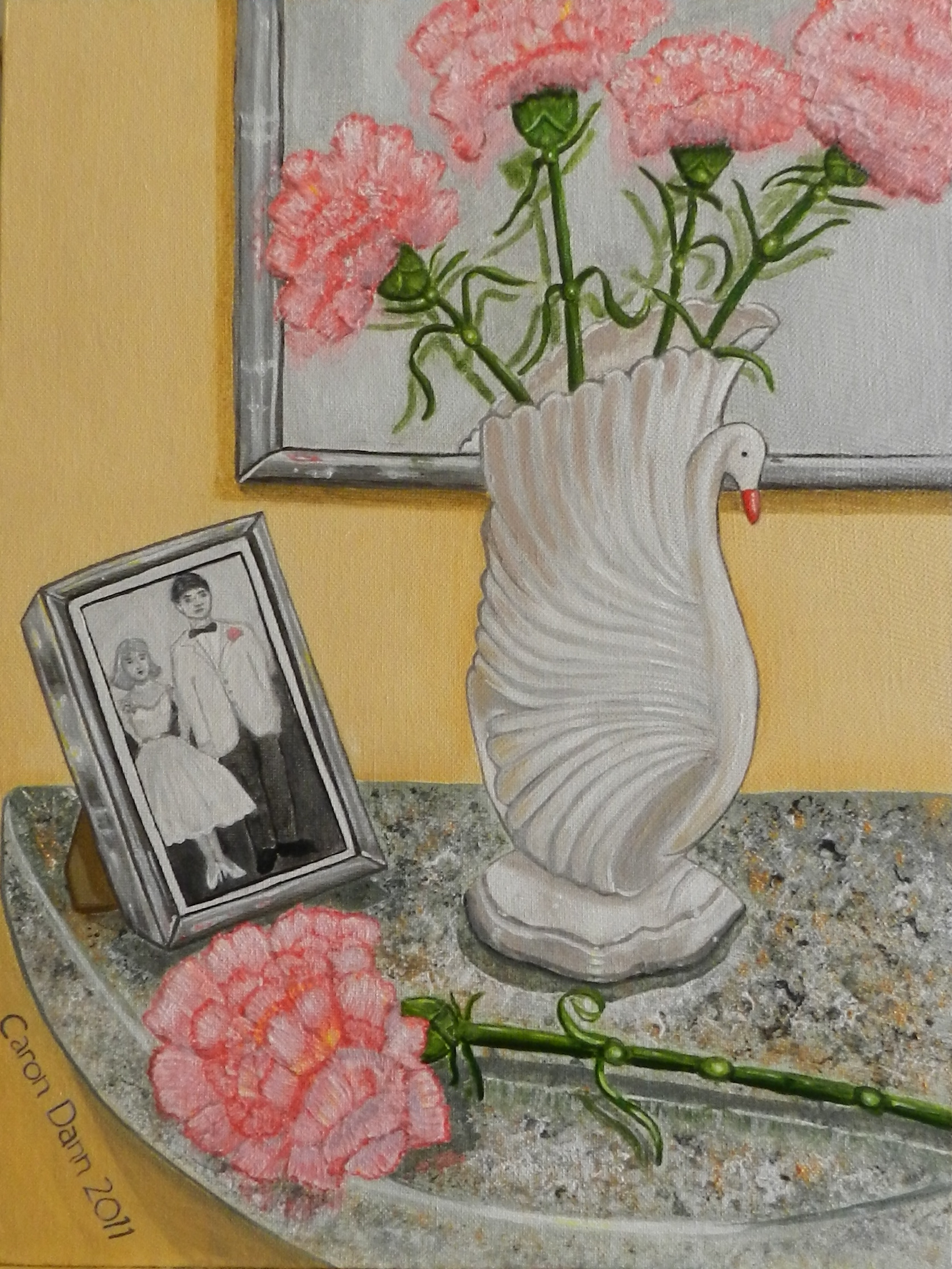
A White Sports Coat...And a Pink Carnation

A White Sports Coat…And a Pink Carnation

“I’m not very smart”

I walked up to the counter today of my local wine shop and noticed there was a new face serving: a young man with a beaming smile, but obviously nervous and trying hard to do the right thing. He was on his own at the counter.

My purchases came to $22 and I handed him a $50 note. He was taking a while to collect the change from the till.

“It’s my first day,” he said.

“Don’t worry,” I replied. “Take your time.”

Eventually, he gave me my $28 change.

“I think the machine might tell you how much change to give,” I said, trying to be helpful.

“Oh yes, it does,” he replied. “But I’m not very smart.”

I started to say “Awww, I’m sure that’s not—”, and he shrugged, and said, “It’s OK,” as if to say “It is what it is”.

After wishing him a good afternoon, I left the shop, feeling sad for him. Not sad that it took him a while to count the change—he got there in the end. But sad that this young man goes through life thinking, “I’m not very smart”. He didn’t say it as I would: “I’m not good at numbers” or, “maths is not my strong point”, because I know I have others. He said it as a whole-life thing: “I’m not very smart”.

Now, children aren’t born thinking they’re not very smart. Somewhere along the line, he’s got this idea. Was it a parent, teacher, sibling, friend, bully…who gave him the idea that he is “not very smart”?

My friend and fellow blogger, Bryan Patterson at Faithworks, wrote a post this week on the different types of intelligence (read it here), and how it’s not an exact science. As I walked home today, I wanted to say to New Man at the Wine Shop:

1) You have a job—they picked you, which means you’re good;

2) You are kind, personable and helpful to the customers, without being overbearing. In my books, that makes you smarter than many people I know.

Good luck to him, and I hope that, someday soon, someone tells him he is smart.