New York, 1968: “Love, Daddy”

NY1968 NY1968_0001

My mother recently gave me some old cards and letters she’d kept, and among them was this wonderful postcard that my late father had sent me when I was a little girl, in 1968. Dad was in the New Zealand army, but we were living in England where he was doing some research at York University, and he had gone to New York on business. This might well be the first piece of mail I ever received addressed to me personally.

It is dated 24.6.68, and he writes:

Dear Caron,

My hotel is just along the road from this big building, and after lunch today, I am going to go right up to the top. I will take some movies, and you will be able to see them when I get home. Love, Daddy.

It reminded me of a much earlier letter I have, from another father to his young child. It is addressed to “My dear little man”, and it was written by my grandfather, Captain Freddy Eastgate, to his son, my father Harold Eastgate (later Captain as well). Dad was 5 when this letter was written to him by his dad, who was a career army man. Years after this letter was born, my grandfather would be away for seven years at the Korean War and with the army in Japan.

MyDearLittleMan

Hut 150
Trentham M. C.
Saturday 16-5-42
My Dear Little Man,
I thought you would be almost better by now. I sent you a small parcel last Sunday but it doesn’t seem to have arrived there yet. There is nothing in the camp much to buy or send to little boys. I hope you are getting better. Try and be a good boy and help Mummy as much as you can. I am going to try and get home to see you next week end. You try and get better by then aye.
Cheerio for now.
Lots & lots of love from
Daddy xxxxxx

I wonder now what was in the parcel and if Dad received it. Dad kept quite a few things from when he was young, so it’s possible whatever it was is still among his possessions, most of which my mother kept.

You’re never too old to dance

juke boxI went into a gift shop at my local plaza, and ahead of me was a very old lady on a walker. She was little and stooped, and didn’t appear to take much trouble about how she dressed. She was wearing an old cardigan and her hair was a little dishevelled.  She handed over some money, then turned to make her way slowly out of the shop. I noticed that her eyes were shining.

The assistant had to tell someone. “See that electronic juke box in the window, the one with all the flashing lights? She’s put it on layby and she’s only got two more payments to make. She’s saving money each week from her pension.”

Is she buying it for a grandchild or something?” I said.

“No—it’s for herself, she says.”

The juke box was $999, an enormous amount of money for a pensioner to pay, even by layby (paying it off in fortnightly instalments).

The old lady was, the assistant said, the most unlikely purchaser for such a thing, and not only because of the expense. “I think she’s suffering from dementia a bit—we couldn’t believe she’d actually see all the payments through.”

I took a picture of the juke box that day, the one at the top of this post.

A few weeks later, I visited the shop again. The juke box was still in the window. “Has she paid it off yet?” I asked.

“Not yet—one more payment. She asked us to put some music on it. I used a flash drive to download a whole lot of songs, which I’ll give to her and all she needs to do is plug it into the juke box,” the assistant continued. “She says she’d like all the old hits from the 1940s and 1950s.”

Another few weeks went by. I walked past the shop and noticed the juke box was gone. I had to know.

“She paid it off today and it’s being delivered to her flat,” the assistant said. “Now she wants more music.” She rolled her eyes.

I have an enduring vision of the old lady young again and accompanied by a handsome beau, playing her juke box and, in her mind, dancing the night away to  Chuck Berry, Jerry Lee Lewis, Bo Diddley, and the Platters.

Rock on—you’re never too old to dance.

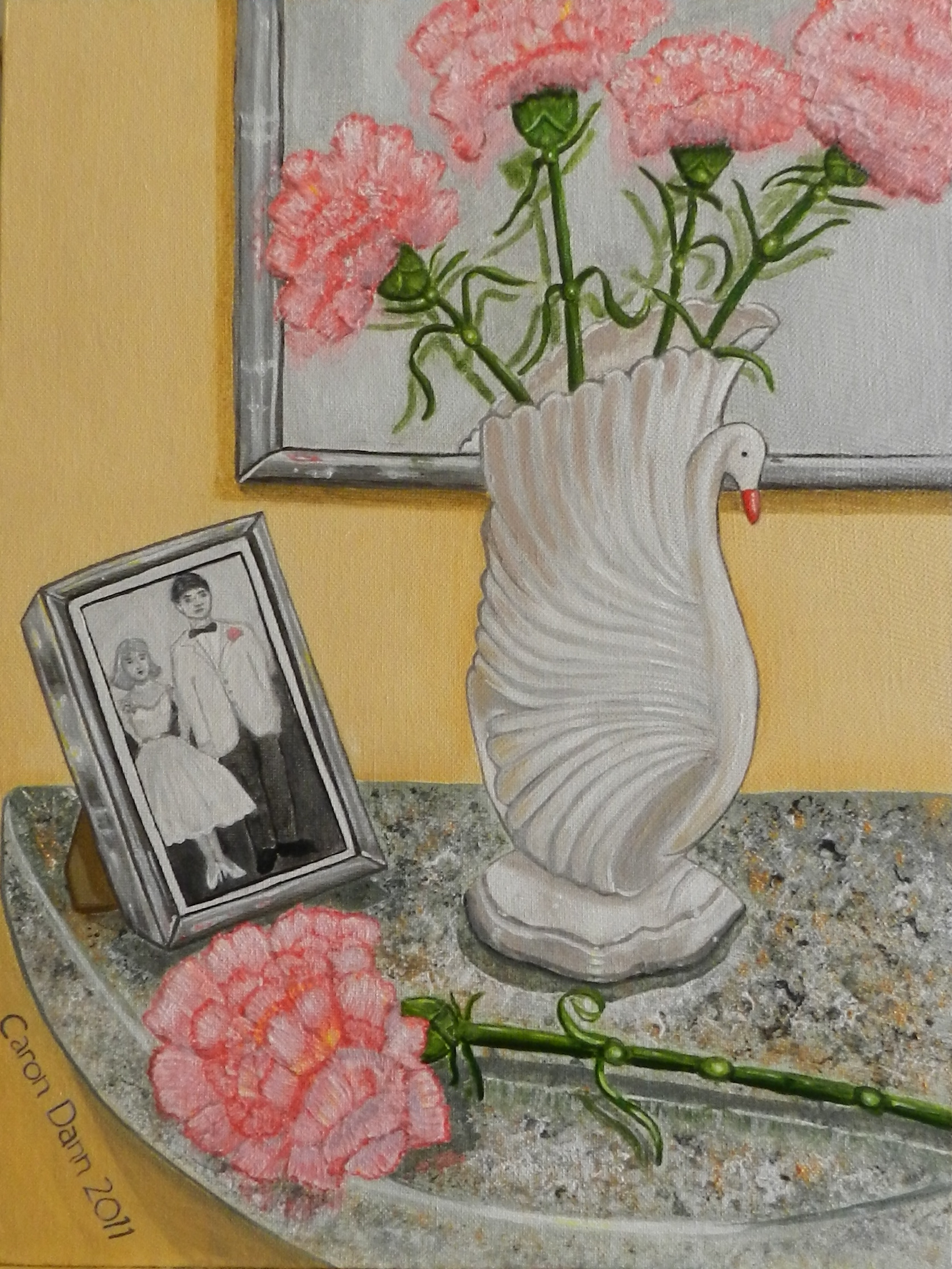
A White Sports Coat...And a Pink Carnation

A White Sports Coat…And a Pink Carnation

My friend and former colleague, Kenny, makes some great points about suburban newspapers.

considerthesauce's avatarconsider the sauce

sub1

My appreciation for and reliance on our suburban press for finding out what is going on in my community have both deepened significantly in recent years.

This process has been hastened by my metropolitan newspaper career fading to memory, at the very time those newspapers fight for survival and seem often to be pre-occupied with major sport, federal politics, shock/horror and click bait.

And, until recently, I was even working on either a regional newspaper (Geelong Advertiser) or its free, weekly “giveaways”, and even (more recently) for the proprietors of one of our three suburban titles.

As well, doing Consider The Sauce has really heightened my desire for information about what’s going on in the greater western suburbs. And I’m not just talking about restaurant reviews – reading the suburban press has hipped me to many festivals and community events, as well as providing information about local politics…

View original post 779 more words

This is a brilliant piece about the way renters are treated by letting agents, especially when they have been instructed to sell a property. What is it with these people? Why can’t they be nice?

skinnywench's avatarA Word in Your Ear

001

About a week before I was due to go on holiday I received a phone call.

“Hello Sue, my name is Nadia and I’d like to arrange a meeting to talk to you about selling the house”.   After 2 years of renting, this was how we found out that the landlady had decided to put the house up for auction!

Since that call we have had nothing but trouble.  Nadia did not turn up for the initial meeting (which I left work early for), correction she did turn up, put a ‘For Auction’ sign up on the fence, got in the car and drove off without even a  knock on the door tell us what she was doing or to cancel the meeting.    When I rang to complain she tried to tell me that I’d got the date wrong then tried to rearranged the meeting for the bank holiday Monday.

View original post 704 more words

“I’m not very smart”

I walked up to the counter today of my local wine shop and noticed there was a new face serving: a young man with a beaming smile, but obviously nervous and trying hard to do the right thing. He was on his own at the counter.

My purchases came to $22 and I handed him a $50 note. He was taking a while to collect the change from the till.

“It’s my first day,” he said.

“Don’t worry,” I replied. “Take your time.”

Eventually, he gave me my $28 change.

“I think the machine might tell you how much change to give,” I said, trying to be helpful.

“Oh yes, it does,” he replied. “But I’m not very smart.”

I started to say “Awww, I’m sure that’s not—”, and he shrugged, and said, “It’s OK,” as if to say “It is what it is”.

After wishing him a good afternoon, I left the shop, feeling sad for him. Not sad that it took him a while to count the change—he got there in the end. But sad that this young man goes through life thinking, “I’m not very smart”. He didn’t say it as I would: “I’m not good at numbers” or, “maths is not my strong point”, because I know I have others. He said it as a whole-life thing: “I’m not very smart”.

Now, children aren’t born thinking they’re not very smart. Somewhere along the line, he’s got this idea. Was it a parent, teacher, sibling, friend, bully…who gave him the idea that he is “not very smart”?

My friend and fellow blogger, Bryan Patterson at Faithworks, wrote a post this week on the different types of intelligence (read it here), and how it’s not an exact science. As I walked home today, I wanted to say to New Man at the Wine Shop:

1) You have a job—they picked you, which means you’re good;

2) You are kind, personable and helpful to the customers, without being overbearing. In my books, that makes you smarter than many people I know.

Good luck to him, and I hope that, someday soon, someone tells him he is smart.

My sentimental journey

Space is at a premium in our house. When we married, we blended two households. Well three, actually, since I had both city and beach residences. We are lucky to rent a three-bedroom unit—most are two bedrooms, so we have the luxury of a study each.

We both had lifelong collections of books; archives of clippings from our long careers as journalists; music collections; clothes we thought might fit us again one day; memorabilia from many travels. A couple of years ago, I copied all my CDs to my computer, then took most of those CDs to the op shop. Cassettes had been thrown out by 2006.

There’s a problem, though: sometimes, I throw out the wrong thing. Many years ago, I discarded all my notes from journalism school and all my assignments from my bachelor’s degree. Now that I am a tertiary educator—something that when I was young, I would never have imagined myself—I would be interested to read them again as artifacts of a generation ago. Mind you, would I have wanted to cart them between three countries and 25 addresses? Not really. Now I’m looking at the three massive tomes in my bookcase that are copies of my PhD thesis. You have to submit quite a few, but you get the two examiners’ copies back. I don’t want them, and neither does anyone else! But it seems wrong, somehow, just to bin them. Perhaps I should use the blank backs of the pages for drawing practice.

Often, you save things for posterity because you think your children might be interested in them when they themselves have children. But if you don’t have children, there seems little point. For example, I recently went through and culled my clippings from three decades: the only person in the long-term future who will be interested in reading my old published stories is me! So I kept only the ones that interest me.

Souvenirs

Just because you don’t still have the souvenir, doesn’t mean you don’t have the memory. I have a collection of snow domes from my travels, but I throw them out when they lose their water. I also collect books and ornaments depicting mermaids, and I bought this retro reproduction from a great vintage shop in Hawaii about 10 years ago. They are salt and pepper shakers!

Poor little mermaid: damaged ornaments with no sentimental value have to go.

Poor little mermaid: damaged ornaments with no sentimental value have to go.

Recently though, when I was cleaning the shelf they sit on, I accidentally knocked the set over and the nose of the mermaid chipped off. It’s always been a difficult set, because there is nothing to hold the mermaid and seahorse together and the mermaid doesn’t stand on its own, so you couldn’t really use them as salt and pepper shakers at a table. So they must go: they have gone. But I have this photo, so I won’t forget them.

What to do with broken stuff
I have two elephant bells that I bought in Chiang Mai in 1991, while I was living in Thailand. The bells are mounted on wooden frames so you can sit them on a shelf. About 10 years ago, one of these flimsy frames broke. I always meant to fix it, but didn’t, and now, some of the pieces of wood have been lost. I realised this week that I will NEVER fix it. Out goes the old frame. I’ve kept the bell itself, which has become a handy doorstop. Meanwhile, the other one’s frame is fine and I’ve put it back on display in my living room (it had been hiding in the hall behind a set of golf clubs).
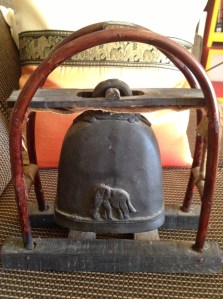
The remaining framed elephant bell. The other bell, minus its frame, is now a perfect doorstop.

The remaining framed elephant bell. The other bell, minus its frame, is now a perfect doorstop.

Stuff that’s not broken
It used to be that you’d never throw out something that wasn’t broken; even if it was broken, you’d try to fix it first, or keep some bits that might be useful.
We have 15 coffee mugs and about 30 wine glasses, plus probably 20 other specialty glasses. For the two of us. I don’t think we need that many. These glasses take up an entire cupboard, two shelves, plus another small shelf. We don’t have a big kitchen.

Crayon Files

Do two people really need this many glasses? And this is not counting the special set from Venice or the martini glasses more often used for shrimp cocktails.

It seems wrong to throw out glasses when they are perfectly good, but we have to do it. We plan to cull them shortly. I reckon six wine glasses is enough for a household of two. I always use the same one, anyway. And six tumblers should be ample, don’t you think?

Sheets and towels
I recently counted our towels and found that we had 13 sets—for two people. Now, colour coding aside (Mr Style-Master likes everything to match), two people do not need 26 towels, 26 face washers and 26 hand towels. There is no linen cupboard in our house, so the Style-Master had to make one and it takes up a whole corner of his study.

Two people need two towels for the bathroom, two for the wash, and two for the cupboard. We could accommodate no more than two house guests at a time, so that’s another two of each. That’s a maximum of eight towels needed, or four sets. Thirteen sets is excessive and we are getting rid of the old ones. Well, some of them.

Photo albums
Remember when people used to put photo albums together of their travels and special events? Mine were complete with typed captions and dates. You would have an album or two on the coffee table so guests could view your most recent trip. But people don’t do this any more. They have electronic photo frames that continuously rotate the photos. And everyone travels these days, so people are not that interested in your snapshots. Even if they don’t travel, they can view any place they like via Google. They don’t need you to show them.
I once had about 10 big albums. They were one of my favourite things. Now, as I dismantle those albums and digitise the images that matter,  I look back and see excess. Yes, I travelled on the Glacier Express train across the Swiss Alps. But I don’t need 100 photos of the journey, icy peak by icy peak. Twenty would be plenty. I used to take loads of pictures in the days of analogue cameras because you couldn’t tell how good the shots were until you had the film developed. I would always be thinking in terms of taking photos for publication, as I used to be a travel writer.
I do still keep the best prints from the old days, but I no longer ever bring them out to show visitors. My visitors no doubt thank me for that.

Sentimentality
In my view, this is a valid reason for keeping some things you no longer use, or that are even broken. My mother has a lot of things from when my brothers were young (in different decades). My first brother was killed in a road accident in 1981; my second brother is now married and lives in the US. So I can understand why she holds on to the books, soft toys, games and so on. Each one has a special memory attached.

Mum also kept a lot of my things that, as a young person, I would have thrown out. I left home at 17, not taking much with me and definitely not wanting to be loaded with childish possessions. Mum recently gave me back some birthday cards I’d treasured as a child, my old music box, some primary school assignments I did and a postcard sent to me by my late father a long time ago (which will be the subject of an upcoming post). I’m really glad now that she saved them all this time, across two countries and five house moves.
Writer’s Diary #5: “Bring out yer dead! Bring out yer dead!”

If you’re a writer, you can probably relate to the idea of there being so many books to write and so little time in which to write them.

I am constantly coming up with great ideas for books, first lines, characters, titles and so on. I have a file for them—well, a few files, actually. I have grandiose-looking title pages with bylines and a copyright line…and no other content. I have outlines, first chapters, premises, character studies, film and stage adaptation ideas.

Image by Dmitry K Valberg

Image by Dmitry K Valberg

The problem is, I am like a child in a candy store: you flit from this piece to that, each one sweeter and more vibrantly coloured than the last. But, sooner or later, you get sick of eating sweets and you crave a nutritious meal.

If you want to continue being a writer, you have to make a decision, knuckle down, and write one book at a time. From start to finish. From cover to cover.

It’s all very well to have ideas, but ideas are cheap. Good ideas are the easy way out if they are not realised: you feel like you’re working on something, but actually, you’re not. Following all the way through on a good idea is much more difficult. Good ideas don’t make you a writer. Writing a complete manuscript makes you a writer. Those two words, “the end”, make you a writer.

I have book ideas from 20 years ago that “might come in handy one day”, just as my grandfather had a shed full of jars of nails, nuts and bolts of different sizes and my father had jars full of hundreds—perhaps thousands—of rubber bands.

I have to realise that I don’t need all those jars of bits and pieces. They will not come in handy.

It’s time to clean out the ideas file and all its cobwebs.

It’s time to get rid of the drafts of my books—they have been published already, so I really don’t need them. I am never going to be such a famous writer that draft marginalia will be worth buckets of money to collectors one day. I don’t have children to pass them down to.

I even have a manuscript written by an old friend of mine who, when she went overseas nearly 20 years ago, asked me to look after it “in case you ever hear of a publisher who wants it”. We lost touch, but I’ve kept it all this time and I’m trying to find her now to see if she wants it back.

There is a finite time in which to write. I have lived more than half my life. I need now to prioritise and to focus on projects one by one that I can research, write, edit, and get published.

Simplifying my writer’s shed with its jars of figurative nuts and bolts and rubber bands will give me more room in which to work, a clear bench on which to craft my works, and a direction in which to proceed.


“Peace is Possible”


At Bloggers for Peace, the Monthly Peace Challenge: Mad Men is to create something that conveys the message of peace: an ad, a slogan, a short film, a poem, a song perhaps.

My modest contribution is this slogan, “Peace is Possible”. It might seem simplistic at first, but it has a powerful message, and that is, don’t give up hope and always think positively. Perhaps the slogan should be “Peace is Positively Possible”.

"Peace is Possible", by Caron Eastgate Dann:  I put together this makeshift peace sign out of bits and bobs—buttons, brooches, earrings (I always knew those buttons you get in tiny plastic packets when you buy something new would come in handy one day).

“Peace is Possible”, by Caron Eastgate Dann: I put together this makeshift peace sign out of bits and bobs—buttons, brooches, earrings (I always knew those buttons you get in tiny plastic packets when you buy something new would come in handy one day).

I was reminded how important hope is for achieving goals by my friend Bryan Patterson on his Faithworks blog this week.

Without hope, we may as well give up. With hope, there is still possibility.

Kozo at Bloggers for Peace has discussed (in the post linked above) the idea that in achieving a goal, it is important to affirm what you want, such as “Peace is Possible”, instead of making a negative statement, such as “No war”.

By envisioning what you want, you can work towards it. This reminded me of something that happened to me 10 years ago. I was working as the branch editor of a magazine, and was particularly unhappy with the way the job had progressed under a new supervisor. However, I felt trapped because I had a big mortgage and needed the regular income.

My friend, who is now a clinical psychologist, asked me what was wrong, and I explained. She said, “So, what do you want?”. I told her I wanted to become a freelance journalist and work for myself from home while continuing my PhD studies. She said that because I already knew what I wanted, I had won half the battle. “Now, you just have to work out how to get there,” she said.

I decided to sell my expensive house for a cheaper one in the same area, thereby halving my mortgage. I could now afford to become a freelance and casual journalist, and did so for about four years, until my PhD was complete and I became a university lecturer.

So, if we know what we want (peace), I reckon we have won half the battle. Now, if we could only work out how to get there…

Check out Fish of Gold’s incredibly cute animal drawings, including the platypus, whose odd looks FOG captured perfectly.

goldfish's avatarFish Of Gold

The other day, I showed you how I drew a giraffe and I asked for suggestions on what to draw next.

Caron Eastgate Dann suggested I draw a platypus:

Platypus. Suggested by Caron Eastgate Dann.

Behindthemaskofabuse suggested I draw a dragon:

dragon1

Kozo suggested I do a calendar of all the Chinese zodiac animals starting with a snake:

snake

But he really wanted me to draw a fox:

fox

And finally, C. R.requested a butterfly:

butterfly

That’s all for today. I’m spent and I haven’t even written anything. The request line is now closed (maybe).

View original post