How do you interview a hitman?

The news that one of Australia’s most notorious underworld figures, Mark Brandon “Chopper” Read, 58, died of liver cancer today, has prompted me to reflect on a series of interviews I did with him 10 years ago.

At the time, and then known as Caron James,  I was Melbourne Editor of Woman’s Day magazine. The story was to be about his wedding to childhood sweetheart Margaret.

At first, I was reluctant to do the interview. My editor asked me if I would like a body guard! I declined, saying it wasn’t that I was in any way scared, just that I had problems with the ethics of doing such a story.

Anyway, I did do it. I met Read and Margaret at his favourite pub in the Melbourne suburb of Collingwood.  He was personable and insisted on buying me a gin and tonic. Carefully, I called him “Mark”.

My interview with Mark Brandon "Chopper Read' and his wife, Margaret, in 2003.

My interview with Mark Brandon “Chopper” Read and his wife, Margaret (centre), in 2003.

“Aww, call me Chopper,” he said, “Everyone else does.”

I turned to his wife and said, “Margaret, do you call him Chopper?”

“Of course not,” she replied. “I call him Mark.” So Mark it was.

This was a true love story. Margaret had met Mark in a fish and chip shop when they were teenagers, before he turned to crime. They went out for a while, but separated. But she always loved him. She waited for him for decades, never marrying anyone else or having children. Margaret lived a blameless life, working hard and buying a little house for herself. But she never forgot her first love.

Finally, in her 40s, they got back together again, after he had married (then divorced) another woman in Tasmania and had a child, Charlie. Mark and Margaret had their own baby, Roy, in 2003 when she was 43.

After the Collingwood pub interview, I met them several more times, attending the launch of one of his books and even going to their house to see their baby. I witnessed Mark as a tender father and loving husband, and it was hard to reconcile that image with the more commonly known one, the violent criminal who spent 23 years in jail, during which he cut off his own ears.

His life of crime was covered in the 2000 movie Chopper, starring the excellent Eric Bana, which in turn helped take Bana from Australian comedian to big-ticket Hollywood movie star.

I guess, at the end of the day, you have to give Mark Brandon “Chopper” Read credit for being rehabilitated, for joining society as a writer, artist, performer. Cynics would have a lot of criticisms.

Tonight, though, I feel sorry for Margaret, who has lost a man, a husband, the father of her only child, rather than the mediatised “former hitman” and later “colourful character” as the media depicts him.

Roses are red, my love

A strange thing happened at my place today.

We have a fully enclosed courtyard at the back of our house, with table, chairs and barbecue. It backs on to a lane way, but there is a high roll-a-door which is the only access. We are the middle of a block of three, with a fence and lattice top on each side.

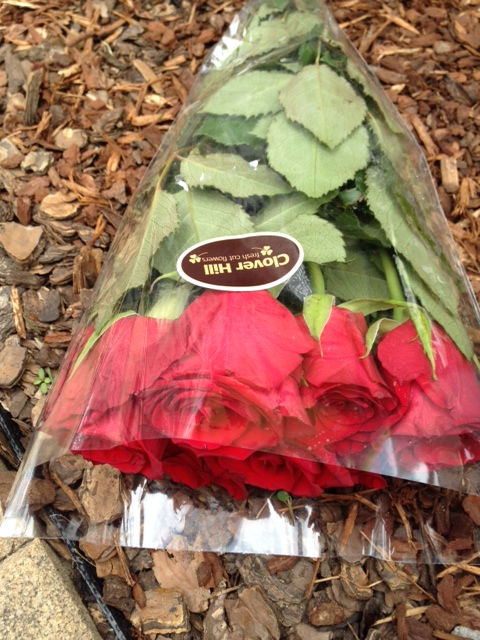
So, this morning, just near the back of the table and chair set, I found on the ground a fresh bunch of roses, still in its cellophane and not in the least bit wilted.

Rose 1From the angle they are in, it doesn’t look like they could have been tossed over the roll-a-door from the lane way. Now I’m wondering which of our neighbours threw them there and why.

In my mind, I have a whole film scenario playing out: the Bad Partner has bought the roses for the Hurt Partner, to say sorry. But the Hurt Partner says this is not good enough, and the Bad Partner cannot be forgiven. In fact, it’s over.

The mind boggles. I can understand how, in anger and sorrow, you might toss the gift away, over the roll-a-door and into the laneway behind the house. But I still can’t fathom why you would pop them over the fence to the neighbours.

Oh well. Now I am left with a perfect bunch of red roses. Do I knock on the neighbours’ doors and ask if they have “lost” some flowers? Or do I take off the cellophane, put them in a vase and enjoy them?

Or…is it one of those Candid Camera type TV shows, filming me to see if I keep what’s not mine? Or perhaps secret agents have mistakenly targeted me and planted listening devices in the blooms…

rose2

John Lennon —- conspiracy theories, a new photo and an imagined audition

What if John Lennon auditioned for The Voice? It’s true, these shows do foster a rather conventional idea of what a popular singer should be, a bit like saying that the only valid art is realism.

bryanpattersonfaithworks's avatarBryan Patterson's Faithworks

John-Lennon-2297592

JOHN Winston Ono Lennon’s 73rd birthday today coincides with the publication in Britain of a rare Lennon and McCartney picture (above) taken a year before they hit the big time. The two were photographed in the summer of 1961, a year before the Beatles scored a record deal and became, well, rock and roll history.

MEANWHILE

A new US poll reveals that 12 per cent of American voters believe the government was engaged in the assassination of Lennon.

This supports the theory that you can get 12 percent of people to agree to just about anything.

MEANWHILE

Some smart cookie imagines what would happen if a young Lennon auditioned for The Voice.

View original post

The letter you don’t want…but know you need

I got a letter today. My name and address were hand written (slightly erroneously, but no matter) and it felt like there was a card inside: perhaps an invitation to something interesting?

Eagerly, I tore open the envelope and found… a reminder from my dentist to say it’s six months since my last appointment. Boo!

dentistOn the bright side though, it’s not really six months. It’s a trick I played on myself. I asked my dentist’s receptionist to send me the reminder two months early because a) It takes me that long to force myself to make an appointment and b) I really should go three times a year, for the health of my gums. If I go before the end of the year, I will have been three times this year.

BUT. I. AM. NOT. GOING. IN. OCTOBER!

Position vacant: journalist. (Journalists need not apply)

I came across a job advertised online this week in which a website for sports fans was seeking a journalist to write for it. Read on, though, and you are told the successful candidate “WON’T have any professional journalism experience or qualifications” (my emphasis).

Yet, in another paragraph, it says the successful candidate is  probably already doing this journalism in their “free time”. If you get the job, you will “Write articles, generate discussion, host forums and use the…platform to grow your online following and generate copious amounts of discussion around a topic we all love. SPORT.”

To me, all those things constitute journalism in some of its many and varied forms today. What they really mean is that you must never have been paid to write. Pity if you’ve had to make a living in the meantime—but I digress.

The great irony is that this job pays—not much, but $10,000-$20,000 a year “OTE” (which, as I’ve discovered after seeing it in several job ads, means “on target earnings”, traditionally used for sales positions as a guide for what the company thinks you might be able to make).

Given that you’re never to have been paid for any journalism, wouldn’t the first story you wrote for the sports website actually then preclude you from continuing with the job? Anyway, it would disqualify you from getting another such job, since you are now a professional journalist.

I agree that in the digital world, you don’t necessarily have to have trained and been paid as a journalist or to have formal qualifications in journalism to practise journalism. There are many great aspects of citizen journalism that I like—and certainly, it cannot be ignored.

But I wonder what it is about journalists or people who have studied journalism that this company so dreads? They have a very old fashioned idea of what a journalist is or is not: these days, the term “journalist” has a very broad application, and can’t be easily delineated.

And what is “professional journalism”? For example, if you write a blog and you get free tickets to a concert, or a free book or meal for review, technically, you are being paid for writing. Does that mean a blogger who has accepted one freebie couldn’t apply for the aforementioned job?

What nonsense.

Journalists are among the most adaptable people I know. If the job requires them to write like a fan, they’ll write like a fan. You CAN be a sports fan…and one of those dratted  journalists, too, amazingly.

Sideshow alley and the silver dollar

The Caryon Files

At the Royal Melbourne Show, 2013. These days, it’s $5 a game (five balls). There aren’t many prizes there worth more than that… Picture by Caron Eastgate Dann, 2013

When I was a girl living in Auckland, New Zealand, we went to the Easter Show every year. What fascinated me most  was the sideshows section: the clowns with open mouths that you dropped table-tennis balls down in the hope of getting enough points for a soft toy; shooting tin ducks as they rolled out in a row; trying to fish things out of paddling pools; throwing rings around various prizes…I loved it all.

I particularly liked the rows and rows of cheap trinkets for sale. My favourite was the doll on a stick. I don’t know why: maybe it was the glitter that made them look so appealing. Anyway, I never got one. But then again, I probably never asked for one. Children didn’t, in those days. You just hoped your parents would somehow know that you desperately wanted something, and that they would magically buy it for you.

I was reminded of this because this week, my husband and I went to the Royal Melbourne Show. I haven’t been since I first moved to Australia more than 20 years ago.

And there they were: the glittery dolls on sticks. There were Kewpie dolls, mermaids, fairy dolls and more. I could have one for $8 or $12.

I didn’t buy one. Instead, I took these photos, which as my husband remarked, we could send to our digital photo frame that sits in our living room:

Picture by Caron Eastgate Dann, 2013

Picture by Caron Eastgate Dann, 2013

IMG_2129

Picture by Caron Eastgate Dann, 2013

Despite all those childhood memories of candy floss (cotton candy), dolls on sticks and clowns in a row, I think the music died for me in regard to sideshow alleys the day I learned a lesson about longing for valueless trinkets.

We were living in Pacific Palisades, Los Angeles, and I was 11. One weekend, there was a local fair and my brother and I were allowed to walk down the road to it. We both had a couple of dollars saved up, and that would be enough for some games and some forbidden confectionery (our dad was a dentist).

At one toss-the-hoop game, I was mesmerised by a plush soft toy that I was determined to get. I was nearly there, just narrowly missing it on my last attempt. The stallholder felt sorry for me.

‘You can buy it, if you want,” he said.

“How much is it?”

“A dollar.”

I was crestfallen. I had nowhere near a dollar left. Then I thought of a great idea, and a way to get that toy.

“Would you accept a silver dollar?” I said. “I have one at home. I could go and get it.”

The stallholder should have said no. Instead, he said, “Well all right, if you want to do that.”

For those who don’t know, a silver dollar was a US coin, some versions of which were made of 40% silver and 60% copper (thus worth more than its face value). They were made by the US mint for collectors, and were not much circulated. My grandparents had visited us in LA from New Zealand recently, and we’d taken them to Las Vegas. My grandmother put a small amount of money in a slot machine and…out came tumbling 20 Eisenhower silver dollars. She gave one to me and one to my brother. It was the sort of thing you would keep forever because your grandma gave it to you.

But off home I went, into my little box of treasures, fished it out and back to the show with it, where I paid for my coveted toy.

You know, I can’t even remember today what that toy looked like. I do remember many years later, as an adult, throwing it away in disgust because I wished I’d kept the silver dollar.

I inherited the other silver dollar from my brother, Phillip, who died at a young age. But it just wasn’t to be. Years later, thieves broke into my house and stole just about everything portable, including my jewellery boxes with their sentimental bits and pieces, Phillip’s silver dollar among them.

So now I go to shows and just look. I keep my dollars in my purse—even though they’re not glamorous Ike silver dollars, but just plain old Australian copper $1 coins.


“I’m late! I’m late!”

IMG_2072It seems we’re constantly rushing in our stressful world. There’s never enough time: we’re always “running out” of it or it is “getting away” from us or “catching up” with us.

I had a friend in the 1990s who was constantly late for everything. When I asked him why this was, and asked if he didn’t think it was rude, he said he found it very strange to see people rushing everywhere constantly. “Because, you rush rush, rush to get somewhere, only to sit down for hours when you get there,” he said.

He had a point, and I’ve never forgotten it. You rush, rush, rush to get to a restaurant, then sit down for a leisurely meal; you rush, rush, rush to catch the train, then sit down for the journey just filling in time;  you rush, rush, rush to get to a social engagement, then when you get there, you just sit down or stand and chat to people over a drink or a cup of tea. It goes on and on.

While I still think it’s rude to be late to an appointment, in pursuit of a peaceful life it’s worth thinking about how our perceptions of time intrude to heighten our stress levels. The Greek philosopher Epicurus (341-270BCE) said the recipe (no pun intended) for a peaceful life included freedom from fear of death. But when we’re constantly measuring time, freedom from this fear doesn’t seem likely for many people today.

In his novella The Time Keeper (2012), Mitch Albom notes that humans are the only beings who mark the passing of time and thereby dread mortality. Here is one of my favourite quotations from the book, one that so clearly expresses the angst at the centre of almost everyone in western society today:

“Try to imagine a life without timekeeping.

“You probably can’t. You know the month, the year, the day of the week. There is a clock on your wall or the dashboard of your car. You have a schedule, a calendar, a time for dinner or a movie.

“Yet all around you, timekeeping is ignored. Birds are not late. A dog does not check its watch. Deer do not fret over passing birthdays.

“Man alone measures time.

“Man alone chimes the hour.

“And, because of this, man alone suffers a paralysing fear that no other creature endures.

“A fear of time running out.”

We humans are so obsessed with counting seconds, minutes, hours, days, weeks, months and years, and running our lives by the boundaries they impose, that sometimes we forget to stop along the way. Life seems tumultuous and anything but peaceful, because we’re constantly looking at our watches and hurrying along to get to the next place “on time”.

Lewis Carroll  used this idea in the character of the White Rabbit in Alice’s Adventures in Wonderland (1865). “Oh dear! Oh dear! I shall be too late!” he cries as he runs down the rabbit hole. In the Disney film, this becomes a song with the lyrics “I’m late! “I’m late! For a very important date!”

So what’s the best way to a peaceful life? I think we need to do less time-keeping and more living.

Another thing to think of is that we’re not the centre of the universe. In fact, we’re rather insignificant, as Sir David Attenborough so cleverly put it in Life on Earth, I think: if you imagine an entire beach, the earth is equivalent to just one grain of sand on it.

In the blogosphere, Goldfish has put life on earth in perspective with her post on finding peace through this insignificant position we hold, in which our petty ticking seconds with which we time our days mean absolutely nothing in the vastness of space. You can read her post here.

Funnily enough, this post is the result of being almost late—for this month’s Bloggers for Peace challenge to write about quotations that bring peace to the world. I’m in today in the nick of time. Whew!

The sad case of Margaret Mary, professor of the working poor

gownWho are the “working poor”? They’re not who you might think.  Well, they are, but in addition to the stereotypical image—a person working in drudgery at a lowly paid and insecure non-skilled job with no hope of dragging themselves out of it—is another, largely forgotten by governments and media alike.

The hidden working poor in western countries such as Australia, New Zealand and the US, include some of our most highly skilled, highly educated professionals. One of those professions is tertiary education. You probably don’t realise that more than 50%—and in some cases up to 75%—of the academic staff at the uni you or your children study at are paid on hourly rates for what is clearly not a casual job, and for little more than half the year.

On paper, the hourly rates look quite good. But not if you factor in actual hours worked, the high amount of extra unpaid work required, the fact that you don’t get paid if you are sick or have to take any other leave, or if your rostered hours fall on a public holiday, that you receive no holiday pay, no security, and that employment is available for only 30 weeks or less a year. I know all about this, because I’m one of them; for six years, my primary employment has been as an academic on sessional or short-term contracts.

This post was inspired by a very sad story this week, posted by my friend Jane on Facebook. “Death of an adjunct”, in the Pittsburgh Post-Gazette on September 18, told of Margaret Mary Vojtko, who worked as an “adjunct professor” (a “sessional academic” in Australia) of French at Duquesne University in Pennsylvania for 25 years.

She was being treated for cancer and had huge medical bills. She was penniless and mortified about being in such reduced circumstances that protective services authorities had threatened to take her into care. She died on September 1 at the age of 83, after a heart attack.

She had recently been fired from her job, and when she was contacted by Adult Protective Services demanding she meet them to discuss her dire situation, she called Daniel Kovalik to intervene. He is the senior associate general counsel for the United Steelworkers union (more about that below).  Kovalik wrote her story for the Post Gazette, and I’ll let him continue here:

“I called Adult Protective Services right after talking to Margaret Mary, and I explained the situation. I said that she had just been let go from her job as a professor at Duquesne, that she was given no severance or retirement benefits, and that the reason she was having trouble taking care of herself was because she was living in extreme poverty. The caseworker paused and asked with incredulity, ‘She was a professor?’ I said yes. The caseworker was shocked; this was not the usual type of person for whom she was called in to help.

“Of course, what the caseworker didn’t understand was that Margaret Mary was an adjunct professor, meaning that, unlike a well-paid tenured professor, Margaret Mary worked on a contract basis from semester to semester, with no job security, no benefits and with a salary of between $3,000 and just over $3,500 per three-credit course. Adjuncts now make up well over 50 per cent of the faculty at colleges and universities…”

Kovalik says the most she could earn, when teaching three classes a semester and two over summer, earned her less than $25,000 a year net, with no health care benefits. Then she became ill and had to cut back on classes, earning less than $10,000 a year. She could no longer afford electricity. Kovalik continues:

“She therefore took to working at an Eat’n Park at night and then trying to catch some sleep during the day at her office at Duquesne. When this was discovered by the university, the police were called in to eject her from her office. Still, despite her cancer and her poverty, she never missed a day of class.

“Finally, in the spring, she was let go by the university, which told her she was no longer effective as an instructor — despite many glowing evaluations from students.”

If you want to read more about Margaret Mary, there’s a link to Kovalik’s story here.

Now, Duquesne University is the largest Catholic University in Pennsylvania and has 10,000 students. On its website, Duquesne says its staff “are the catalyst behind the University’s growth and prosperity. The University’s remarkable advances in higher education, technology and research are a testament to their hard work and drive.”

I think of Margaret Mary and know there is something wrong with those website claims. A line from Orwell’s Animal Farm comes to mind: “All animals are equal, but some animals are more equal than others”. Her story went viral this week, and a follow-up on Inside Higher Ed explains that when Duquesne adjuncts voted to join the United Steelworkers Union last year, they were blocked by legal action taken by the university on the grounds it should be exempt from labour laws because it was a religious organisation.

In Australia, there are many people in the same situation as Margaret Mary. Every year in November, tens of thousands of academics across Australia brace themselves for the long, lean times ahead with no pay at all until the semester starts again at the end of February or beginning of March—and that’s if they get a job at all. They often don’t know until a couple of weeks or even days before the semester starts. Mid-year, it’s the same, though not as long a break.

Some find casual jobs working at supermarkets or homeware superstores, waiting tables, or perhaps the very lucky ones might get some shifts at a book shop. Many just hunker down for the lean summer months—at least they won’t have to pay for heating—and wish away their well-deserved break.

Of course, academia is not the only area of mass casualisation. I use it as a case study to point out this growing problem of “working poor”. It is short sighted in the extreme: it means so many more people in the future will be reliant on welfare to survive. Or, they will just work until they die.

This is particularly so of single people who don’t have any other person’s income to help with expenses or to cover the lean times. Over the last few weeks, I have been talking to several of my friends, women in their 40s and 50s, who are terrified of what their financial future holds because they can’t find a permanent job.

The New Zealand Listener magazine this year focused on this mass casualisation in a story about “the rise of the precariat class and the end of the golden era of work” (by Karl du Fresne, May 18-24, 2013). The term “precariat”, a portmanteau of “precarious proletariat”, was coined by the British economist Guy Standing in his book, The Precariat: The New Dangerous Class (2011). Initially, it referred to people in unskilled casual jobs, with little education and no prospects. The article, which you can read here, said that in New Zealand—and I’m widening that to Australia as well—the term had morphed to include many well educated people in skilled jobs and professions.

Those in the precariat, according to the article, include accountants, air crew, government employees, and educators at all levels from pre-school teachers to university lecturers.

We will probably never go back to the era when a job meant full-time employment and entitlements. But as a society, we need to think more deeply about sustainable patterns of work and employment.  What we have at the moment is just not good enough.