Weekly Writing Challenge: the great ebook versus pbook debate

Over at The Daily Post,  They’re having a debate about ebooks versus printed books. There’s been so much talk about how printed books are doomed, that there’s a danger this  could become a self-fulfilling prophecy.
Now, I am both a bibliophile and a bookworm. I have loved books for as long as I can remember. I also love new technology and, since 2008, have made a concerted effort to keep up with it. I love my Mac, iPhone, iPad and Kindle and I learn something new about them every day.

kindle
Well, I don’t learn so much about the Kindle, because there’s not much to learn: and that’s the way I like it. I have the old-style one with the keyboard, bought in 2010, from memory. My husband has a new one with a touch screen and virtual keyboard.
I have to say, I like mine better. The touch screen is annoying because you can suddenly touch the wrong thing and lose your page. The virtual keyboard is harder to use. Not that I use the keyboard much. My Kindle is for reading—not for games, emails, Facebook or surfing the net. Just reading.
That pretty much makes my Kindle just like a real book, only weighing less. When I first got it, I thought I would miss the physicality of a printed book. But that’s only a peripheral thing. Once I start reading, and lose myself in a book, the medium doesn’t matter; I forget about the medium entirely, unless it’s obtrusive or clunky.
If I turn my iPad to airplane mode, I can read comfortably on it. Ditto, even the iPhone—excellent for commuter trains when you can’t get a seat and have to stand.
HOWEVER—and it’s in upper case because it’s a big however—I still like printed books. The book, to my mind, is one of few things in the world that I call a perfect invention: that is, it’s not necessary to improve upon it.
The printed book is portable (more or less, depending), doesn’t need batteries, and is very durable.

As a young journalist, I wormed my way into a position of literary editor of the then-Sunday Star newspaper in Auckland. I interviewed Jeffrey—now Lord—Archer (a hilarious story for another time). I asked him to sign my copy of his latest paperback, First Among Equals, which he did.
Then my flatmate asked to borrow the book and took it away camping. When he brought it back, he apologised for its condition, explaining that he’d dropped it into a puddle. Because of the autograph, I still have that paperback 28 years later: it is a wreck, but it’s still readable, and none of the pages is even loose.

Archer, Crayon Files
Another reason the printed book is a perfect invention, is that it’s not seen as a security risk. You can read it anywhere, any time (unless it’s a banned book, of course). I love my Kindle for journeys, because it means I can travel lighter—and buy more books while I’m away. BUT, I still have to take a book for planes, for landing and taking off when electronic devices must be turned off.
Another perfect invention that has not been superseded by new technology is the transistor radio. This is because the batteries last forever, radios are comparatively cheap to buy, and you can listen all day and night for free. Despite all my expensive, high-tech devices, I still have a portable radio in my bathroom. It’s simple, cheap to run and it always works.
radio
It seems that whenever a new medium becomes popular, lots of people think the old medium will disappear. While sometimes this is true: the telegram, for example, was largely trumped by more convenient and cheaper phone and email services. I was surprised though, in the course of researching this post, to discover that some countries still offer telegram services, although Australia’s closed in 2011. New Zealand closed its service in 1999 but reopened it in 2003 for business customers: apparently, it’s useful for debt collection services.

But there are a lot of old media that have not been superseded by the new.  My mother says that when she was young, everyone thought TV would spell the end of films and that all the cinemas would close down. This didn’t happen.

Similarly, live theatre didn’t die when film came along, video didn’t kill the radio, digital music didn’t kill vinyl. The latter is the most interesting of all. It was said that cassettes and the “indestructible” (ha ha, what a lie) CD would put paid to vinyl records. But now, the cassette is dead, CDs are on their way out, and vinyl is back in a huge way.

What happens is that the old medium changes to accommodate the new. So, for example, we no longer have news reels before movies at the cinema.

I believe that ereaders and printed books can continue to exist side by side.
How great for students to be able to get electronic text books, which are so much cheaper and easier to carry than the printed versions.
For myself, I prefer text books and academic texts in printed form. This is because I’m constantly looking up notes, indexes and other references, and often have seven or eight books on the floor beside my desk, all open at different pages. Even though I’ve got a huge screen on my Mac desktop, I can’t quite emulate the convenience of my books-on-the-floor method.

Aesthetics is another reason printed books will remain: the world is full of collectors, and showing someone your collection of ebooks isn’t quite the same as showing them your collection of 200 vintage books on Thailand, as I have.

So let’s agree to live and let live: ebooks and printed books side by side in glorious harmony.
Digital art versus traditional art media

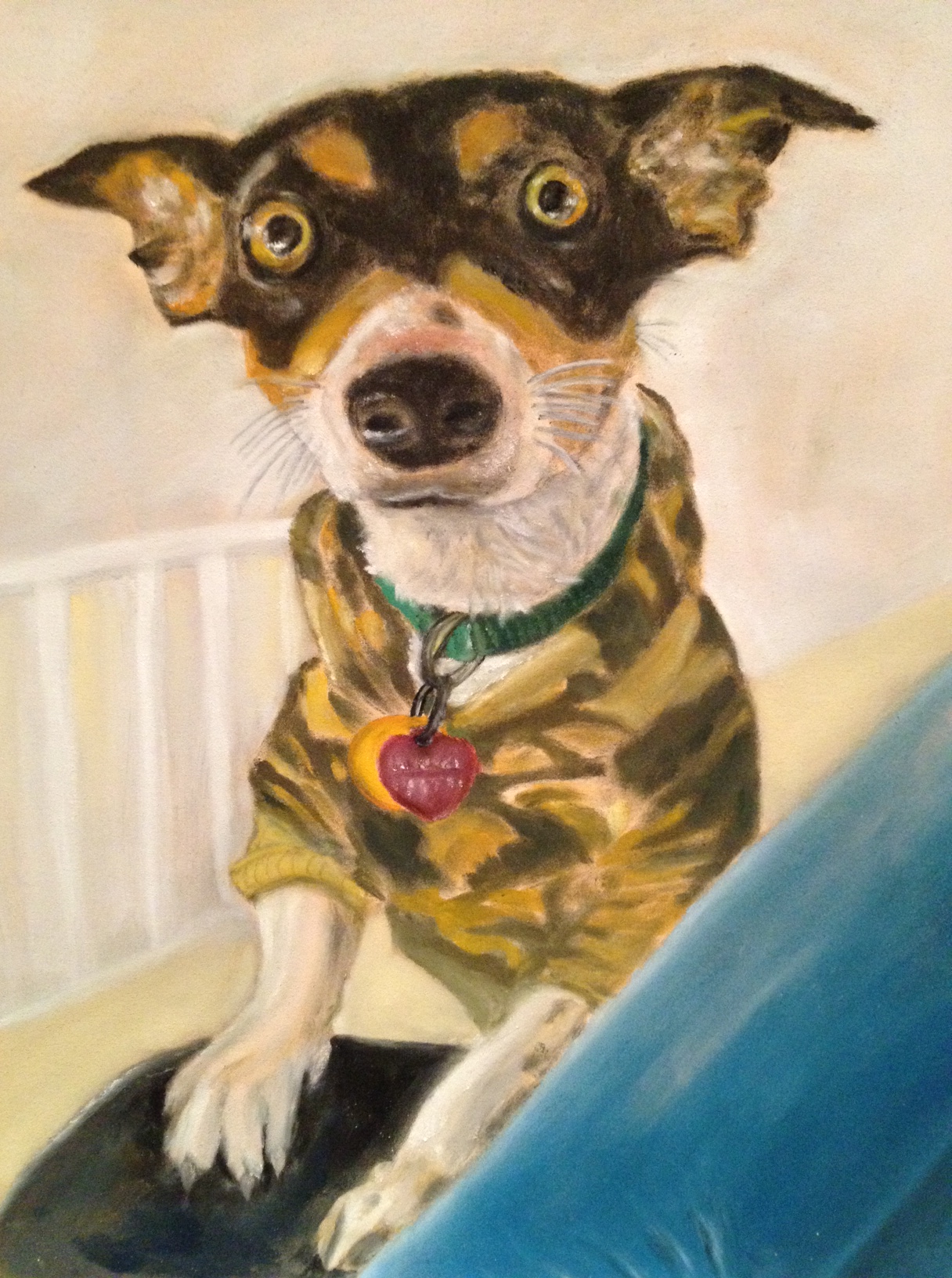
The blogger known as Fish of Gold, who is an art director by profession but who is also an artist, was discussing how different in style her fine art is using traditional media such as charcoal and pencil, from the artwork she does using digital media (see more here). I am just an amateur artist, but I have noticed the same thing with my art. So, for example, here is a pastel painting I did of my brother’s dog, Maggie:

"Maggie", by Caron Dann, 2012.

“Maggie”, by Caron Dann, 2012.

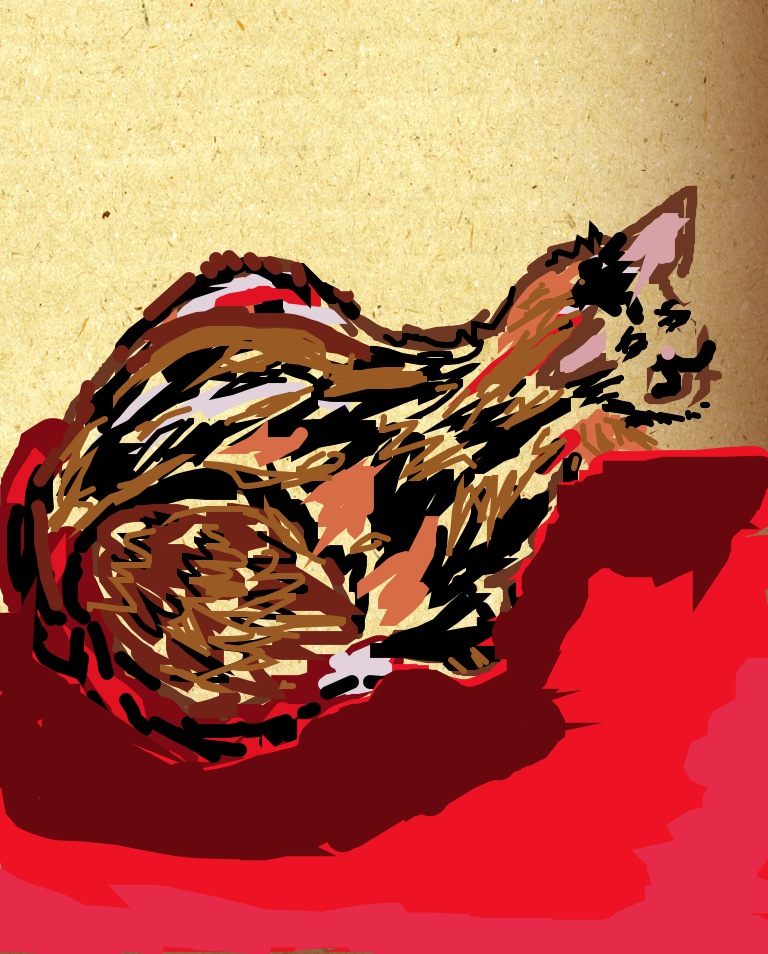
In comparison, have a look at how different this digital painting is, done with my finger on an iPad, depicting my cat, Lucy Locket:

Lucy Locket, digital painting by Caron Dann, 2012

“Lucy Locket”, digital painting by Caron Dann, 2012

Maggie took me weeks to do, but Lucy took me only about 15 minutes. Lots of people like the style of the Lucy painting better! I could get a similar result using paint if I used my fingers and not a brush, I guess. But I wouldn’t—painting to me is about brush work, sometimes fine brush work.

So, perhaps Marshall McLuhan was right in this regard, and the medium really is the message. (By the way, here is an interesting MM memorial website run by his family, I think: http://www.marshallmcluhan.com/).

My Brilliant Careers

Well, that’s what I’d like to think, with a nod to the famous Australian book, My Brilliant Career, by Miles Franklin.
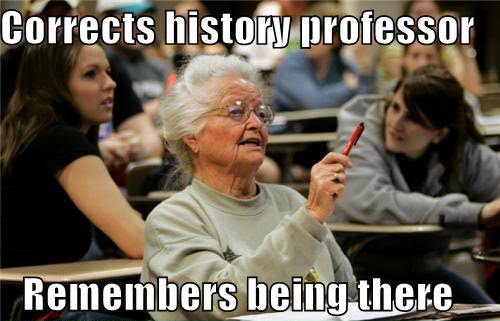
In reply to The Retiring Sort’s Future Challenge post about second and third careers  (which you can read more about here), I am much in favour of them. Gone (mostly) are the days when someone retired at a set age and expected to die a few years later of old age. People are starting new careers in their 40s, 50s, 60s and older.

CorrectsHistoryProfessor-RemembersBeingThere
It’s exciting to think, for example, that one of New Zealand’s best selling authors, Jenny Pattrick, did not have her first novel, The Denniston Rose, published until she was in her 60s. Now well into her 70s, she’s still going strong. Before she was a novelist, she had a long career as a jeweller.
The great British novelist P. D. James, now aged 92, did not have her first novel published until she was in her early 40s, and did not give up her career as a hospital administrator until she was 48.
After a couple of decades as a journalist, I did a PhD in literary studies in my 40s and have worked for five years as a university lecturer in media studies.
But it’s hard to get an ongoing position in this field: perhaps harder than it is to get a full-time journalism position these days. So I could be heading for a third career—I’m thinking I might become a secondary school teacher. That would require me to get a diploma, which would take two years part-time.
What I’d most like to do, of course, is be a full-time writer, instead of having to write in my “spare” time. I’ve already had two books published and I’d dearly like to do a third. Perhaps this will be my next career. I once asked my late father, who was a dentist, what career he would choose above all others if he had the talent to do anything. He replied that he’d be a best-selling novelist, because he could be famous without being recognised in the street (debatable though in these days of modern media). Unfortunately for him, he couldn’t write fiction.
I know many people in their 50s and older who are sick of the career they have chosen—because it has changed so much, because there is ageism in it, or because there is a drive to employ cheaper staff and casuals. I urge them to think about what they would like to do, to plan for it, retrain and take up something new. It took me five years to get my PhD while working full-time for most of the duration, but I’m very glad I did it.
Even if gaining a qualification doesn’t lead directly to a job, the sense of satisfaction involved is worth its weight in gold.

What’s In a Name?

A few people have asked me to explain the title of my blog, The Crayon Files. It actually evolved from an apt nickname someone once gave me.
My first name, Caron, is a French surname (as in Leslie Caron, the dancer and star of Gigi, for whom I was named).

I’ve been writing constantly since I knew how. When I was a journalist, I always scribbled down my notes in shorthand. I worked for years in the 1990s at a tabloid TV magazine that had a big youth readership. During that time, I appeared in an ABC (Australian Broadcasting Corporation) series for children titled Writers and their World, or something similar.  I had thought it would be an innocuous little show screened during the day and forgotten. But the power of TV in those days was extraordinary. The series was shown during the day all right, but loads of children, their parents and teachers tuned in, and it was repeated for years. I was even recognised in the street! “Are you on TV?” a stranger asked me one day. “No,” I replied, truthfully I thought. “Well if you’re not, you’re a dead ringer for that girl on that show about writers,” he said. I had to then sheepishly admit that it was me after all. A local shopkeeper recognised me too.
Then the funniest part: I was then our magazine’s reporter for one of Australia’s highest rating shows, so the cast knew me well. So, one day, they were in the makeup room preparing for the day’s shooting. There was a TV in the room, which was tuned not to their own network but to the ABC.
Up pops Caron on the writers’ show episode. “Oh look,” said a cast member, one of the country’s best known actors and a writer himself now, “It’s Crayon”.
The name stuck, and quite a few colleagues called me Crayon for years—one still does.

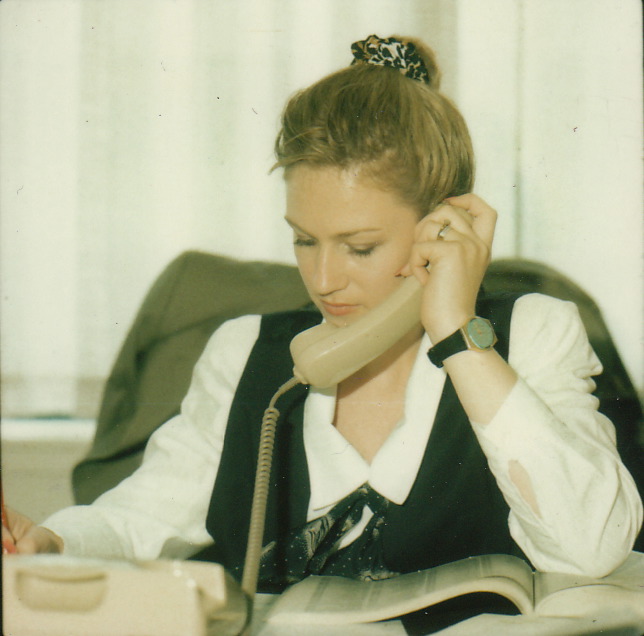
Crayon-to-be: Caron at work at the magazine in 1990, about six years before the "Crayon" nickname came about.

Crayon-to-be: Caron at work at the magazine in 1990, about six years before the “Crayon” nickname came about.

I’ve also been nicknamed C.J., after my then initials, which morphed to Siege; and Biddle, by my parents when I was a baby, because I used to say “Biddle, biddle biddle” when I got frustrated.
Most people have had at least one nickname in their time—some stick and some don’t. If you’re Thai, you most likely use your nickname for all but the most formal of occasions.

I’d love to hear some of your nicknames and how they came about.