The perfect inventions: top 11

Apart from the ancient essential inventions, such as the wheel and fire, and the obvious modern inventions, such as antibiotics and X-rays, and world-changing new media, such as the internet and computers, what are the inventions that make our everyday life better than it would otherwise be? What are the inventions that just can’t be beaten? I’ve made a list of some of my favourites. To make the list, they had to have longevity, be sturdy if not unbreakable, be cheap and provide an essential function. Here, then, are my top 11 inventions, in no particular order.

 1.Transistor radio: you need never feel lonely and a couple of batteries will last for a very long time. I have a transistor in the bathroom. Steam from the shower doesn’t bother it, I don’t need to pay anything or use up any data to listen to live radio shows at any time of the day or night. I can get news, real current affairs, interviews, travel updates, music, talkback, lifestyle information, comedy and more. Even my cat likes to sit and listen to the radio.

Radio Lucy: my cat likes to listen to the radio. I've heard they also like a CD, and there are some specially made for cats. That might be taking it a bit far. Picture © Caron Eastgate Dann, 2013.

Radio Lucy listens to the morning pet show on the radio. I’ve heard they also like a good music CD, and there are some specially made for cats. That might be taking it a bit far.                                  Picture © Caron Eastgate Dann, 2013

2. Ballpoint pen: doesn’t go forever, but goes for a long time. Tiny, and never needs batteries. A $20 bundle of pens from the Post Office shop has so far lasted me 10 years. Granted, I don’t hand-write much these days, but there are doodles, occasional lists, scribbled reminders, class rolls. Great books have been written with one of these. Roald Dahl wrote by hand in his garden shed. Students with late essays would never be able to use the excuse that their “computer broke down”.

3. Paperback book: probably the most dodgy on the list, because people will say that ereaders have superseded it. Well, not necessarily. I love my Kindle and my iPad for reading, too, but they have limitations. Obviously, with the iPad, its battery life is a problem (though some flights now allow you to recharge). And with the basic Kindle, although the battery life is great, you still can’t operate electronic gadgets when a plane is taking off and landing, meaning you have to find something else to read then. I often take a paperback, as well as my Kindle, for the no-electronics times. And marginalia, although it can be made electronically, is just not the same. I recently found a text I’d had to read as an undergraduate student, and in the margin, I’ve written in pencil, “Soooooo tedious”.

4. Automatic analogue watch: all you have to do is wear it every day and it just goes. Or you can wind it up. No battery ever needed. My father had the same automatic watch almost all his life (though he owned lots of other watches, too).

5. Toothbrush: I’m talking the manual kind over the electric. I recently went back to this old fashioned gadget that never needs charging or a battery, is easy to clean, is good for three months or more, and is very cheap—the one I just bought cost $1.

6. Plastic comb: minimal cost, you use it every day and it fits in your purse or pocket. All you have to do is wash it every so often. I’ve had the same comb for more than 20 years, and now it has sentimental value.

7. Automatic kettle: most of us still have one, even though we can heat up water in the microwave quicker. My twentysomething brother doesn’t have one though, so perhaps times are a-changing.

8. Electric non-stick toasted sandwich maker: a meal in five minutes, barely any mess, maximum satisfaction and you can pick one up for $30 or less. You can also make omelets in the compartmentalised ones. I like the sandwich-press style these days, which you can also use as a mini grill.

9.  Digital camera: ‘new’ technology but so much better than film cameras (for everyday snapshots at least—proper photographer/artists might have a different opinion). The concept of putting a camera in our phones was brilliant. It’s so easy now to illustrate my blog, for example.

10. Scissors: imagine if they didn’t exist. We could still cut things, but it would be a pain. I have scissors in just about every room of the house. They’re cheap, simple, and although they are sharp, there’s much less chance you’ll accidentally injure yourself with them (unless, as the old saying goes, you run with them—even then…).

11. Dried pasta: lasts for ages without refrigeration, is very cheap (from 65c a packet), filling and incredibly versatile. The simplest of pasta dishes is also my favourite: for two people, boil half a packet (or less) of dried spaghetti in salted water until just al dente, then drain it (do NOT rinse). Meanwhile, in a deep-sided fry pan, heat two tablespoons or so of olive oil (or 1 of olive oil, one of butter) and, on low heat, add a couple of cloves of finely chopped garlic and fresh or dried chilli. Fry for a few minutes until the garlic starts to brown, then add one or two bottled anchovy fillets with a little of their oil, and a squeeze of lemon. Fry for a couple of minutes, stirring to break up the anchovy. Add the spaghetti and stir well in the sauce until it is piping hot. Serve  garnished with parsley, black pepper and parmesan, and you have aglio e olio, superb, simple and tasty comfort food.
Old Gadgets

It’s strange to think that something that was made as recently as 2000 could now be a relic of the past, a strange reminder of technology most of us no longer use.

I teach media studies and communications at a university, and I’m interested in the links between creativity and technology. One of my hobbies—ironically, to get away from that world—is painting.  I’ve been doing a series I call “Old Gadgets”.

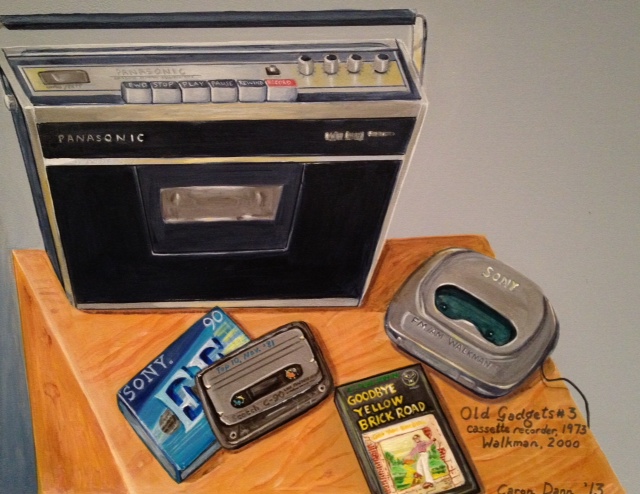
My latest painting in this series, finished last night, is “Old Gadgets No. 3”, which features my mother’s Panasonic cassette player-recorder. It was state of the art when my parents bought it in 1973 at the Santa Monica mall in Los Angeles, where we were living at the time. At the same time, I got a smaller cassette deck, which I was very proud of but which is long gone. Now I wish I’d kept it!

Old Gadgets #3: Panasonic cassette player-recorder, 1973; Sony Walkman, 2000. Acrylics and Faber-Castell Pitt artist pens on treated board.
Old Gadgets #3: Panasonic cassette player-recorder, 1973; Sony Walkman, 2000. Acrylics and Faber-Castell Pitt artist pens on treated board. © Caron Eastgate Dann, 2013

The Sony Walkman in the painting was bought by my husband to take on an overseas holiday in 2000. Remember when cassette players used occasionally to “eat” the tape, and you had to carefully unravel it?

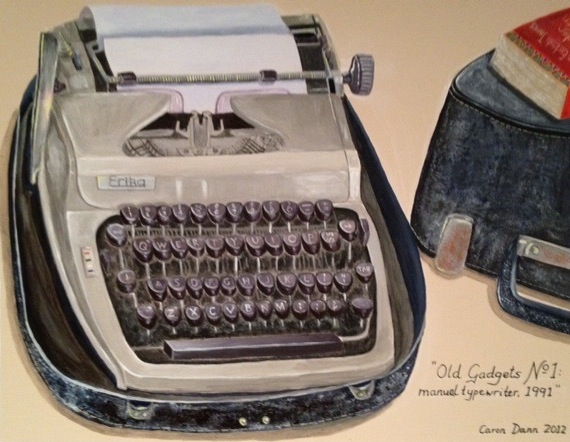
Old Gadgets No. 1: my manual typewriter, bought in Bangkok, 1991. On the case is the German version of my novel, The Occidentals (Das Erbst Der Schwestern). I wrote the first draft of this novel many years before it was published, on this typewriter. Acrylics on board.

Old Gadgets No. 1: my manual typewriter, bought in Bangkok, 1991. On the case is the German version of my novel, The Occidentals (Das Erbst Der Schwestern). I wrote the first draft of this novel many years before it was published, on this typewriter. Acrylics on board. © Caron Eastgate Dann, 2012

“Old Gadgets No. 1” features my manual typewriter, which I then gave to a friend who collects such things. I bought this typewriter in 1991, when I was living in Bangkok, because we had frequent power cuts during the rainy season and I wanted to be able to keep writing. Remember how messy and annoying it was to change the typewriter ribbon?

“Old Gadgets No. 2” is my Canon Eos film camera, bought in 1999, and various accessories. I used it until 2005, but it was already well out of date then. Remember those Kodak print packs you’d pick up and excitedly see what surprise gems you had taken on holiday?

Old Gadgets No. 2: my film-era camera, 1999. Acrylics on board. The prints are from a trip I did to China in 2001. The slides are the only ones I ever took, on a trip to Vietnam in about 1996.

Old Gadgets No. 2: my film-era camera, 1999. Acrylics on board. The prints are from a trip I did to China in 2001. The slides are the only ones I ever took, on a trip to Vietnam in 1996. © Caron Eastgate Dann, 2012

I have a drawer at home where I keep old gadgets I might want to include in a painting. In the drawer are a purse-size address book, a tiny Motorola cell phone from 2003, 3D glasses that are still current but will be relics within a few years, and a TEAC external floppy disc drive unit in see-through turquoise, which matched my iMac in 1999. Apple had decided, ahead of its time, not to include floppy disc drives in its computers, so we all had to buy these little gadgets.

I wonder what the next thing I relegate to my “old gadgets” drawer will be?

Light of my life

lampDo you have a possession that has been with you a long time and that you’d never part with? Mine is, surprisingly perhaps, this replica French art deco lamp.

I bought it when I moved to Australia as a young journalist in the late-1980s and, for me, it symbolised an exciting new life. I think it was one of the first things I bought in Australia, and it was expensive. But I had to have it, and it’s been with me ever since, to Thailand twice and to many different addresses and styles of house.

I loved art deco style (and still do), but in my 20s, I thought it THE most beautiful style. I’ve since broadened by ideas of what good style is, but art deco is still up there.  It is the reason I love the style of Napier in New Zealand, which is the best preserved art deco-style city in the world. Sadly, this is because there was a major earthquake there in 1931 and virtually the whole town had to be rebuilt.

But back to the lamp. It has been on the mantlepiece of the formal sitting room in an Edwardian house I owned in Kew, Melbourne. It has been on a side table in two marble-floored apartments in Muang Thong Thani and in Bangkok, Thailand. It has been in a flat above a fish and chip shop in the coastal town of Sorrento, Victoria (Australia).

The frosted glass backing has been broken and replaced twice. It wasn’t broken in transit, as you’d expect: you can undo the glass and pack it separately, and when reassembling it, if you do it back up too tightly, the glass breaks. But I haven’t done that for some 15 years now.

For the last 10 years or so, it has been my bedside lamp. Every night when I turn on my lamp, I find a source of comfort, like a dear old friend. If I wake in the night with a bad dream or a worry, I turn on my lamp. It’s bright enough to read by, but low enough to go to sleep by if you want.

Chances are, I will have this lamp forever.

lamp2

New Zealand Marmite versus UK Marmite versus Australian Vegemite: The Great Taste Test

© Caron Eastgate Dann, 2013

Never before have these three existed side by side in my house, though I’ve tried them all at one time or another.

I favour NZ Marmite, but the factory in Christchurch was closed in November 2011 as a result of damage done by the earthquake in February that year, and when stocks ran out, I had to make do with Vegemite. Recently, the factory started production again, but supplies have not yet reached our supermarket shelves in Australia. A kind friend from Hawke’s Bay on NZ’s North Island took pity on me and sent me two jars of Marmite. Another friend, from Sydney, decided I hadn’t really lived until I’d tasted again the superiority of British Marmite, and he sent me a special jar of limited-edition UK Marmite Gold, “blended with gold coloured flakes”. Thanks, dear friends—you know who you are.

People are deeply divided over these three. In my early adult life, I ate Vegemite until the mid-1990s, when a NZ friend also living in Australia told me she much preferred Marmite. I hadn’t eaten it since I was a child, but when I did, I never again bought Vegemite unless stuck.

These three spreads baffle and disgust the uninitiated, especially Americans. If you’ve never tasted any of them, they’re almost impossible to explain to you. They are savoury, and there’s a meaty taste, which might account for the myth I heard as a child that Marmite was made from meat by-products (as opposed to Vegemite, which was supposedly made from vegetable by-products). In reality, all three are made from yeast extract with various flavourings added. The myth must persist, because Sanitarium still feels the need to write “100% vegetarian” on the NZ Marmite label.

So this Saturday morning, I decided to do a taste test. I bought a freshly baked loaf of pane di casa  and cut three thick slices, spreading each with a little olive oil spread before adding—sparingly as is best—a layer of Marmite, Marmite Gold or Vegemite accordingly.

Here is my verdict:

NZ Marmite

Consistency: sticky and gooey, but not runny.

Taste: Balance of salty and sweet.

Best way to eat: on toast or plain bread with butter or margarine, accompanied by a cup of tea.

UK Marmite

Consistency: viscous but runny like golden syrup.

Taste: extremely salty – a little goes a long way.

Taste: sophisticated, probably more enjoyable for adults than children.

Best way to eat: on crackers with gourmet cheese. The nutty, slightly sweet cheeses such as gruyere would work well.

Vegemite

Consistency: like margarine; not runny or gooey.

Taste: quite salty, and less complex than either of the others; a bit bland after the other two, which is probably why it has been marketed at parents for children (see the Happy Little Vegemites ad here).

Best way to eat: in a sandwich with cheese and lettuce, or just solo with margarine. This very Australian-style sandwich was even written into a hit song. Down Under, by Men at Work (“He just smiled and gave me a Vegemite sandwich”).

The verdict

Though I still love my NZ Marmite, the UK Marmite, being quite a different product, could exist with it in the cupboard happily. NZ Marmite is comfort food; UK Marmite is rather a shock to the palate at first, but I could acquire a taste for it as a pre-dinner snack with a glass of wine. Vegemite? Nothing wrong with it, but it’s still my least favourite.

Marmite pasta?!?

© Caron Eastgate Dann, 2012

My version of Nigella Lawson’s Marmite/Vegemite spaghetti

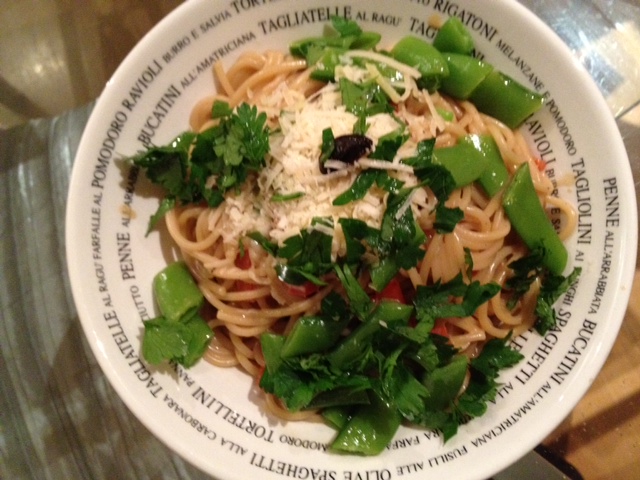
Yes, it’s true, and there are several versions of spaghetti with a Marmite or Vegemite sauce. The British chef Nigella Lawson was asked by an Australian interviewer last year if she had a recipe using Vegemite. She said yes, because she had made Marmite pasta, so it could be easily adjusted for Vegemite. I have made Nigella’s Marmite spaghetti several times and it is truly delicious (my version is pictured above). If you use Vegemite or UK Marmite, add a small amount of sugar, but don’t add sugar if you’re using NZ Marmite. Here’s my effort, adjusted from her recipe. I added sugar-snap peas, parsley and slivers of red capsicum for colour. You can find Nigella’s recipe here.

Which has the least calories?

Surprisingly, NZ Marmite has fewer calories than UK Marmite or Vegemite, even though it has the most sugar. Here’s the run-down:

NZ Marmite

KJ per 100g: 690 (165 calories)

Sodium (mg) per 100g: 3310

Sugars (g) per 100g: 11.2

Vegemite

KJ per 100g: 798 (263 calories)

Sodium (mg) per 100g: 3450

Sugars (g) per 100g: 2.2

UK Marmite

KJ per 100g: 1100 (250 calories)

Sodium (mg) per 100g: 3900

Sugars (g) per 100g: 1

About-face

This post is part of A Word A Week Challenge: Face, run by A Word In Your Ear.

Akha hilltribe woman, Doi Suthep, Thailand, 1991, by © Caron Eastgate Dann, 2011. Acrylics on canvas board.

Akha hilltribe woman, Doi Suthep, Thailand, 1991, by © Caron Eastgate Dann, 2011. Acrylics on canvas board.

I met and photographed this Akha hilltribe woman at a village on Doi Suthep, near Chiang Mai in Northern Thailand, in April 1991. Twenty years later, when I first took up art as a hobby, I decided to paint her portrait.

She always stuck in my mind, because she was the only Akha living in a Lisu village. Through the guide, she told me she was aged 39 and had three children.

I had been living in Nonthaburi, central Thailand, since December 1990 and we had taken advantage of the songkran (Thai new year) holiday to travel up north for a few days.

The Lisu village we visited was a set-up for tourists really. I still have my journal from that time, in which I’ve written that the Lisus usually live in isolated villages high in the mountains, but this village had been persuaded by an elephant training centre to relocate within a half-hour trek of them so they could bring in tourists to buy their arts and crafts.

In those days, the village had no electricity, no running water, no TVs or even radio. In the past, the hilltribes relied on opium as their cash crop, but the Thai government had banned its sale, so they had to find other ways to make a living.

Lisu hilltribe woman, Doi Suthep, 1991. Photo ©Caron Eastgate Dann 1991.

Lisu hilltribe woman, Doi Suthep. Photo ©Caron Eastgate Dann 1991.

This woman was also at the Lisu village, sitting in the same hut as the Akha woman. They were both doing some sort of needlework.

Picture © Caron Eastgate Dann, 1991.

Merchants at a Hmong village, Doi Suthep, Thailand. Picture © Caron Eastgate Dann, 1991.

The next day, we went to a Hmong village that was not so far up the mountain and that we could drive into. This husband and wife were among the stall-holders there. All the adults then wore traditional dress and—even though there was an element of showmanship for tourists—I found the images unforgettable. Children at the more isolated village we had visited also wore traditional dress—at least for the cameras—but at the Hmong village, many were wearing T-shirts and track pants.

In my journal from that time, I’ve written about the Hmong village: “There was no road to the village until 12 or 13 years ago, and villagers once went to Chiang Mai only around once a year. Now they go more often, but still they resist development, although we did notice a pick-up truck in one garage.”

They resist “development” no longer, it seems. In November 2012, more than 21 years later, I returned to the Hmong village. These days, there are no traditional costumes to be seen, just jeans, T-shirts with marketing logos and other ordinary Western clothes. There are pick-up trucks everywhere. Most people speak English as well as Thai.

The village market today is full of the same “hand-made” crafts you can buy in Bangkok, Phuket, or anywhere else. There are still people assembling these goods, but they seem to come ready-made in large batches, to be quickly pieced together on site. Someone is making  a fortune, and it’s surely not the hilltribe people.

Angry Mr Smith: A Parable

'Venice Beach, sunset', pastel painting © Caron Eastgate Dann, 2012

Mr Smith was an angry man. There didn’t seem to be any good reason for his anger: it just was.

He felt angry when his neighbour got a bigger, newer SUV than him; he felt angry when his brother got the latest smart phone and boasted about all its apps; he felt angry when the woman over the road bought a cinema-sized TV screen; he didn’t feel happy for colleagues who got promotions—he felt only anger that HE hadn’t got that promotion; he felt angriest of all when the neighbour with the big TV sold her house and moved to a much bigger one in a better suburb closer to the city.

Mr Smith took his anger out on random people he didn’t know. One day, as he was driving his big vehicle with its bull bars on the front, a woman in a small car cut across in front of him, and he had to brake suddenly. He made a point of driving up beside her at the next intersection.

“Where did you get your licence, lady—out of a cereal packet?” he shouted, shaking his fist.”

“Sorry,” she said, genuinely.

“Aw, get stuffed,” he said, and roared off.

The woman, Ms Jones, knew she had made a mistake, and she really was sorry. She was not herself today because her faithful dog had died that morning unexpectedly, and she was driving home from the vet’s surgery. Of course, Mr Smith couldn’t have known that, but Ms Jones cried all the way home, and felt very alone—more so since she had made a mistake while driving and had been shouted at. All she wanted today was someone to be kind to her.

Eventually, Mr Smith became a manager at his work, and was in charge of 20 people. He was always finding fault with them—most of them were so useless, he thought.

When the sales figures came in for his first year, they were well below what they had been the year before, under kind Mr Tickle. Mr Smith was furious, and he made a plan to get back at the staff. “This will teach them,” he said, fuming. Then he called his staff together and told them their work was not good enough and that they would have to work harder, and take a pay cut, if they wanted to stay. And three of them would have to go anyway: Mr White, Ms Green and Mr Brown. These three had always been very hard workers and had been with the company for many years.

Mr White had had some bad luck: he had a chronic illness for which he needed expensive medication. Even though he had sold his car and his house, when he lost his job he knew he would no longer be able to afford this medication. A year later, he died. Mr Smith said they couldn’t send a card or flowers to his family, because everything the company did had to be cost-effective. And anyway, Mr White no longer worked at the company, so it was not like he was an employee.

One day, Mr Smith had a heart attack, a big one. The doctors told his lovely wife and their three adorable children that he might not pull through and that the next 24 hours would be crucial.

They kept a bedside vigil: although they knew their husband and father was an angry man, they loved him all the same and wanted him to live. The children, Sam, Eliza and John, stood on the left side of the bed, holding his hand. His wife, Jane, sat on the right side, holding his other hand. As Mr Smith stared up at the loving faces, they all started to glow like moonlight; but they were gradually going out of focus, and he knew he was dying.

Without warning, he saw in front of him a burst of forked lightning, and, like a huge wall of TV screens, videos from all his angry outbursts appeared before him, all running together. Beside each screen of him being angry was a video of his victim. There he was, shaking his fist at the errant driver, Ms Jones, and there she was, sobbing as her faithful dog died in her arms. There was Mr White, being told by Mr Smith to pack his things and leave the building immediately; and there was Mr White, dying in pain because he couldn’t afford the medical attention he needed. On and on it went.

All the screens disappeared again, and Mr Smith could just faintly see through the white mist the faces of his wife and children.

Suddenly, he got it—the point of life, and he knew he had failed miserably. He had brought children into the world, but he hadn’t done anything to make the world a better place for them, and for their children and their children, and so on. In fact, he had made the world a worse place for them.

Sorrowfully, he admitted to himself that he had done nothing but take from the world and had let his anger be directed at innocent people who did not deserve it. He had made lots of people miserable. He had been greedy, arrogant and mean.
And now, tragically, just as he saw the error of his ways, it was too late to do anything. If only he could have a second chance to mend his ways. If only he hadn’t left it this late.

Slowly, the faces of his wife and children were coming back into focus. He could not speak to them, but he could squeeze their hands just slightly.

The doctor said he would live for now, but he must change his ways and give up work, and even then, he might not have a long life. Luckily, Mrs Smith had a job, and they decided that if they sold their house and bought a cheaper one, they would be all right.

When he returned home, Mr Smith thought about how he could best use his remaining time. He knew he wouldn’t be able to do anything big, or world-changing. But something was better than nothing.

He had been advised by his doctors to exercise every day, so each afternoon, he set off on an hour-long walk, to the end of his street , where there was a park beside the beautiful beach. Along the way, he smiled at every person he saw and wished them good health. Sometimes, he could see the sorrow and lack of hope in their eyes. But actually, there was barely a person who didn’t smile back just a little.

Before too long, Mr Smith found himself whistling a tune as he walked along. This brought smiles to the faces of passers-by, too. Often, he would see the same people in the same places, and they would exchange a few words. After a while, Mr Smith’s walks turned into two- and even three-hour outings, he had so many friends along the way that he talked to.  They would often tell him their troubles, and he would listen to them. Often, it was dusk by the time he walked home again, and he grew to love this peaceful time of the day, the sinking sun sparkling across the water.

Five years passed, and Mr Smith’s doctor said he was a walking miracle.

 Mr Smith was happy with his life, but he wanted to do something more. So he wrote a book about what he had learned, and how he had once been an angry man, but that nearly dying had helped him to change. He called his book A Walk in the Park.

The book was a runaway success, and it sold a million copies. Mr Smith decided to give most of the money to the park, for all his friends to share. As a result, they set up outdoor chess tables, a speaker’s corner, children’s swings and slides, and a cafe where anyone could have lunch for free.

Soon, other people in various suburbs started to follow the idea in their own neighbourhoods. Then other cities and other states caught on. Mrs Smith and the now almost-grown children were very proud of him, but, mostly, they were so pleased that he was such a happy person to be around. They hardly remembered the angry Mr Smith from years ago. And still, Mr Smith went on his daily walk to the park, smiling at every one he met.

Against all the medical predictions, Mr Smith lived to 95, eventually dying peacefully in his sleep. His local park was renamed Smith Park, and a statue put up in his honour—a man walking along, whistling a tune; a happy man who had made a difference.

Painting: ‘Venice Beach at Sunset’, pastels on board, © Caron Eastgate Dann, 2012.

Thailand: kaleidoscope of patterns

Suvarnabhumi Airport, Bangkok

Suvarnabhumi Airport, Bangkok

Like Sara Rosso at The Daily Post, I am always inspired by the colourful, highly detailed and often surprising patterns of Thailand. This is the subject of my entry in The Daily Post’s Weekly Photo Challenge: Pattern.

My parents and brother visited me in 1999 when I was living in Thailand, and I always remember Mum said that when they returned to Melbourne, she missed the colours and shapes of the temples and other buildings of Thailand.

When I was there in November last year, I took many photos of the intricate patterns I saw all round me, both man-made and natural. I intend to use them to inspire abstract paintings.

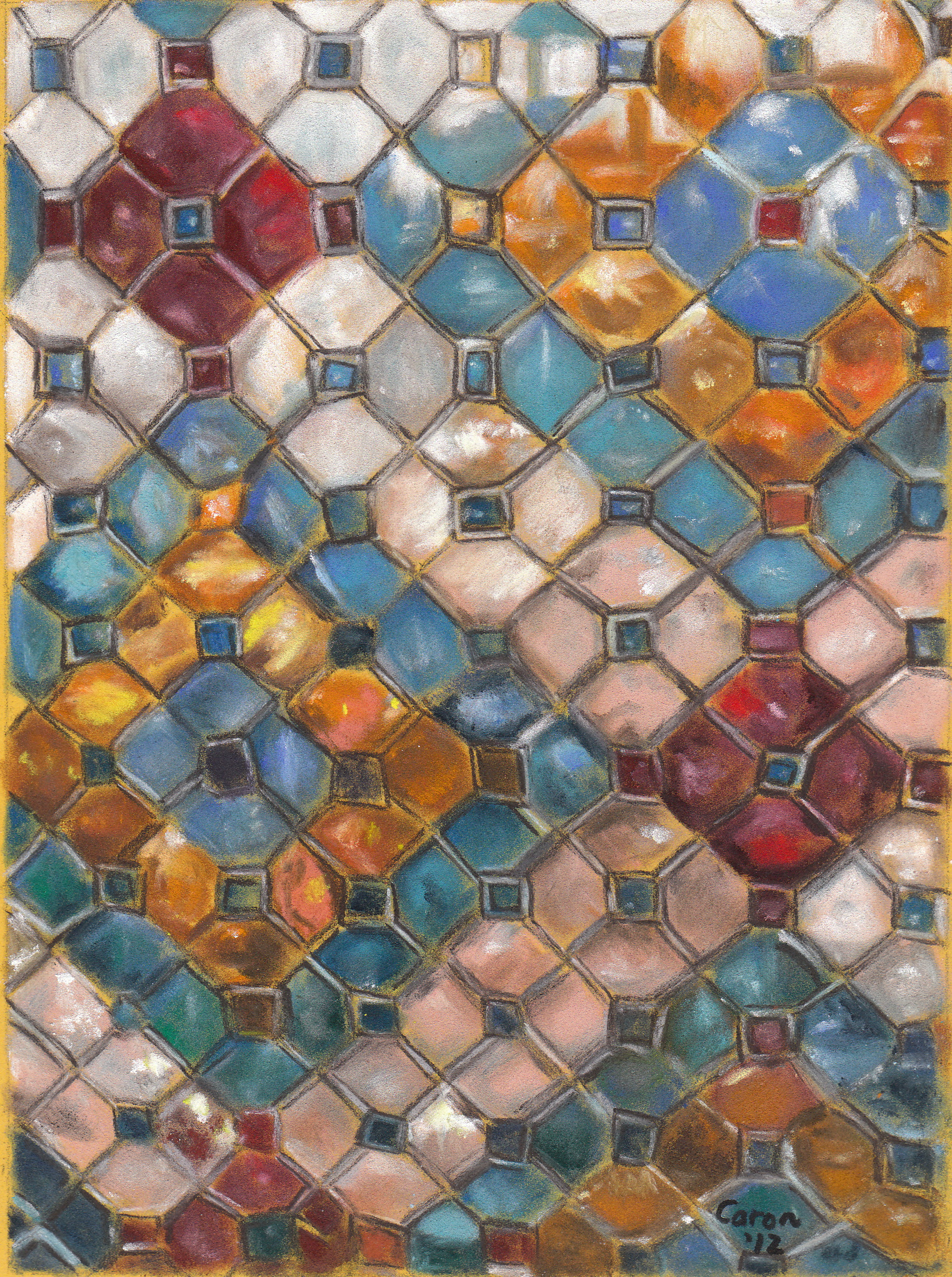
Here are some of my photos from our trip, which took in Bangkok, Chiang Mai, Chiang Rai and Chiang Saen, and a painting to finish, of a temple wall mosaic at the Grand Palace, Bangkok.

Chair detail, in-room at Dusit D2, Chiang Mai

Chair detail, in-room at Dusit D2, Chiang Mai

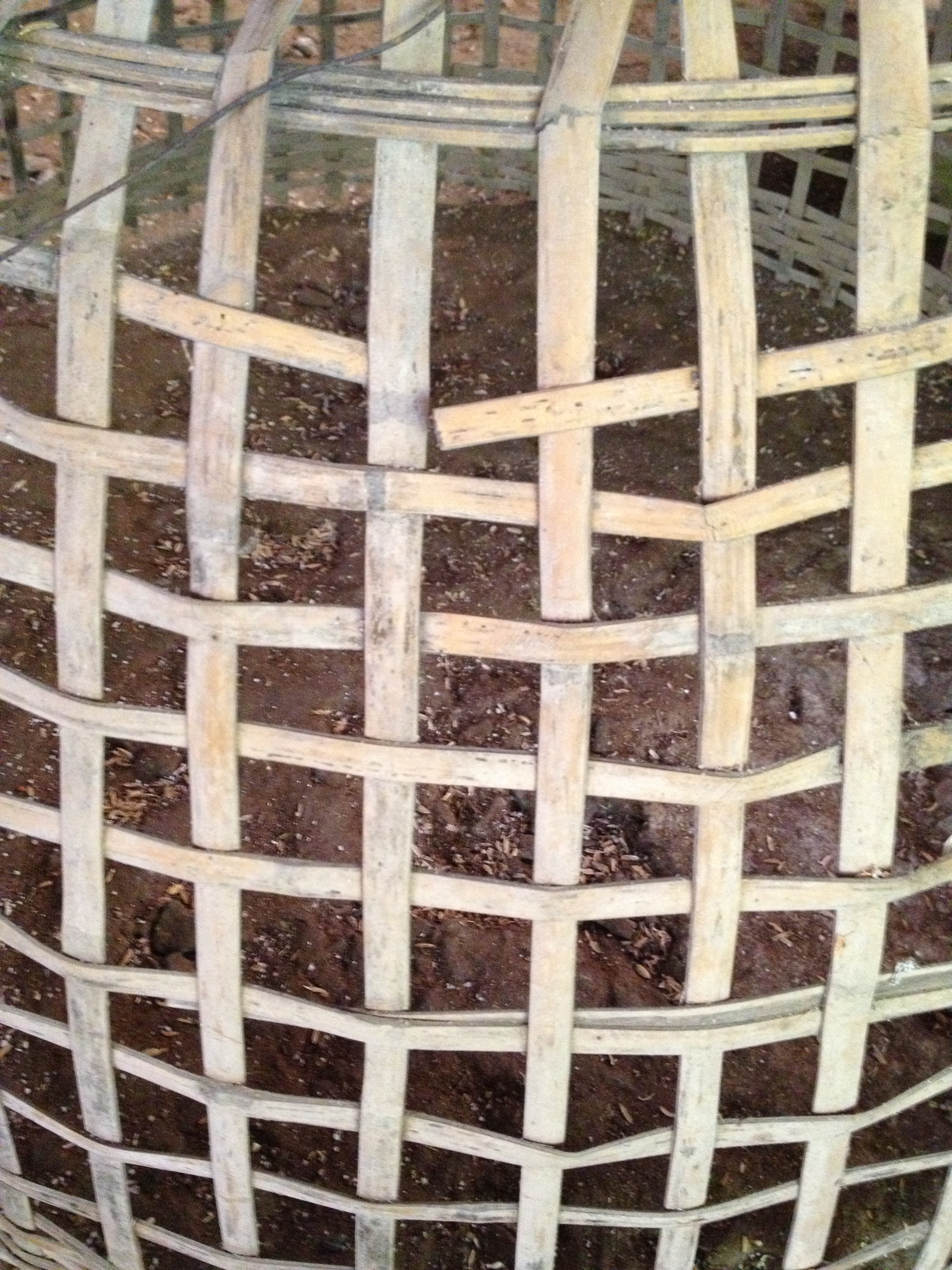
Basket detail, Thai Farmer House, Chiang Mai

Basket detail, Thai Farmer House, Chiang Mai

Floor tiles at Wat Doi Suthep, Chiang Mai

Floor tiles at Wat Doi Suthep, Chiang Mai

At the lush gardens of Queen Sirikit's Bhubing Palace, Doi Suthep, near Chiang Mai.

At the lush gardens of Queen Sirikit’s Bhubing Palace, Doi Suthep, near Chiang Mai.


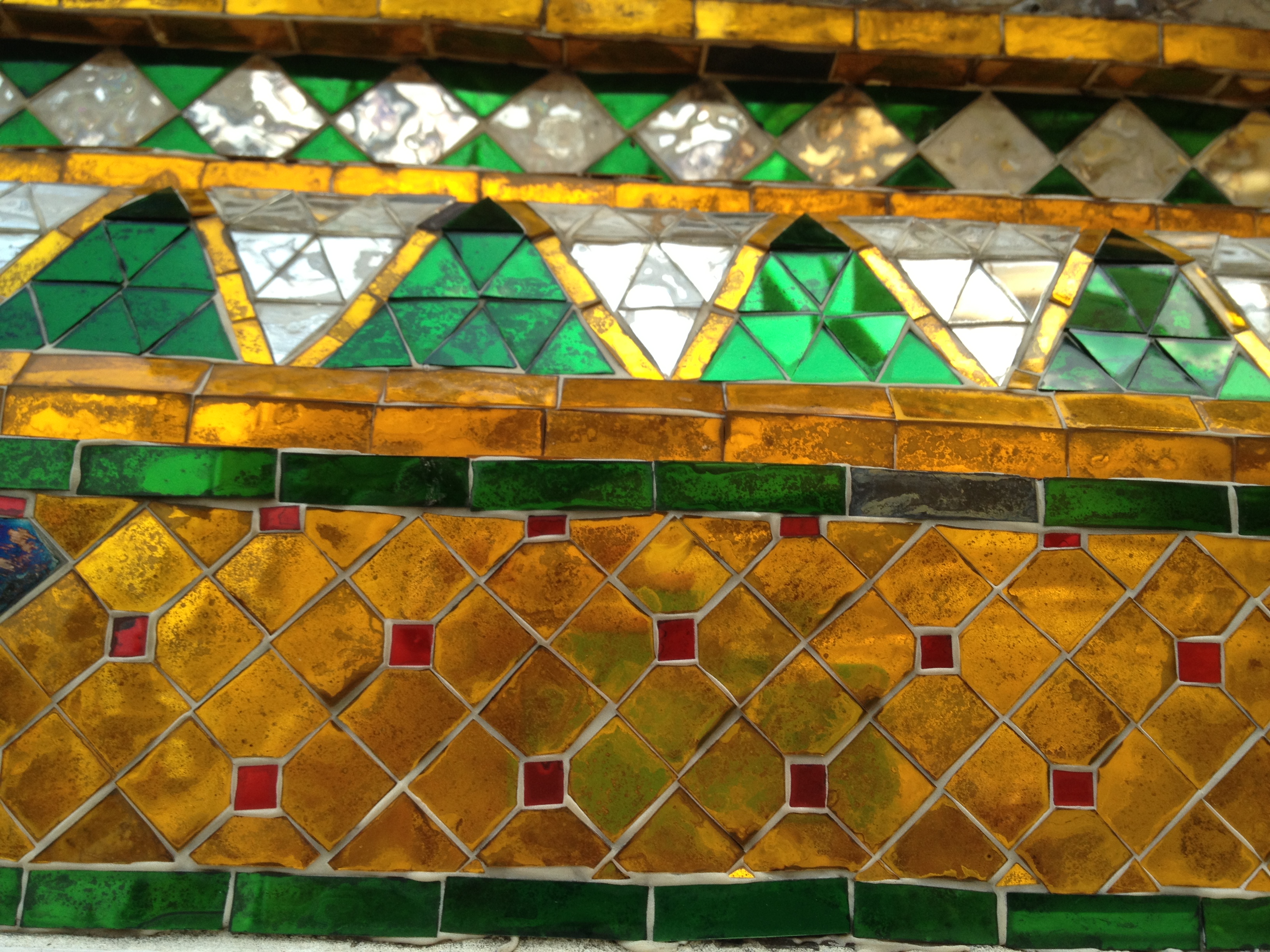
Temple Wall detail, Grand Palace, Bangkok

Temple Wall detail, Grand Palace, Bangkok

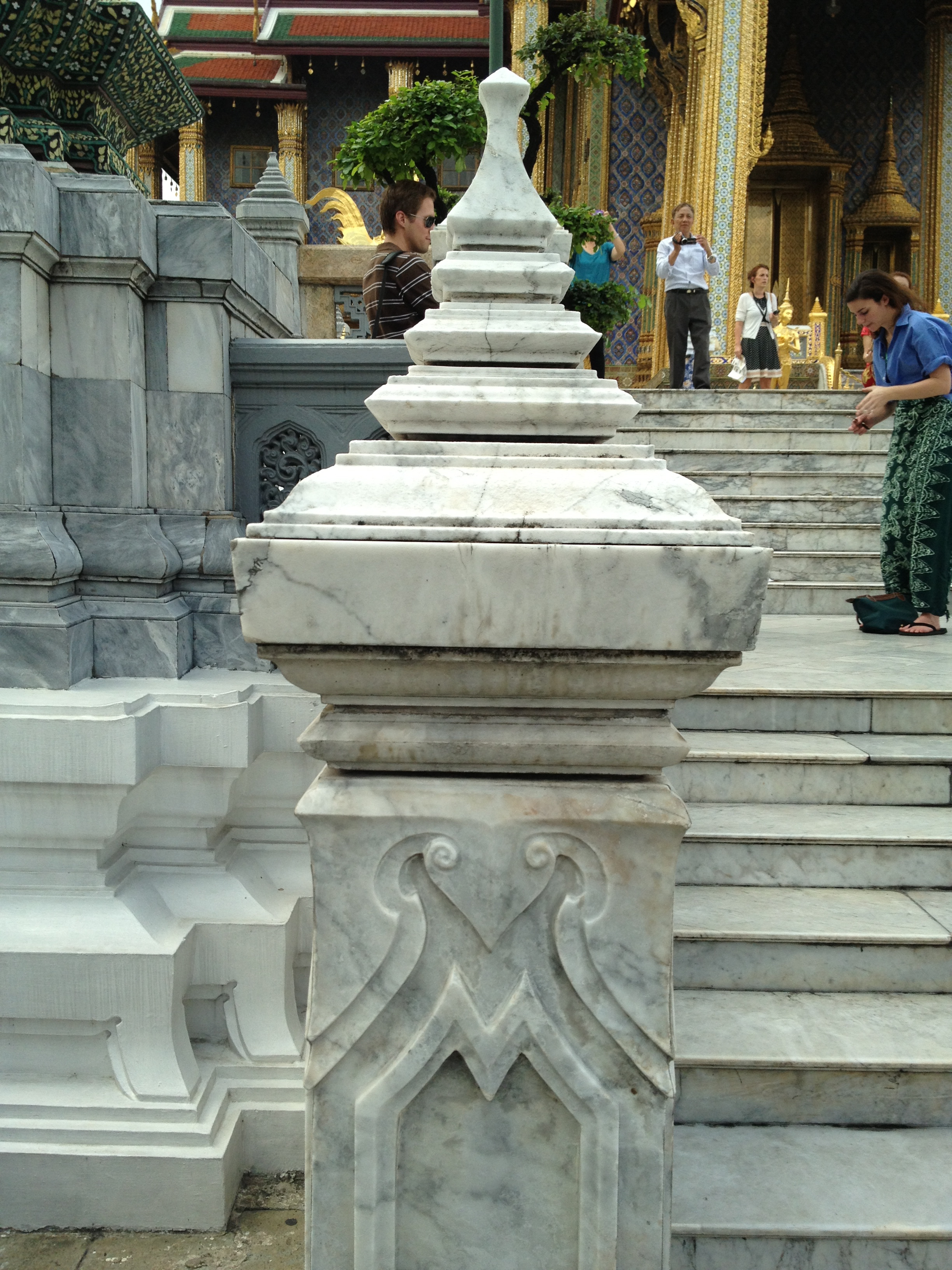
Grand Palace, Bangkok

Grand Palace, Bangkok

Temple tile details, Grand Palace, Bangkok

Temple tile details, Grand Palace, Bangkok

Detail, temple wall, Grand Palace, Bangkok

Detail, temple wall, Grand Palace, Bangkok

Wooden carving at Wat Doi Suthep

Wooden carving at Wat Doi Suthep

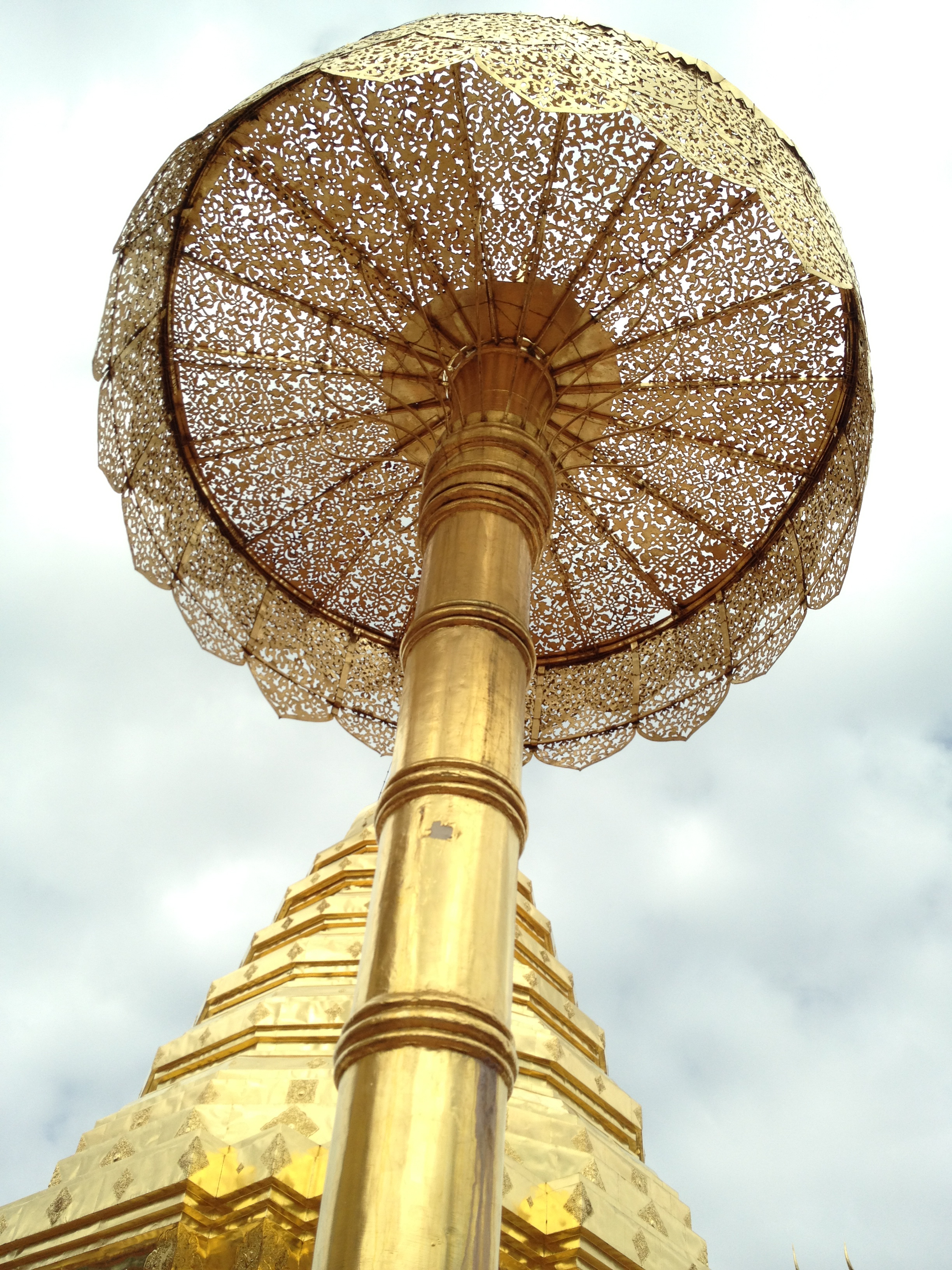
Golden umbrella with intricate lacework at Wat Doi Suthep, near Chiang Mai

Golden umbrella with intricate lacework at Wat Doi Suthep, near Chiang Mai

Photo ©Caron Dann, 2012

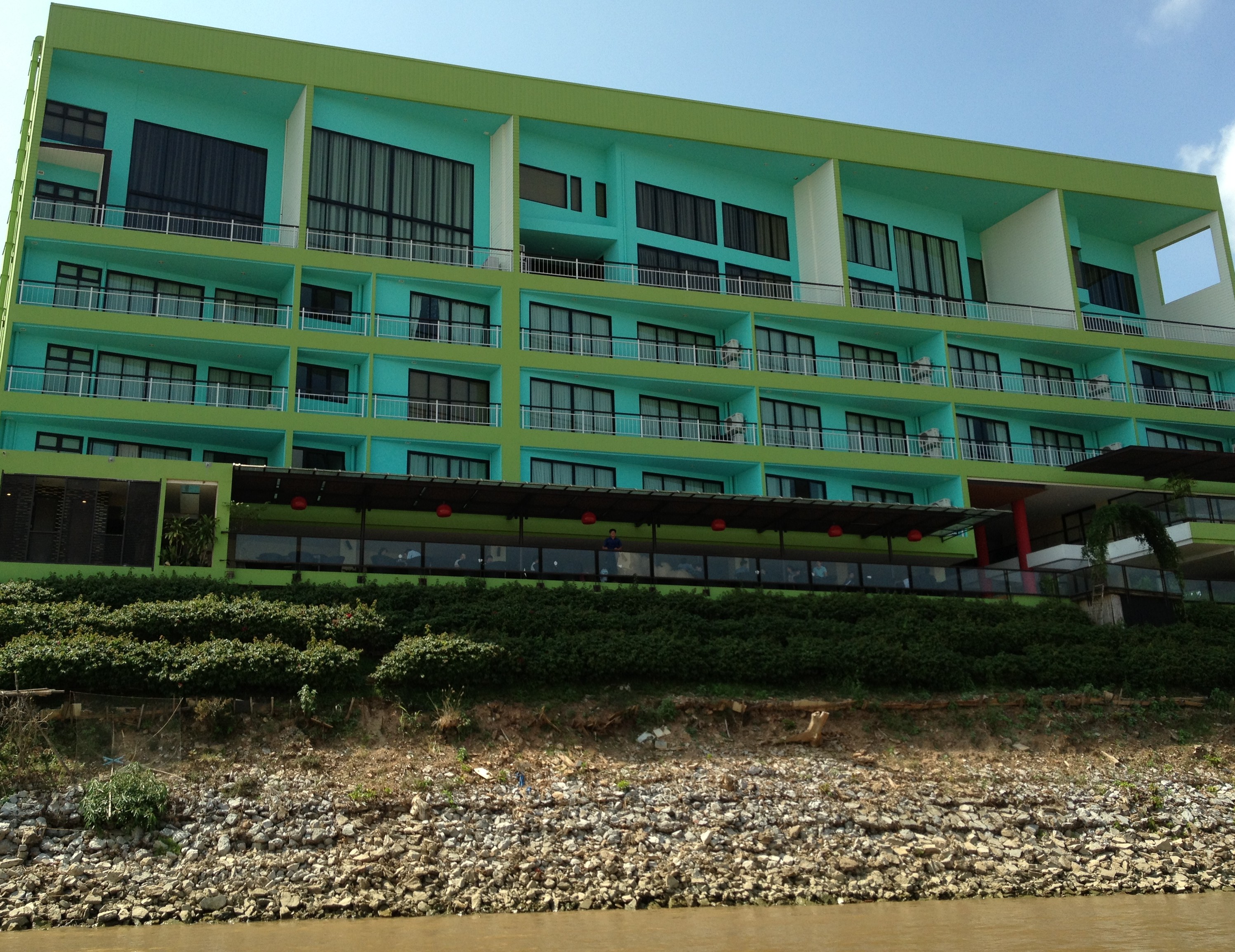
The Serene Hotel at the Golden Triangle, near Chiang Saen, with views across the river to Laos and Myanmar.

My painting of tile detail at the Grand Palace, Bangkok. Pastel on board.

My painting of tile detail at the Grand Palace, Bangkok. Pastel on board.

Recreationist Theory

GrandCanyon

This post is written in response to Kozo’s monthly peace challenge at everyday gurus

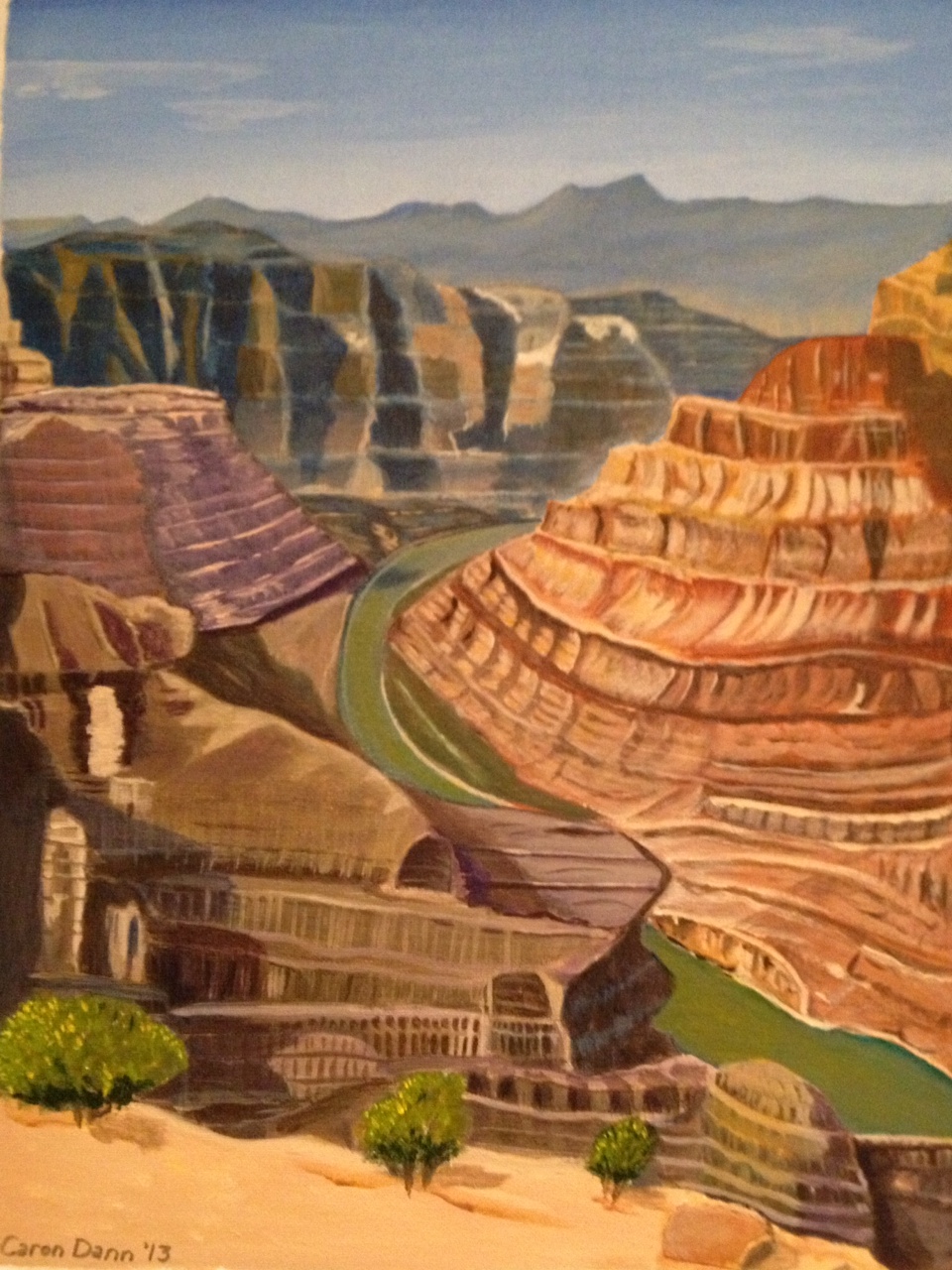
When I was about 10 and living in Los Angeles, my parents took me and my brother to Arizona to see the Grand Canyon. Though we came from New Zealand, a land of majestic and awesome scenery, we were aghast at the sheer size of the canyon. When I first got out of the car, for some reason I thought that in front of me was a giant billboard painting, it looked so surreal. “No, it isn’t a painting,” my mother replied. “It’s real.”

I now live in Australia, but I went back to see the Grand Canyon in 2009. You know how when you’re a child, things look enormous, and then when you revisit as an adult, they look so much smaller? This was NOT one of those moments. The big GC was every bit as magnificent as I remembered.

More recently, I saw a remarkable documentary series on America’s national parks, then I found the photos I had taken on the last trip, and I was inspired to try to paint the Grand Canyon as I’d seen it in my mind’s eye as a child.

I am a novice painter and the Grand Canyon is notoriously difficult to paint, but whether the painting is any good or not is irrelevant, really. The point is, the Grand Canyon reminds us of the great beauty in nature that we should be celebrating every day. Painting the Grand Canyon was a creative challenge that I set myself and which took concentration and effort, and trying some bits again and again.

This, I believe, is how creativity can help make a more peaceful world. When you are trying to create or recreate something beautiful, whether it be in an image or in words, whether a piece of writing, a painting, a photo, a sculpture, a garden or a hundred other things, your mind becomes peaceful and focused on the task.

Perhaps it is something to do with that idiom, “Idle hands make the devil’s work”.

My Mum, an excellent cook!

My friend Kenny wrote this engaging, nostalgic piece about his mum’s cooking, which made me also remember what it was like growing up in NZ in the 1970s. Like Kenny, I’m from Dunedin originally and so is my mum, though I was brought up in Auckland from the ages of 7-9 and 12-17.

considerthesauce's avatarconsider the sauce

mum4

Pauline, Russell and Jean celebrate a combined 240 years!

Bennie and his father have just returned from a quickie four-day visit to New Zealand –  to New Plymouth in the North Island region of Taranaki, to be precise.

The ostensible reason for the visit was to help Bennie’s Grandma, Pauline Ethel Weir, celebrate her 80th birthday.

But it was more than that, as it was a triple-banger 80th birthday party taking in also the milestone’s of Pauline’s brother-in-law Russell (Kenny’s uncle), and his partner Jean.

And it was far more than that again, as relatives and friends flew or bussed in from all over New Zealand and Australia.

It was a family reunion of the likes never before experienced by myself, let alone Bennie!

Over three organised events on the Saturday and the Sunday and more informal get-togethers, tales and family lore were exchanged and rolled out.

Relatives and neighbours…

View original post 728 more words