Travel theme: Circles

The World of Snow Domes

I read an article about de-cluttering the home a while ago that advised tourists not to buy souvenirs when travelling. Just because you don’t have a souvenir of a place doesn’t mean your memories of it are less vivid, it reasoned. Well, maybe not, but I like a souvenir, and my favourite type is possibly the weirdest: those funny little domes, filled with water and fake snow or glitter and a miniature scene or figure that, in a kitschy sort of way, represents the place you have visited.

IMG_0962

In this post, inspired by the weekly travel theme on the blog Where’s My Backpack?, I want to show you some of my favourite snow domes (also called snow globes). I’m fascinated by these spheres, circular representations of places around the world (but ironically, usually with “Made in China” stamped on their base).

I’ve been collecting snow domes since the early 1990s when a colleague gave me two “Hawaii” domes in a retro style with hula dancers, sand, sea and surf. When I say collecting, I don’t mean hoarding. I have discarded as many as I have bought, domes that have become tatty and discoloured, the liquid almost gone, though sometimes this adds to their charm. I now have a limited collection, many of which are displayed on a glass cupcake stand on the coffee table of my living room (pictured above).

Here are some of my favourites and what each destination represents for me:

IMG_0980London, UK

This is a promotional dome that I acquired in the lead-up to the London Olympics. I last went to London myself in 1998, and looking at this newer snow dome, I am reminded how much the 135m-high London Eye has changed the landscape of that part of the inner city. It was derided by some as a folly while it was being built and beset by embarrassing technical problems that meant it couldn’t open to the public for nine weeks after its planned date on December 31, 1999. However, it was a huge success and the Eye is now one of the most  recognised London landmarks.
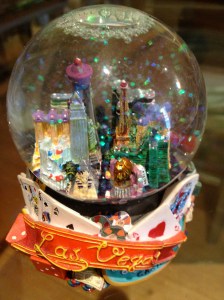
IMG_0973Las Vegas, Nevada, US

I first visited Las Vegas as a child while living with my family in Los Angeles. We stayed at a motel near The Strip, and I remember going in to Circus Circus, to a viewing area that allowed minors, and being amazed at the trapeze artists hanging by their teeth above the gambling floor. I’ve been back to Vegas twice in recent years: in 2005 for a week on an all-expenses-paid first-class “famil”— a sponsored trip for travel writers; and in 2009 for my brother’s wedding. This great snow dome was bought on the 2005 trip, and I like it because it’s a historical record of the buildings as they were at that time. I don’t know why, but I really love Las Vegas. There’s something about it that makes me smile (granted, this wouldn’t be the case if I had a gambling problem). I like the musical fountains, the great restaurants, the shows—I saw Jersey Boys there in 2009 and Blue Man Group in 2005. And the desert and national parks are so close: My brother and sister-in-law, an American, were married out in the wilderness, just 90 minutes by road from The Strip, but a million miles away from it in spirit.
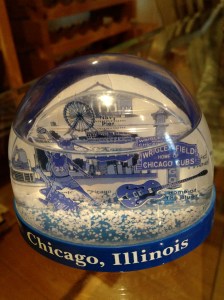
IMG_0985Chicago, Illinois, US

I’ve never actually been to Chicago, though I intend to go some time to do some research on a writing project. This snow dome is precious to me because it was bought by my late father when he travelled from Australia to work at the synchrotron at the Argonne National Laboratory near Chicago, for a few weeks in late 2005. This was only a couple of months before he died unexpectedly, at the age of only 69.

LaosLaos

This is my newest dome, bought a few weeks ago when I stayed at the Golden Triangle near Chiang Saen, Thailand. For B1000 (about $AU 31), you can hire a boat and driver, who will take you up and down the Mekong River for an hour, including a half-hour stop at Donsao in Laos. This is a strange experience: no passport or ID is needed, but all you see is a rather boring market full of bags and belts made in Thailand, rows of whiskey with whole snakes inside—and yes, snow domes. You can use Thai baht, and by the boat ramp, children beg for money and quickly snatch any notes offered and run off. However unrepresentative this strange little market is, I can say I’ve been to Laos and I have the snow dome to prove it.

 BangkokBangkok

One of the symbols associated with this great city is the tuk tuk. I lived in Bangkok for four years in the 1990s and have visited Thailand 23 times, but I hardly ever travel in tuk tuks (though I did take one in November when I was in Chiang Mai). This is because within a couple of weeks of first arriving in Bangkok in 1990, I saw a shocking accident in which a tuk tuk overturned at speed. The driver immediately ran away down the road, leaving his bleeding and badly injured passenger behind. A crowed gathered, and luckily, this included a doctor. Someone offered their pick-up truck (quicker than waiting for an ambulance) and the man was carted off to hospital.


St MoritzSt Moritz, Switzerland

This dome is past its best now, but I keep it because it brings back memories of a dream-come-true holiday in 1998. I had taken up skiing in my 30s and decided it would be romantic to go skiing for a week at St Moritz. It was difficult to get information from the travel agent (we didn’t do much booking by internet in those days), but she eventually put our unusual trip together. We started with two nights at the Waldorf in London, which had the best breakfast buffet I’ve ever experienced, and tiny but well appointed rooms (tiny probably because they’d had to squeeze ensuite bathrooms into them once people were no longer content to share a bathroom down the hall). At St Moritz, we stayed at a boutique hotel with a very reasonable deal that included breakfast and dinner. Just as well, because after every afternoon on the slopes, we would be exhausted and would be asleep every night by about 9pm. It was odd, but mineral water tasted like wine to us up in the alps, so we never needed any wine with dinner. We then caught the Glacier Express to Zermatt, wondering at the life going on outside despite the deep snow of the alps. Every so often, I’d see weird markings in the snow and wondered what they were. Then I worked it out: they were cross-country ski marks. People living outside the villages would ski through the snow to the village and the local shops, then put their shopping on their backs and ski home again. The holiday finished with a couple of nights in Paris, one of them at The Ritz (yes!). Strangely enough, I couldn’t find a snow dome at The Ritz shopping arcade.
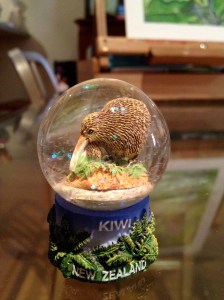
KiwiNew Zealand

Although I live in Australia, I was born in New Zealand, so I always like to have some reminders of home around me. I posted a painting two blogs ago depicting my favourite NZ things—books, a kete (woven flax bag), greenstone pendant, paua shell ring and so on. I can’t say this snow dome is my favourite, but interestingly, it was made in NZ, which is unusual.

Gold CoastGold Coast, Australia

Although many Australians snootily say the Gold Coast is crass and over-touristy, I always enjoy going there. It’s sunny, the people are friendly, and there’s a relaxing feel in the air, similar to the feeling I have at Waikiki Beach in Hawaii or at Mount Maunganui in New Zealand. In December, 2006, I spent my honeymoon in the Gold Coast hinterland with a day either side at the Gold Coast itself, which is when I bought this snow dome, I think.
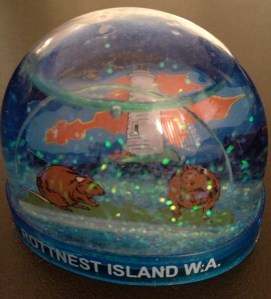
Rotto Rottnest Island, Western Australia

The former penal colony of Rottnest Island is 19km off the coast by ferry from Fremantle. My husband was brought up in Perth, and “Rotto” was where they went every summer, even sometimes staying on and attending the local school for a few weeks. In those days, it was a no-frills place for locals to holiday, with a general store and a pub. These days, it’s an expensive destination, with restaurants and boutiques, and accommodation costing hundreds of dollars a night. We stayed in the old jail, which has been converted to motel units. Despite the gentrification, Rotto retains its charm, is free of cars, and there are plenty of unspoilt walks and beaches on which to while away the time. We spent an idyllic few days there in 2011. The most confronting thing about Rottnest is that it is overrun by a small marsupial called a quokka. They are absolutely everywhere, and they’d come in to your hotel room if you left the door open.

IMG_1008Norfolk Island

Norfolk is a self-governing external territory of Australia. It is 1600km from Sydney, so it’s actually closer to New Zealand than Australia. It’s like going to a foreign country, and even Australians have to take a passport with them and do not have the automatic right to live or work there.

My parents went on their honeymoon to Norfolk Island in 1961, and returned for their 40th anniversary, with most of the other couples they met there, in 2001. I got to stay there for eight days in 2003 for a travel story when I was  working as the Melbourne Editor of Woman’s Day magazine.

The island has a fascinating history as a penal colony (1788-1814). In 1855, it was bequeathed by Queen Victoria to the descendants of the Bounty mutineers, who needed a new home when Pitcairn Island became overcrowded. About 1000 locals on the island today, half its permanent population, are direct descendants of the mutineers. It’s also home to the writer Colleen McCullough, while the 1970s singer Helen “I am Woman”  Reddy divides her time between Norfolk and Sydney, and tourists can visit her home and extensive garden on the island.

 The globe that got away

I regret not buying a snow dome at Vatican City when I visited in the late 1990s. But they were the most expensive I have come across, and I became annoyed at what I thought was the Vatican exploiting tourists. I bought an exquisite hand-painted brooch instead—for five times what the dome would have cost.
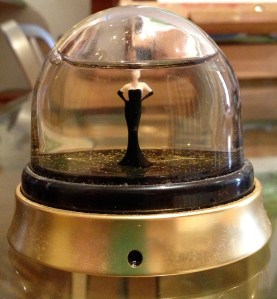
IMG_0996Fragile

Not a snow globe of a destination, but a Jean-Paul Gaultier perfume! This one was made for me, I’m sure.

IMG_0992Virtual snow dome

I now have virtual snow domes for my iPhone, and although cute, they’re not as endearing as the real thing. Somehow, they lose that kitschy, retro feeling when they become high tech.

My $750 dinner: why it was worth it

I rarely eat dinner out, and even more rarely do I eat at “fine dining” establishments when I’m at home in Melbourne. This is due to a number of factors, including a husband who works evening shifts. But mostly, it’s because I don’t feel I get good value. I come away thinking I could do better at home for a fraction of the price. Or, I feel the food is too fussy, too rich, too laden with oil and sauces.

I’m not talking about your cheap and cheerful eatery that provides tasty and filling food for a few dollars and to which you go for a quick meal, not a big night out. Melbourne has a plethora of these wonderful establishments, as food blogs such as Consider the Sauce show.

I’m talking about a full-on restaurant at which you sit for two or three or more  hours as a social occasion. For a two- or three-course dinner for two with wine in Australia, where wages are some of the highest in the world, I would expect to pay $Au 150-300*. And usually, at the end of the night, I would arrive home thinking, “It wasn’t worth that”.

So how is it that, on my recent trip to Thailand, I was happy with a bill of 24,000 baht (about $750) for dinner for two at the Lebua Hotel’s Sirocco Restaurant at the Dome on the 63rd floor of the State Tower building? Well, just check out the view, for a start (CLICK on the image to get the full view and caption):

The spectacular view from the Sirocco restaurant and its Sky Bar. Image courtesy of Lebua Hotels and Resorts

They claim to be the highest rooftop restaurant in the world.

A colleague said to me the other day “I would never pay that much for dinner, no matter how good it was—in fact, it couldn’t be that good”. I want to address here some obvious reasons against paying this much for one dinner:

  1. Yes, of course the money would be better given to charity. But I work hard, pay my taxes at home, recycle goods and redistribute excess wealth.
  2. This is just another example of western capitalist decadence. Well, decadence, anyway, since there were plenty of Thais and other non-westerners there. Yes, agreed, but it provides work for a lot of people, including live musicians. I think it’s only decadence if you do it all the time.
  3. You should never pay this much for dinner on principle. I know, and I agree, most of the time…

But not this time. I can say without a doubt that $750 for dinner for two at Sirocco was worth it.  At the end of the night, I knew it would be a location I would remember forever.

The view from our table. Picture by Gordon Dann

The photographs don’t do it justice: the open-air restaurant on the 63rd floor has panoramic views of the enormous city of Bangkok, which extends in every direction as far as the eye can see. I have spent years of my life in this city, but never have I viewed it this way. It’s truly breathtaking and one of the most impressive sights I’ve ever been confronted with. In keeping with the theme of this blog, sitting at a table on the 63rd floor, I rediscovered a city I thought I knew well, because this view gave me a completely different angle on it.

We started with a dozen Tasmanian Pacific oysters au naturel and dips at a hefty 2480 baht ($75). This is probably at least twice as much as I’d pay in Australia for the same, and the irony that I was eating these Australian oysters in Thailand did not escape me. However, I can say that these particular oysters were the best I have ever eaten. How can that be? I don’t know. Perhaps it was something in the air over Bangkok that night.

We opted then for the six-course chef’s tasting menu, which at 4500 baht a person ($140) was reasonably priced for what it was. Although it was nouvelle cuisine, it wasn’t overly fussy, tiny or otherwise ridiculous. The fusion of Japanese and Mediterranean influences worked seamlessly. So, simplified slightly from the menu, this is what we had, each course delectable and each served by impeccably trained staff who were attentive without being fussy or over-bearing:

Cured salmon cannelloni, sesame, lemon gel

Alaskan diver scallop with squid ink sauce and ossetra caviar

Porcini risotto

Chilean seabass with white miso, seaweed, and candied walnuts

Wagyu beef sirloin with porto sauce and confit of pork belly

Mint brulee, chocolate crumble and sorbet, meringue

The food was 11,480 baht ($380), the drinks 8590 baht ($268), leaving 3930 baht ($123) for service charges and VAT.

So, let’s say we would have to spend an average of $200 for two people for dinner at a fine dining restaurant in Melbourne— more for a degustation menu. Typically, this might be somewhere with no view, good food but indifferent service. Was Sirocco four times better than that? Yes it was.  Thus, it was worth it and I rest my case.

* All $ values are in Australian dollars.

The Lebua Hotel in Bangkok by day. Sirocco is just below the dome.

Travel theme: Liquid

A rainy day on Doi Suthep, Chiang Mai

Image

In response to Where’s My Backpack? blog’s call for entries on the theme of liquid, here’s a picture I took a couple of weeks ago on Doi Suthep, the mountain 16km from Chiang Mai. It’s most famous as the location of the historic temple Wat Phra That Doi Suthep, but this picture was taken at the entrance to Phra Tamnak Phu, the royal family’s winter palace, about 4km from the wat. It’s free to visit the beautiful gardens that surround the palace. When we arrived, it was overcast, but as we neared the end of our walk, suddenly—in that familiar tropical style—there was torrential rain. After about 10 minutes, it stopped long enough for us to make a dash for this row of shops at the entrance, and shelter there for another 15 minutes while we watched as sheets of water hit the pavements.

In keeping with the theme of The Crayon Files, such a heavy but short-lived downpour is typical of life in the tropics and reminded me of the many I was caught in when I lived in Thailand in the 1990s. I’ve waded through floods in central Bangkok, been stuck in traffic jams for hours and hours, and been given a lift home on a motorbike down roads so flooded, I had to tuck my legs up by the seat. There was an old house opposite my apartment in Sukhumvit Soi 11 then, and it always flooded in the wet season, looking like a house boat floating on a lake. It was one of the last remaining traditional houses in the area and the land would have been worth a fortune. I guess it has gone now. Here’s what it looked like (unflooded) then (photos taken from my balcony):

Back to the present and Phra Tamnak Phu: here are some shots of the gardens, taken a few minutes before that rain started:

Image

Image

Image

The way we pack


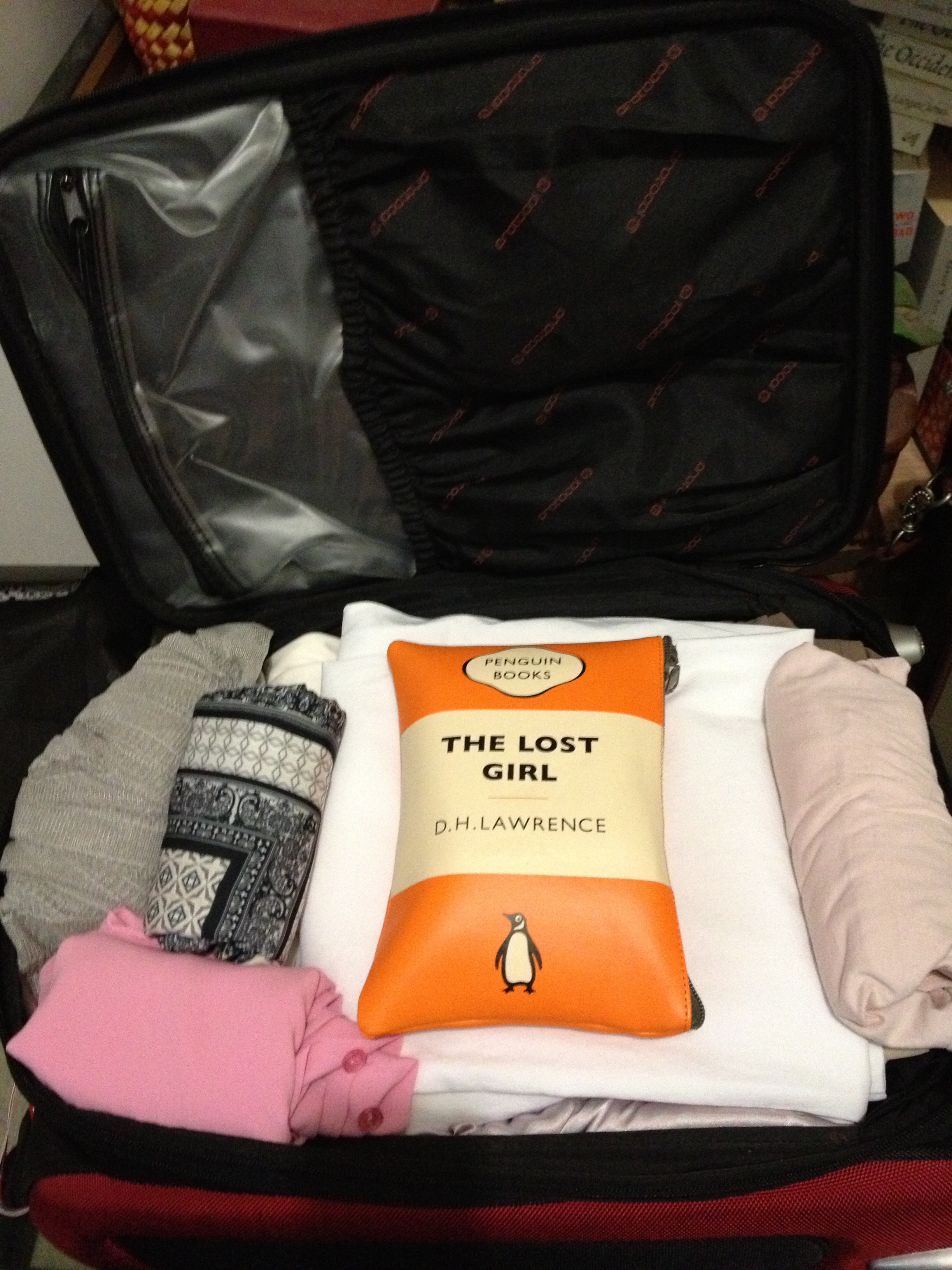
Here’s my little bag all packed for my return to Thailand, October 28-November 11. I say “little bag” because what I travel with these days is much smaller and easier to get around with than in the days of those big, shallow, oblong suitcases. When I arrived in London in 1998 with an enormous bag and then had to travel on the Tube at rush hour, I vowed I would never again travel with a bag I couldn’t manage on stairs, escalators and the street.  I see so many people, though, who are still travelling with enormous bags. The old advice to “take half the clothes and twice the money” as you think you’ll need is the best I’ve heard. Even so, my bag weighed 11kg going and 12kg coming back. Can I get it down to 10 next time?

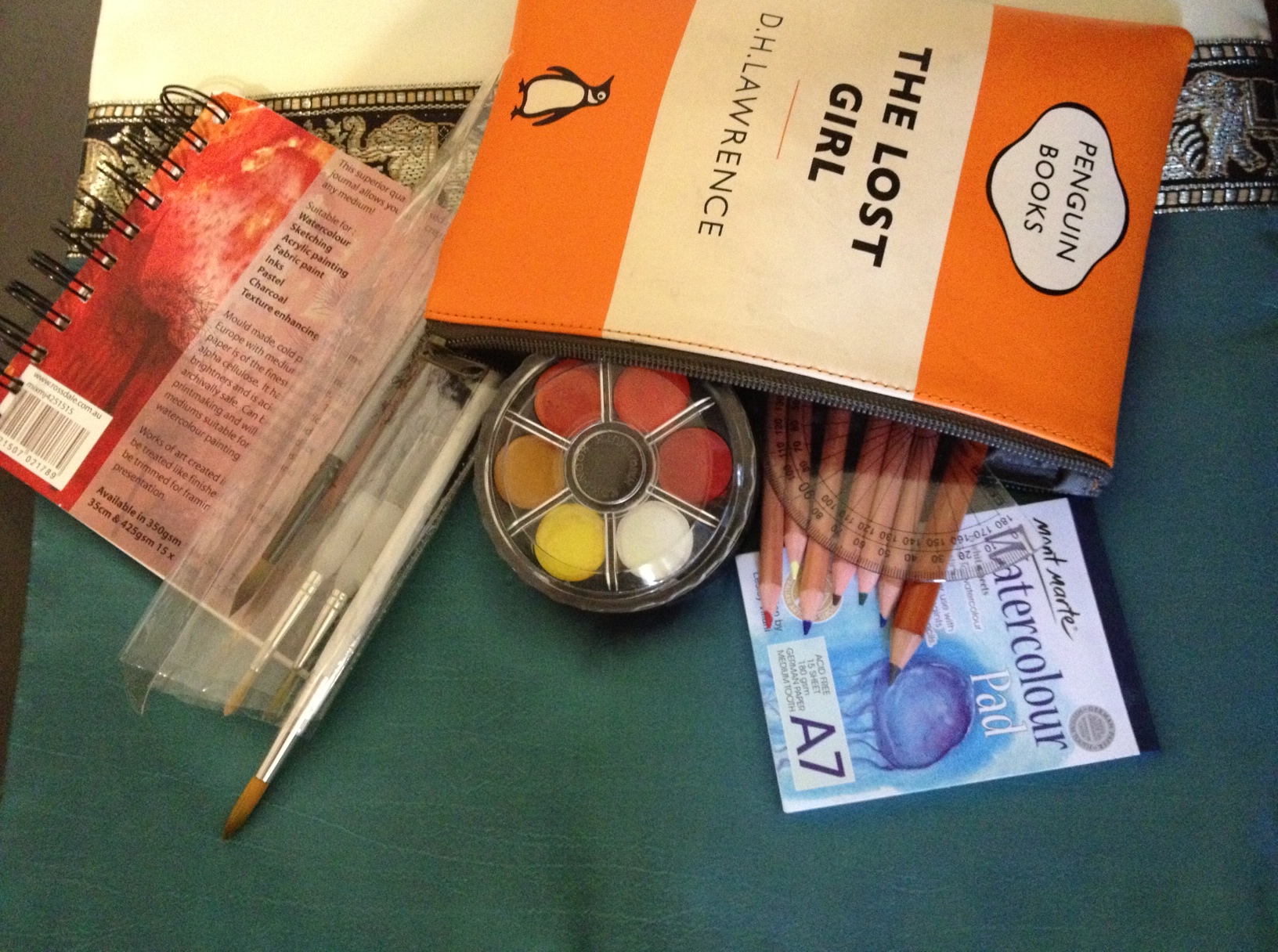
Note: that’s not a book in my case (I travel with a Kindle). It’s a pencil case and it holds my mini art kit (see my previous post on Chiang Saen for a picture).

Travel theme: Mystical

This post is in response to this week’s challenge from the blog Where’s my backpack?, which you can link to here.

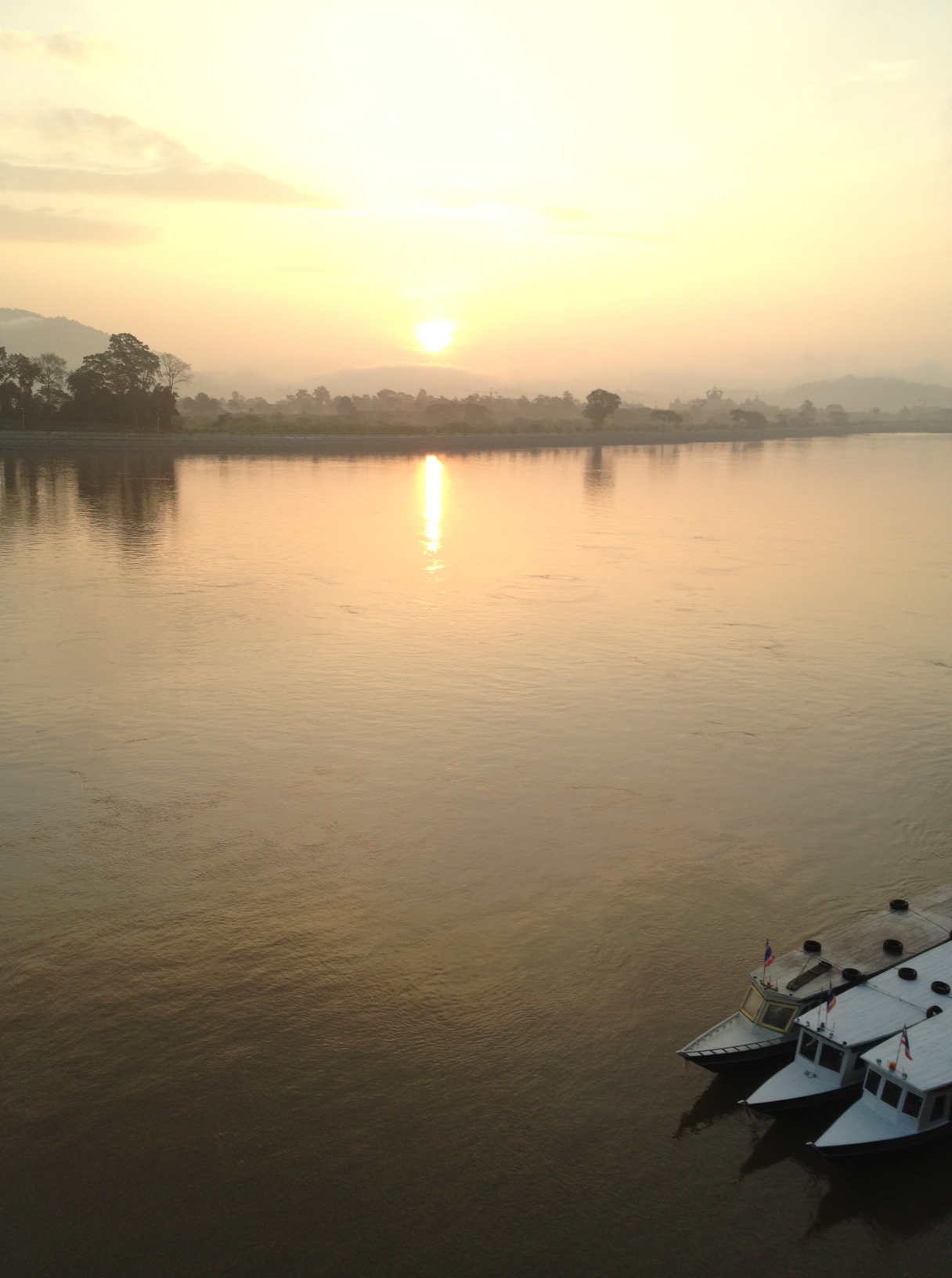
We woke on the last morning of our stay at the Golden Triangle, near Chiang Saen, Thailand, to find the view from our hotel balcony obscured by thick fog. So thick was it that most river traffic stopped, though a few brave (aka foolhardy?) souls were still plying the waters, sounding their horns as they went. 

The fog gave the place a mystical, otherworldly quality, a totally different view to the one we had woken to at dawn the previous day, which looked like this:

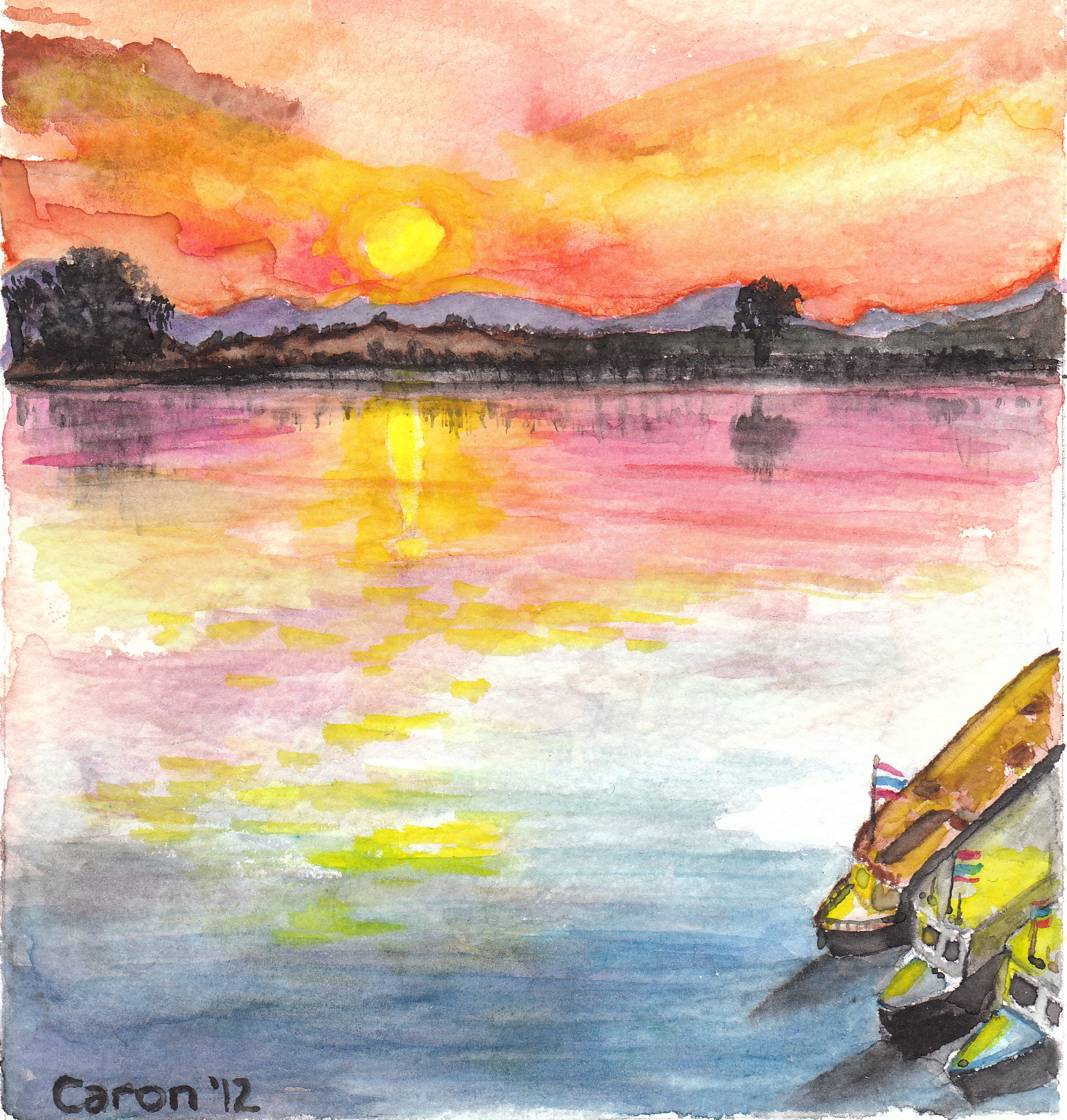
With fog or without, this is an enchanting area to spend a few days. From the delightful and aptly named Serene Hotel, where we stayed, and which seems to be the only hotel on the river in this village about 7km from Chiang Saen. One of my aims while we were away was to do a painting on location, so here is my effort:


I’m relatively new to painting, having taken it up early last year. I loved art as a child, but never quite knew what to do and was never able to get my ideas successfully onto canvas. Now, I paint most nights. I travelled with a miniature art set, including an ingenious and tiny watercolour paint set, which I housed in a pencil case:


Back to Bangkok

Bangkok, 1992: the infamous Asok-Sukhumvit  crossroads. Lane upon lane of cars, trucks, motorbikes turning in, turnout out, turning all about, it seems. No crossing lights or lines for pedestrians, no indication of how one should get across the seemingly impenetrable traffic ocean. But I have done this many times before since moving to Bangkok in December 1990, and I know just how to go about it. As I ready to step off the curb, a plaintiff Irish voice sings out, “How the be-jaysus do you get across here?” I laugh and say simply, “Follow me”. And he does. Like the Red Sea parting, as we step out into that rabble, it somehow makes its way round us, and we arrive, miraculously unharmed, at the other side of the road.

Bangkok, 1991: view from the Tara Hotel, Sukhumvit Soi 26/1

Cut to Bangkok, 2012: the infamous Asok-Sukhumvit intersection looks as daunting as it did 20 years ago. Only now, I am viewing it from above, serenely gliding by in air-conditioned iciness on the BTS (Bangkok Mass Transit System) Skytrain. It’s my first trip to Bangkok in 11 years, though I passed through on my way to Phuket in early 2005 to report on the aftermath of the tsunami.

Bangkok 2012: view from the Landmark Hotel, Sukhumvit

The skytrain and other transport systems completed since 1999 have changed not only the face of the city, but the nature of what it is to live in or even just visit Bangkok. There are walkways everywhere now, up to stations and across major roads.

The trains are packed night and day, but Thais are ever polite, making way for others, giving up seats for those they deem might need them, and allowing people to exit the train before they enter. And even if you don’t have anything to hold on to, it’s hardly necessary, the ride is so smooth. In a week of catching trains all over the city, I saw no drunks, no thugs, no menaces, no rude people, no graffiti, just people going about their daily business. At 20-40 baht per ride, the train is not cheap for the average Thai (though it is cheap compared with public transport in Australia), but it certainly beats any other mode of transport across the city.

There is also a quick, efficient and cheap train service from Suvarnabhumi International Airport. However, there is a major problem: you will need to connect with a BTS or other train in the city, where most stations don’t have elevators or escalators, and you find yourself having to lug your bag up and down flights of stairs in the heat and humidity. The BTS has been much criticised for the lack of disabled access. So if you are elderly, unfit or in any way disabled, you’d still be better to take a cab.

And if you have a child in a stroller or pram, you’ll need to be travelling with another adult to manage. This hasn’t changed. Another memory I have from the early 1990s is on Sukhumvit Road, a major shopping, apartment and hotel area, when I came across a young English woman with her baby in a pram. She was standing on the curb, crying. When I asked her what was wrong, she said, “I’ve just moved here, and I just can’t see how I’ll ever get across this road”.

While I note that the landscape of the city has changed markedly in the last 20 years, and that you can readily buy western food and drink such as a cappuccino or a British sausage, in essence, Bangkok has hardly changed at all since I lived there in the late 1990s: I was still addressed as “Sir”, a term of respect, interchangeably with “Madame” (pronounced in the French way); my rudimentary street Thai was still needed to negotiate prices and times and to give street directions; the smells of lemongrass, fried garlic, basil and chilli still competed with nameless less pleasant ones; goods for sale in the markets looked like the same ones that had been on sale in 2001 or 1991.

There is one major change to daily life that I noticed: that is, I hardly walked on the streets. I used to walk everywhere from my apartment in central Bangkok, because taxis and tuk tuks were too slow. I knew every shop, market and clean toilet within a 3km radius.

This time, from the skytrain whizzing along Sukhumvit, I saw with pleasure that the small tailor’s shop where I used to get clothes made from 1997 to 2001, Mr Lucky’s, was still there. Unfortunately, I didn’t have time to go in: I was too busy going other places fast. Last time I was there, the proprietor, Mr Lucky (naturally), had recently been back to India to marry a bride selected by his parents. I hope his life has lived up to his name, and that perhaps I will have time to drop by next time I am in Bangkok, which, I vow, will not be as long as 11 years from now.